
ER Wait Times: What to Expect & How to Reduce Waits (2026 Guide)
ER Wait Times: What to Expect & How to Reduce Waits (2026 Guide)
ER wait times in 2026 average between 40 minutes and 2.5 hours nationally, but they vary dramatically based on triage level, hospital capacity, and time of day. You arrive expecting that an emergency means immediate care, only to discover that "emergency" does not mean the same thing for a sprained ankle as it does for chest pain. This guide explains exactly what affects your wait, how to check current times before you leave home, and proven strategies to reduce unnecessary delays.
Key Takeaways
- ER wait times in 2026 average 40 minutes to 2.5 hours nationally, but they depend mostly on your triage level, not your arrival time.
- The national median door-to-doctor time is 38 minutes, while a full ER visit averages about 2.5 to 3 hours.
- Life-threatening emergencies are seen immediately, while non-urgent issues can wait 2 to 4+ hours.
- Checking real-time ER wait times near you before leaving home is the single most effective way to get seen faster.
- Avoid Monday evenings (5 to 10 PM); Tuesday through Thursday mornings have the shortest waits.
Before you rush to the nearest hospital, you can check real-time ER wait times near you on ERWaitTimes.org, which updates every 15 to 30 minutes.
Consider how this plays out in real life. Imagine a child falls during soccer practice and cannot put weight on an injured ankle. Before rushing to the nearest hospital, a quick check of ERWaitTimes.org shows the closest ER at a 105-minute wait, while a community hospital fifteen minutes away reports just 35 minutes. Understanding ER wait times makes a smarter choice possible, getting the child seen and treated an hour faster than the default option would have.
ER wait times confuse and frustrate millions of patients annually. Wait times vary from immediate to over four hours depending on factors most patients do not understand until they are already sitting in a crowded waiting room. You will learn when that "45-minute average" actually applies to you, and when it absolutely does not.
How Long Are ER Wait Times in 2026?

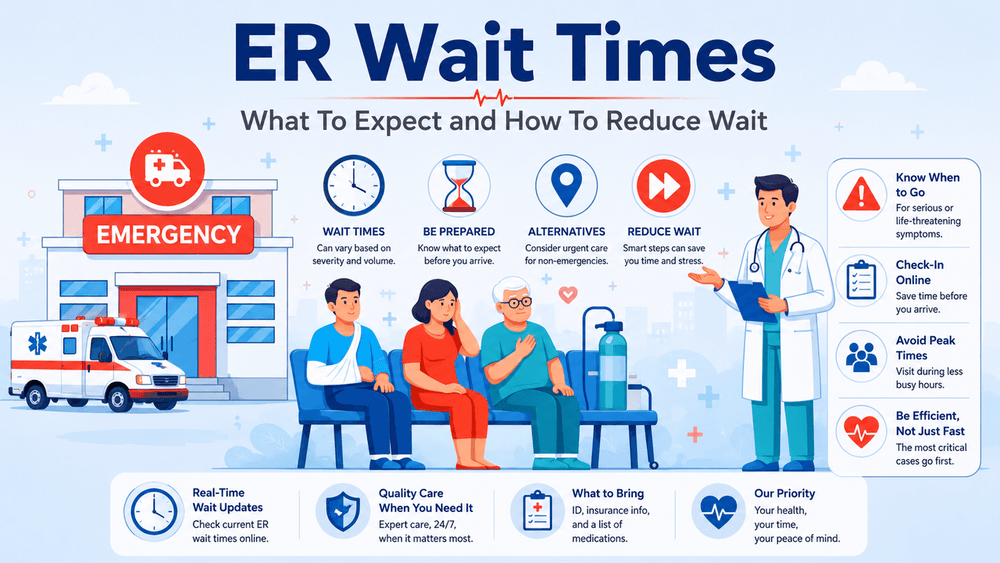
Illustration of patients waiting in an emergency department reception area with an ambulance outside, a clock and hourglass, and a doctor holding a clipboard
The median emergency room wait time from arrival to seeing a physician currently stands at 38 minutes nationally (CDC National Hospital Ambulatory Medical Care Survey, 2022, most recent available). That number misleads more than it informs. Half of patients wait less than 38 minutes, half wait longer, sometimes dramatically longer.
What you can expect depends almost entirely on how urgent your condition is:
- Life-threatening emergencies (chest pain, stroke, severe bleeding): immediate to 15 minutes
- Urgent but stable conditions (broken bones, deep cuts, high fever): 30 minutes to 2 hours
- Less urgent problems (minor injuries, mild symptoms): 1 to 4+ hours
Current national averages (2026 data):
- Median door-to-doctor time: 38 minutes
- Average total ER visit: about 2.5 to 3 hours
- Peak wait times (Monday evenings): 90+ minutes
- Off-peak wait times (Tuesday to Thursday mornings): 20-40 minutes
Average total ER visit duration runs about 161 minutes, roughly 2.7 hours, from check-in to discharge. This includes registration, triage, waiting, doctor evaluation, diagnostic tests, treatment, and discharge paperwork. Some visits finish in 45 minutes. Others stretch past five hours.
The 90th percentile wait time hits 125 minutes, meaning one in ten patients waits over two hours just to see a doctor (Agency for Healthcare Research and Quality, 2025). These patients are not forgotten. They simply have less urgent conditions while the ER handles heart attacks, strokes, and severe trauma requiring immediate attention.
Geographic variation matters enormously. West Coast urban ERs average 70 to 110 minute waits, while Midwest community hospitals average 45 to 70 minutes. Rural hospitals often see patients within 20 to 40 minutes. Location changes everything.
Average ER Wait Times by Triage Level
| Triage Level (ESI) | Condition Examples | Typical Wait Time | % of ER Visits | Priority Level |
|---|---|---|---|---|
| Level 1 - Resuscitation | Cardiac arrest, severe trauma, respiratory failure | Immediate (0 min) | 2-3% | Life-threatening, see immediately |
| Level 2 - Emergent | Chest pain, stroke symptoms, severe bleeding, difficulty breathing | 0-15 minutes | 15-20% | High risk, see within 15 min |
| Level 3 - Urgent | Broken bones, deep cuts needing stitches, high fever, severe pain | 30 min - 2 hours | 40-45% | Stable but needs care soon |
| Level 4 - Less Urgent | Minor injuries, moderate pain, urinary issues, rashes | 1-3 hours | 25-30% | Can wait, unlikely to worsen |
| Level 5 - Non-Urgent | Cold/flu symptoms, minor cuts, chronic issues, med refills | 2-4+ hours | 5-10% | Lowest priority, consider urgent care |
Why ER Wait Times Vary So Much
Hospital Size and Patient Volume
Large academic hospitals with 500+ beds average 75 to 120 minute waits because they handle higher patient volumes and more complex cases. These facilities see 300 to 500 patients daily through their ERs, triple the volume of community hospitals.
Smaller community hospitals with 100 to 250 beds process 100 to 200 daily ER visits, creating 30 to 50 minute average waits. Critical access hospitals in rural areas might see only 20 to 30 patients daily, yielding wait times under 30 minutes.
Freestanding emergency departments, independent ERs not attached to hospitals, maintain the shortest waits at 15 to 45 minutes. They handle fewer complex cases, do not receive ambulance trauma patients, and staff specifically for quick throughput. The trade-off is significantly higher costs and limited specialist availability.
Staffing Levels and ER Capacity
Available physicians determine how many patients receive care simultaneously. An ER with three doctors can evaluate roughly 12 to 15 patients hourly. With four doctors working, that same ER handles 16 to 20 patients hourly, dramatically reducing waits during busy periods.
Nursing staff ratios matter equally. Each ER nurse typically manages 3 to 4 patients. Understaffing means patients wait in rooms after triage because no nurse is available to initiate care. Posted wait times do not capture these delays. You are "in a room" but still waiting.
Available beds create bottlenecks. ERs cannot place new patients in examination rooms until current patients move to hospital beds upstairs or discharge home. When the hospital runs at full capacity, ER patients stack up in hallways and waiting areas.
Geographic Location and Demographics
Urban emergency rooms face unique pressures. Cities concentrate populations, trauma centers, and uninsured patients using ERs for primary care. Urban ERs generally see longer waits than suburban ones, though the gap varies widely by hospital, day of week and time of day. Because waits swing so widely by region, it helps to browse average ER wait times by state before you decide where to go.
Socioeconomic factors affect wait times significantly. Areas with limited primary care access see higher ER volumes for non-emergency conditions, as people go where they know they will be seen. This floods ERs with lower-acuity patients, extending waits for everyone.
Teaching hospitals add complexity. Medical residents and students participate in care, which improves quality but slows throughput. Attending physicians supervise all decisions, creating additional steps before treatment begins.
Time of Day and Day of Week
Evening hours from 5 PM to 10 PM generate the longest emergency room wait times, 90 to 150 minutes for moderately urgent conditions. People finish work, notice symptoms they have ignored all day, and head to ERs simultaneously. Pediatric visits surge as parents bring children with fevers that spiked after school.
Monday stands as the busiest ER day nationally, with average waits 20 to 30% longer than mid-week. Weekend injuries and illnesses accumulate as people hope symptoms resolve, then seek care Monday when they do not improve. Add weekend accident victims still being treated, and Mondays become overwhelmed.
Tuesday through Thursday mornings (6 AM to 10 AM) offer the shortest waits at 30 to 50 minutes. Overnight volumes decline by 3 AM, and day staff arrive before afternoon crowds build. Understanding when to visit the ER strategically can save hours.
Overnight hours (midnight to 6 AM) average 25 to 45 minute waits with reduced staffing but minimal volumes. True emergencies receive immediate care, while non-urgent issues might encounter longer waits than daytime due to skeleton crews.
Wait Time Reality Check The wait time displayed on hospital websites or entrance boards typically reflects recent door-to-doctor times for Level 3 (urgent but stable) patients. If you arrive with a Level 4 or 5 condition during peak hours, expect to wait 2 to 3 times the posted duration. Conversely, Level 1-2 emergencies bypass all waits regardless of what the board says. Source: Emergency Nurses Association (2026)
What Happens When You Arrive at the ER
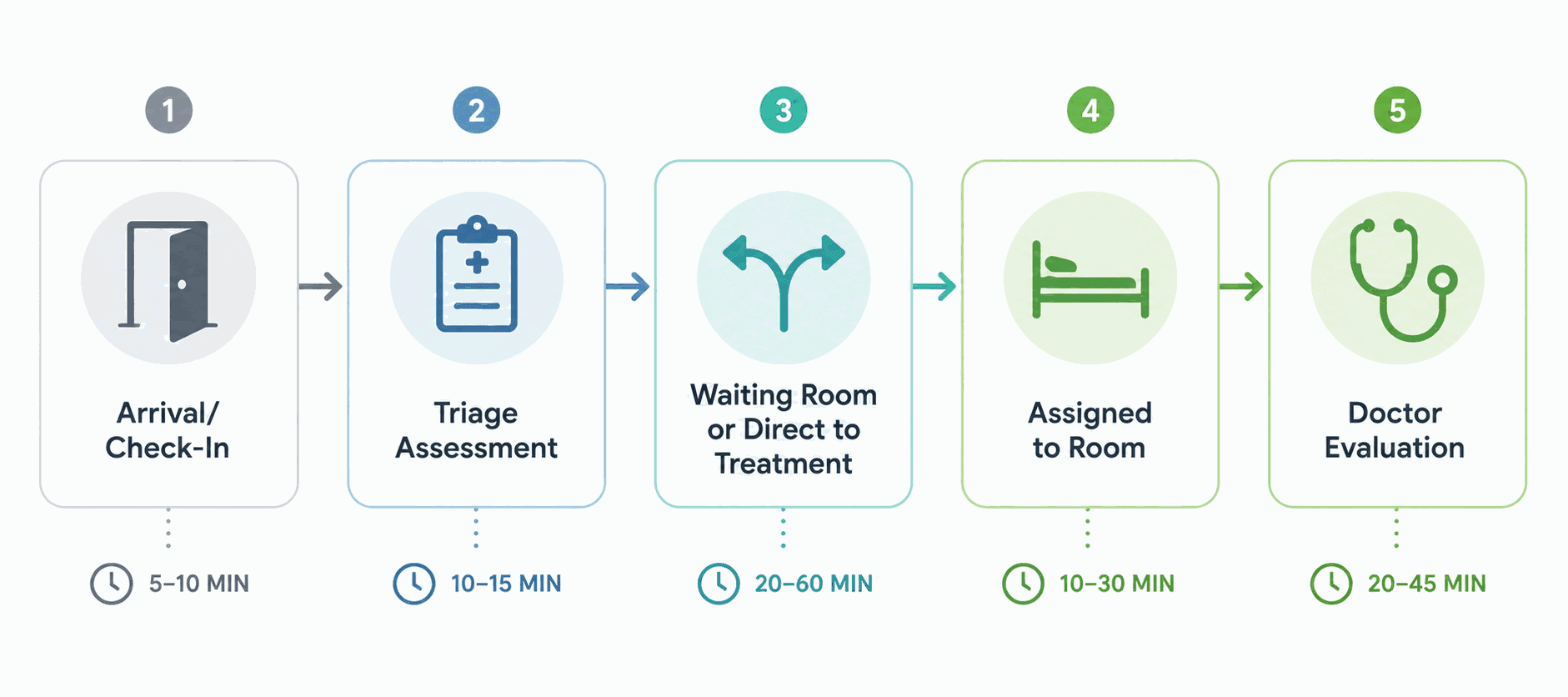
Five stages of an ER visit with typical timings: arrival and check-in 5 to 10 minutes, triage assessment 10 to 15 minutes, waiting room 20 to 60 minutes, assigned to a room 10 to 30 minutes and doctor evaluation 20 to 45 minutes
Registration occurs first. You provide identification, insurance information, and the basic reason for your visit. This process takes 3 to 8 minutes at most facilities. Some hospitals now offer digital pre-registration through mobile apps, shaving 5 to 10 minutes off your total visit time.
Triage assessment follows immediately after registration. A specially trained triage nurse evaluates your vital signs, symptoms, and medical history. This critical 5 to 15 minute assessment determines your Emergency Severity Index level, the number that controls everything about your wait. For a deeper look at how priorities are assigned, see our guide on how emergency room triage works.
Waiting room or direct admission depends on your ESI score and available rooms. Level 1-2 patients move directly to treatment areas, often before completing full registration. Level 3 patients might wait 15 minutes or 90 minutes depending on current ER volume. Level 4-5 patients almost always wait in the reception area.
Room assignment happens when space opens and a nurse becomes available. Getting placed in a room does not mean immediate care. It means you are in the queue for nursing assessment and doctor evaluation. You might wait another 15 to 45 minutes in the room before anyone enters.
Doctor evaluation begins once the assigned physician reaches your case. Emergency physicians work multiple patients simultaneously, evaluating one, ordering tests for another, and interpreting results for a third. When the doctor enters your room, your active medical care finally starts.
ER nurses note that many patients get upset when they sit in a room for 45 minutes before seeing the doctor, assuming that being placed in a room means they are next. In reality, the department may be handling several patients coding, ambulance arrivals, and a stroke activation at the same time. A stable injury like a sprained wrist has to wait while those higher-risk cases are managed, even when it is uncomfortable.
The Triage System: Why You Might Wait Longer
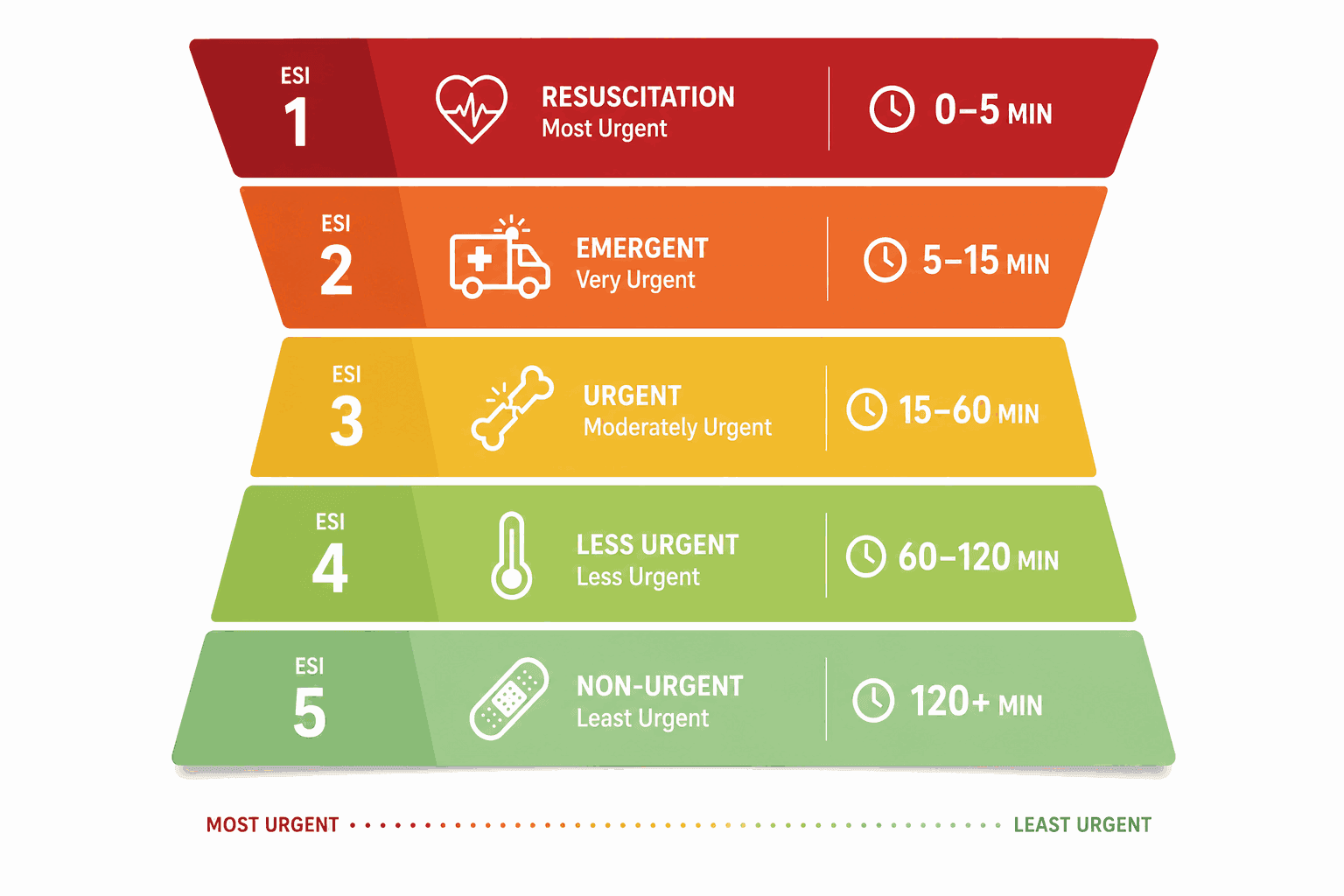
Emergency Severity Index levels and typical waits: ESI 1 resuscitation 0 to 5 minutes, ESI 2 emergent 5 to 15 minutes, ESI 3 urgent 15 to 60 minutes, ESI 4 less urgent 60 to 120 minutes and ESI 5 non-urgent over 120 minutes
ESI Level 1-2: Immediate to Life-Threatening
Level 1 patients require immediate resuscitation: cardiac arrest, unresponsive, not breathing. These patients move directly to trauma bays with full teams assembled within 60 seconds. No waiting. No registration delay.
Level 2 encompasses high-risk situations: chest pain suggesting heart attack, stroke symptoms, severe bleeding, respiratory distress, and altered mental status. These patients see physicians within 0 to 15 minutes, often before completing paperwork. Staff monitor continuously while diagnostic testing proceeds urgently.
Together, Levels 1-2 represent just 17 to 23% of ER visits but consume disproportionate resources. A single cardiac arrest occupies 4 to 6 staff members for 30+ minutes. Recognizing heart attack and stroke symptoms helps patients seek appropriate emergency care promptly.
ESI Level 3: Urgent But Stable
Level 3 makes up 40 to 45% of ER visits, the largest category. These patients need care today but are not in immediate danger. Broken bones, deep lacerations requiring stitches, high fevers in children, severe abdominal pain, and kidney stones all land here.
Wait times for Level 3 patients range dramatically from 30 minutes to 2 hours based on how many Level 1-2 emergencies arrive. You might be next when an ambulance brings a car accident victim, and suddenly you are waiting another 45 minutes while staff stabilize the trauma patient.
This category frustrates patients most. You are genuinely injured or ill, experiencing real pain, but watching others arrive after you and get seen first. The system prioritizes medical risk over arrival time, always.
ESI Level 4-5: Less Urgent Conditions
Level 4 patients need evaluation but can wait safely for 1 to 3 hours. Minor injuries without complications, moderate pain, urinary symptoms, and non-severe rashes fit here. These conditions rarely worsen during reasonable wait times, making them lowest priority when critical cases arrive.
Level 5 represents non-urgent issues that should not use emergency resources: cold symptoms, minor cuts, chronic problems, medication refills, and routine issues better handled by primary care. Average waits reach 2 to 4+ hours, and frankly, you are lucky if staff do not suggest you would be better served, and seen faster, at urgent care down the street.
About 35 to 40% of ER visits fall into Levels 4-5 combined. These patients often wait longest because every Level 1-3 case takes priority. Knowing when urgent care is more appropriate prevents unnecessary four-hour waits for conditions treatable in 45 minutes elsewhere.
ER Insider Tip The posted wait time you see online or at the front desk typically shows the "door-to-doctor" time for recently admitted patients. Your actual wait depends entirely on your triage level. A person with chest pain will be seen immediately, even if the posted wait says 90 minutes. Meanwhile, someone with a sprained ankle might wait 3+ hours when the posted time says 60 minutes. Source: Emergency Nurses Association (2026)
Peak Times and Seasonal Patterns
Monday evenings from 5 to 10 PM create perfect storm conditions: the week's busiest day intersects with the day's busiest hours. Average wait times for Level 3 patients reach 90 to 150 minutes during this window. People postpone weekend medical issues hoping they will resolve, then panic Monday evening when symptoms persist.
Weekend ER volumes run 15 to 25% higher than Tuesday through Thursday due to accidents, alcohol-related incidents, and sports injuries. Friday and Saturday nights especially see trauma cases from car accidents, falls, and assaults. These high-acuity patients delay care for everyone else waiting.
Flu season (December through February) extends hospital wait times by 20 to 30% nationally. Respiratory illnesses fill ER waiting rooms with coughing, feverish patients. Hospitals operate at capacity, slowing patient movement from ER to inpatient beds, the bottleneck that creates the longest waits.
Summer months (June through August) bring 15 to 25% increases in trauma and accident-related visits. Motorcycle crashes, heat exhaustion, drownings, and outdoor activity injuries peak during warm weather. These serious cases occupy significant ER resources.
Holiday weekends (Memorial Day, July 4th, Labor Day, Thanksgiving, Christmas, New Year's) see 25 to 40% longer average ER wait times. Reduced staffing meets increased patient volumes from travel, celebrations, and stress-related health issues. Plan accordingly for non-urgent needs.
ER Wait Times by Time of Day and Day of Week
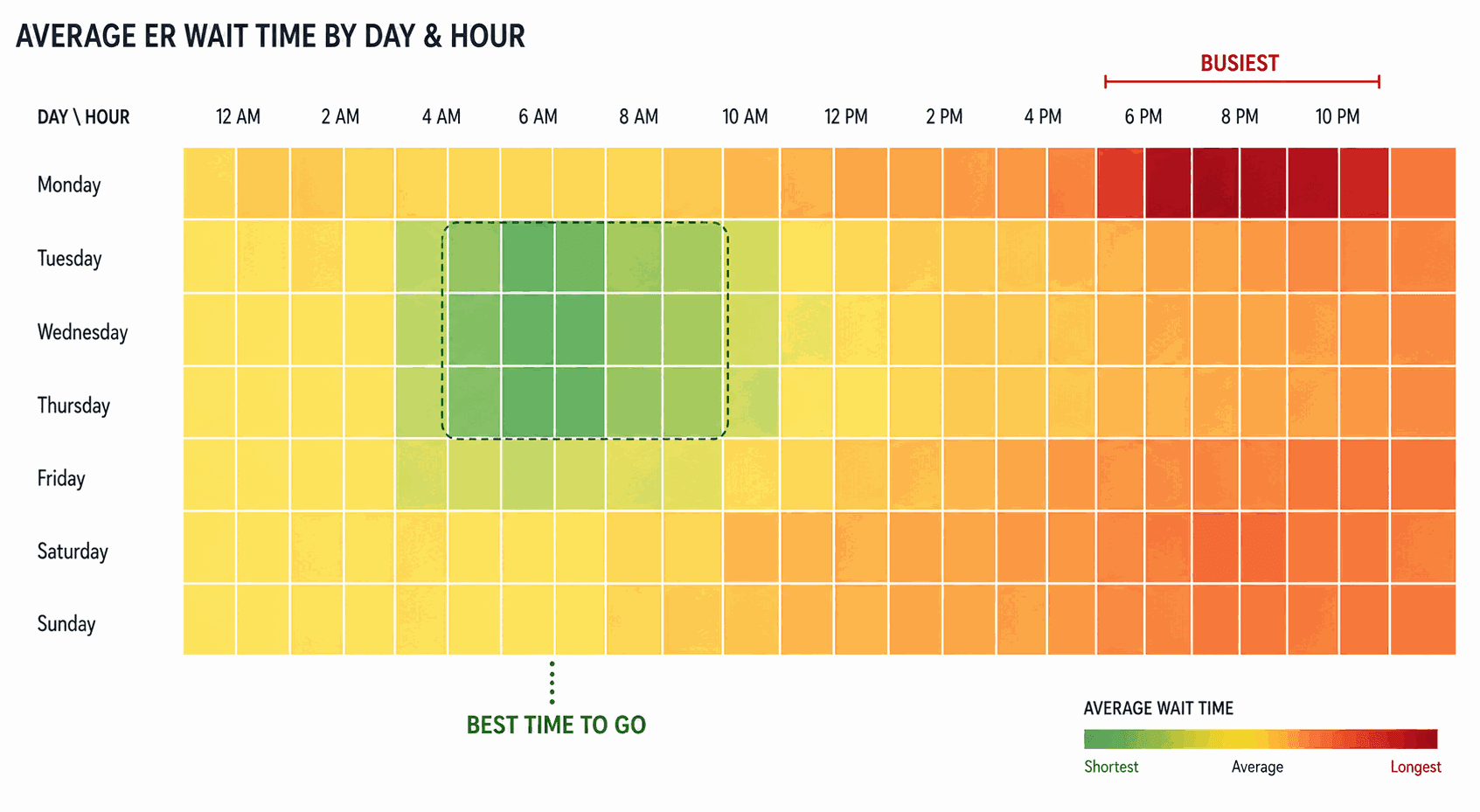
Heat map of average ER wait times by day of the week and hour of the day, highlighting the busiest periods and the best times to go
| Time Period | Average Wait Time | ER Volume | Best For | Notes |
|---|---|---|---|---|
| Overnight (12 AM - 6 AM) | 25-45 min | Low | True emergencies only | Fewer staff, but fewer patients |
| Early Morning (6 AM - 10 AM) | 30-60 min | Moderate | Non-critical issues | Before afternoon rush |
| Midday (10 AM - 3 PM) | 45-75 min | Moderate-High | If you can't wait | Busy but manageable |
| Afternoon (3 PM - 5 PM) | 60-90 min | High | Avoid if possible | School/work ending, volume increases |
| Evening (5 PM - 10 PM) | 90-150 min | Very High | Emergencies only | Peak period, longest waits |
| Late Evening (10 PM - 12 AM) | 75-120 min | High | If symptoms started at night | Still busy from evening rush |
| Monday | Highest wait times | Busiest day | Avoid for non-emergencies | Weekend issues + start of week |
| Friday-Sunday | Moderate-High | Very busy | Expect crowds | Accidents, alcohol-related visits |
| Tuesday-Thursday | Lowest wait times | Least busy | Best days if you can choose | 20-30% shorter waits than Mon |
How to Check Real-Time ER Wait Times
ER wait time tools like ours combine estimates from participating hospitals with user-submitted updates. Coverage and freshness vary by facility, so treat the times as estimates rather than a live hospital feed. These systems count patients currently in the ER, track how long recent patients waited, and calculate projected waits based on current conditions.
ERWaitTimes.org aggregates wait time estimates and user-submitted updates from participating facilities across roughly 30 states. Enter your ZIP code to see current wait times at nearby emergency rooms and urgent care centers. The platform updates continuously throughout the day, reflecting actual conditions rather than historical averages.
Hospital websites and mobile apps increasingly display current wait times on their homepages. Many major health systems now offer this transparency. Search for "[hospital name] ER wait times" or download the facility's official app to access their data directly.
Posted wait times at ER entrances show recent averages but lag reality by 30 to 60 minutes. These digital boards help somewhat, but checking online before leaving home provides more current information and lets you compare multiple facilities.
Call ahead with caution. Phoning the ER to ask about waits is like calling a restaurant during dinner rush to ask how long the wait is. Staff are too busy to give accurate estimates, and the answer changes minute by minute anyway. Use online tools instead for reliable, current data.
Limitations exist for all wait time systems. Posted times typically reflect Level 3 patients, not your specific situation. A hospital showing "45-minute wait" might see you in 10 minutes (if you have chest pain) or 3 hours (if you have a cold). Triage level determines your personal wait more than the posted average.
Pro Tip: Compare Multiple Facilities Do not automatically go to the closest ER. A hospital 10 minutes farther might have 60 minute shorter waits. Check wait times at 3 to 4 nearby facilities before deciding. For non-life-threatening conditions, driving an extra 10 minutes to save 90 minutes waiting makes obvious sense. Use the ERWaitTimes.org comparison view to see all options at once. Source: Patient experience data (2026)
Strategies to Reduce Your ER Wait Time
Choose Your ER Strategically
Check current emergency room wait times near you before leaving home. This single action saves more time than any other strategy. A community hospital 15 minutes away might have one-third the wait time of the major medical center three miles closer.
Consider freestanding emergency departments for moderately urgent conditions. These independent ERs handle everything except major trauma and complex surgeries. Average waits run 15 to 45 minutes versus 60 to 90 minutes at hospital-based ERs. Verify insurance coverage first, as many freestanding ERs operate out-of-network for major insurers.
Smaller community hospitals process patients faster for standard emergencies. Their ERs see 100 to 150 daily patients compared to 300 to 500 at academic medical centers. You will wait less but trade access to subspecialists and advanced technology. For broken bones, deep cuts, and common emergencies, community hospitals excel.
Teaching hospitals make sense for complex or unusual conditions despite longer waits. You gain access to specialists, cutting-edge diagnostics, and physicians experienced with rare diseases. If your condition requires specialized expertise, the extra wait justifies the benefit.
Arrive at Off-Peak Times When Possible
Tuesday, Wednesday, and Thursday mornings (6 AM to 10 AM) offer optimal timing for non-urgent ER visits. Wait times average 30 to 50 minutes, half the evening average. If your condition allows delayed care, visiting during these windows dramatically improves your experience.
Avoid Monday evenings at all costs for non-emergencies. This weekly peak generates waits 2 to 3 times longer than Wednesday mornings. If you can postpone until Tuesday, do so. Your ankle will still be sprained, but your wait will be 60 minutes shorter.
Late-night hours (1 AM to 5 AM) see minimal volumes but operate with skeleton crews. You might wait 30 minutes or 90 minutes depending on how many staff are working and whether any serious cases arrived recently. Overnight works well for insomnia-related distress but risks longer waits if your issue seems non-urgent.
Weekend afternoons and evenings rival Monday for crowding. Friday night through Sunday evening sees continuous high volumes from accidents, sports injuries, and alcohol-related incidents. Understanding when to seek emergency care helps you time visits strategically when medically appropriate.
Have Your Information Ready
Prepare a written list of current medications including doses and frequency. This simple step saves 5 to 10 minutes during triage and registration. Include over-the-counter medicines, supplements, and vitamins, as all matter for treatment decisions.
Bring your insurance card, photo ID, and a method of payment. Having these ready prevents registration delays. If uninsured, bring proof of income or financial hardship documentation to expedite financial counseling discussions that otherwise occur after treatment.
Write down your symptoms before arriving: when they started, what makes them better or worse, severity (rate 1 to 10), and what you have tried already. Triage nurses assess faster when you provide organized information rather than rambling explanations colored by pain and stress.
List allergies and previous surgeries clearly. Medical alert bracelets expedite this process. Knowing your last tetanus shot date, whether you take blood thinners, and if you have a pacemaker or implants matters for treatment planning.
Know When to Consider Alternatives
Urgent care centers treat most non-life-threatening conditions with 30 to 60 minute average waits versus 90 to 150 minutes at ERs during peak times. Broken bones (excluding hips, spines, or skulls), deep cuts requiring stitches, fevers without respiratory distress, urinary tract infections, and sprains all receive excellent urgent care treatment.
Telehealth services handle many issues previously requiring ER visits. Rashes, medication questions, mild infections, and minor ailments often resolve through virtual consultations. Your insurance likely covers telemedicine with low copays, so check your benefits before heading to the ER.
Primary care same-day appointments eliminate ER waits entirely for non-urgent issues. Many family medicine practices reserve slots for urgent concerns. Call your doctor's office first. They will direct you to the ER if necessary but might schedule you within hours for less serious problems.
Hospital Type and Typical ER Wait Times
| Hospital Type | Average Wait Time | Pros | Cons | Best For |
|---|---|---|---|---|
| Large Academic/Teaching Hospital | 60-120 min | Specialists available, advanced equipment, handles complex cases | Very busy, longer waits, teaching environment | Complex conditions, rare diseases, severe trauma |
| Community Hospital | 35-75 min | Shorter waits, personal attention, familiar with locals | Limited specialists, may transfer complex cases | Standard emergencies, local care |
| Small Rural Hospital | 20-50 min | Very short waits, quick service | Limited resources, may need transfer for serious issues | Minor emergencies when closest option |
| Freestanding ER | 15-45 min | Shortest waits, modern facilities, convenient locations | Higher costs, not always in insurance network | Non-life-threatening emergencies, when time matters |
| Children's Hospital ER | 45-90 min | Pediatric specialists, child-friendly, specialized equipment | Can be very busy, limited to children | Serious pediatric emergencies, complex child cases |
Emergency physicians consistently say the single best way to reduce your wait is to check which ER is less busy before you go. A patient who drives an extra 25 minutes to a suburban ER instead of the Level 1 trauma center five minutes away can have a broken wrist treated in under an hour total, rather than waiting three hours at a trauma center occupied with gunshot wounds and car accidents.
When to Go to Urgent Care Instead of the ER
Urgent care facilities treat sprains, strains, minor fractures, and joint injuries faster and cheaper than emergency rooms. X-rays, splinting, and pain management happen routinely at urgent care with 30 to 60 minute total visit times. Save the ER for compound fractures, hip, spine, or skull injuries, or broken bones with severe deformity.
Cuts requiring stitches receive excellent urgent care treatment unless they are extremely deep, involve arteries, or penetrate the skull, chest, or abdomen. Simple lacerations on limbs, faces, and torsos get sutured quickly at urgent care. Glue and skin adhesives close many cuts without stitches at all.
Respiratory infections, flu, strep throat, ear infections, and similar illnesses belong at urgent care unless breathing difficulty, high fever (104°F+), or dehydration complicate the picture. Urgent care performs rapid tests, prescribes antibiotics, and provides treatment in a fraction of the ER time.
Minor burns, allergic reactions without breathing issues, urinary tract infections, eye problems (not chemical burns or penetrating injuries), and skin conditions all fit urgent care's scope. Locate urgent care centers near you to find facilities with current availability and short wait times.
ER visits remain necessary for chest pain, difficulty breathing, severe bleeding, head injuries with loss of consciousness, stroke symptoms (facial drooping, arm weakness, speech difficulty), severe abdominal pain, or any life-threatening situation. Do not risk your life to avoid an ER wait. If you are unsure, our guide on when to call 911 versus go to the ER can help you decide, but call 911 for any genuine emergency.
What to Bring to Minimize Delays
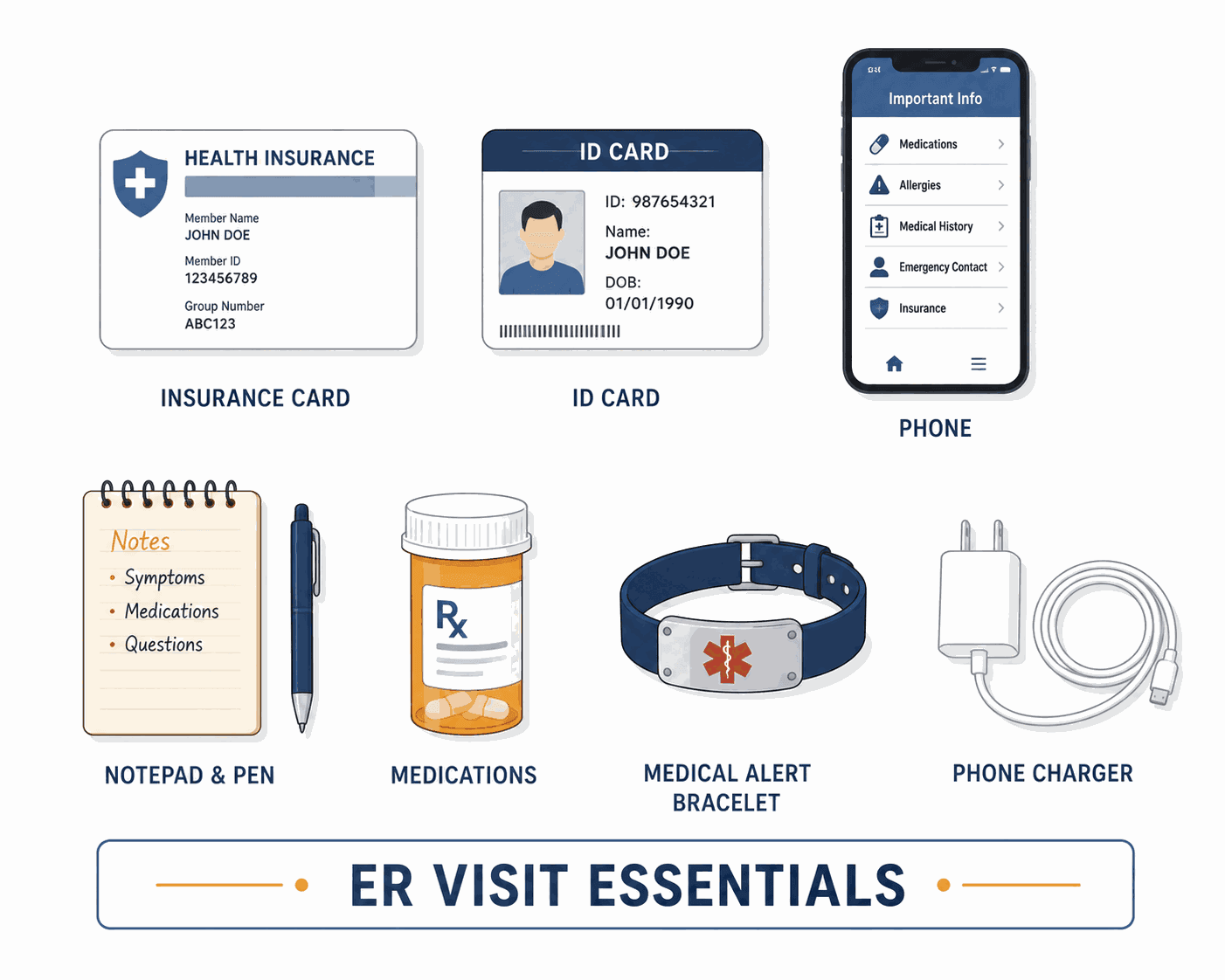
ER visit essentials to bring: photo ID, insurance card, medication list, allergy and medical history notes, emergency contacts, phone and charger
Insurance cards, both medical insurance and prescription coverage, top the essential items list. Registration stalls without this information, and while ERs treat everyone regardless of insurance, having cards ready prevents 10 to 15 minute delays in check-in and reduces billing complications later.
Photo identification verifies your identity and prevents medical record mix-ups. Driver's licenses, state IDs, passports, or military IDs all work. Minors need a parent or guardian present with ID to consent for treatment except in life-threatening emergencies.
Complete medication lists save enormous time. Include prescription names, doses, frequencies, and prescribing doctors. Also list over-the-counter medicines, herbal supplements, and vitamins. Bring medication bottles if you do not have a written list, as photographing bottle labels works too.
Medical history summary helps if you have chronic conditions, previous surgeries, or ongoing health issues. Knowing your last hospital admission date, current health problems, and specialist names speeds the evaluation process. Many patients keep this information in phone notes or as a photo of their medical summary page. Our full checklist of what to bring to the ER covers every document worth packing.
Contact information for your primary care doctor and specialists allows ER staff to access your medical records electronically. This coordination prevents duplicate testing and ensures continuity of care. Having these phone numbers and fax numbers readily available demonstrates preparation that impresses and expedites.
Phone chargers keep devices powered during multi-hour ER visits. You will need your phone for communication, entertainment during waits, and accessing medical information. Many modern ERs provide charging stations, but bringing your own cable guarantees power availability.
Personal comfort items make long waits bearable: reading materials, snacks (if allowed, since some conditions require fasting), water bottles, and prescription medications you take regularly. Do not assume the ER will provide your home medications. Bring them yourself if you will be there during your usual dose time.
ER Visit Preparation Checklist
- Insurance card and photo ID
- Complete medication list (include doses and frequency)
- List of allergies (medications, foods, environmental)
- Recent medical history and surgical history
- Primary care physician contact information
- Phone charger and earbuds
- Written symptom timeline (when started, severity 1 to 10, what helps or hurts)
- Medical records if you have complex conditions
Having these items ready can reduce your total visit time by 15 to 30 minutes through faster check-in, triage, and evaluation.
Understanding "Door-to-Doctor" vs Total Visit Time
"Door-to-doctor" measures time from arrival to when a physician first evaluates you. The national median sits at 38 minutes, but this metric only captures one phase of your ER experience. Many hospitals advertise this number because it sounds better than total visit time.
Total visit time averages about 161 minutes (roughly 2.7 hours) nationally and includes every phase: registration, triage, waiting, doctor evaluation, diagnostic testing, treatment, results review, and discharge. Some visits finish in 60 minutes. Others exceed five hours depending on needed diagnostics and treatment complexity.
Waiting after seeing the doctor surprises many patients. The physician orders X-rays, CT scans, or bloodwork, and you wait for testing, wait for results, wait for the doctor to interpret results, then wait while treatment plans are implemented. Each step adds 15 to 45 minutes.
Diagnostic testing creates the longest delays. CT scans require radiologist interpretation taking 30 to 60 minutes. Lab results take 45 to 90 minutes for standard tests, longer for specialized studies. If consultations with specialists become necessary, add another 30 to 90 minutes while they review your case and examine you.
Discharge procedures consume 15 to 30 minutes even after treatment concludes. Nurses provide instructions, pharmacists review medications, doctors complete paperwork, and administrative staff prepare discharge summaries. You are medically ready to leave before you are administratively cleared to go.
Frequently Asked Questions
What is the average ER wait time in the United States?
The median ER wait time in 2026 is 38 minutes from arrival to seeing a physician, but total visit times average about 2.5 to 3 hours including treatment and discharge (CDC, 2026). Wait times vary dramatically based on triage level, with life-threatening emergencies seen immediately while non-urgent issues can take 2 to 4+ hours. Your actual wait depends on the severity of your condition, how busy the ER is, and available staffing when you arrive.
How can I find ER wait times near me?
Check real-time emergency room wait times at ERWaitTimes.org by entering your ZIP code to see current waits at nearby hospitals and urgent care centers, updated every 15 to 30 minutes. Many hospital websites and mobile apps also display their current wait times on homepages. Call the hospital directly as a last resort, since online tools provide more accurate, current data than phone inquiries to busy ER staff.
Why is the ER wait so long if it's an emergency?
ERs prioritize by medical urgency (triage level), not arrival order. Life-threatening emergencies receive immediate care while stable conditions wait (Emergency Nurses Association, 2026). A person with chest pain arriving after you will be seen first, even if you have waited two hours with a sprained ankle. Limited rooms, physician availability, and sudden influxes of critical patients extend waits for lower-priority cases.
Does calling ahead reduce ER wait times?
No, calling ahead does not reduce your ER wait time or reserve a spot. Triage upon arrival determines your priority regardless of advance notice. Calling can help verify the facility treats your specific condition and confirm they accept your insurance, but you will still wait according to medical urgency when you arrive. Use online wait time tools instead to compare facilities before leaving home.
What time of day has the shortest ER wait?
Early morning hours from 6 AM to 10 AM on Tuesday through Thursday typically have the shortest ER wait times, averaging 30 to 50 minutes for moderately urgent conditions. Overnight hours (1 to 5 AM) see low patient volumes but operate with reduced staffing, creating variable waits. Avoid Monday evenings (5 to 10 PM) when waits peak at 90 to 150 minutes for the same conditions.
Can I leave the ER if the wait is too long?
Yes, you can leave an ER waiting room at any time if you have not been placed in a treatment room. This is called "leaving without being seen" (LWBS). However, leaving after being placed in a room may require signing out "against medical advice" (AMA), which can affect insurance coverage. If your condition allows safe waiting elsewhere, consider urgent care alternatives with shorter waits for non-emergencies.
Do children have shorter ER wait times?
Children do not automatically get shorter ER wait times unless their condition is more urgent than adult patients being triaged simultaneously. Pediatric ERs and children's hospitals use the same triage system (ESI levels) as adult ERs. Medical severity determines wait time, not age. Our guide on when to take your child to the ER explains how pediatric emergency care works, though children's hospitals often have longer average waits due to high patient volumes.
Will insurance affect my ER wait time?
No, insurance status does not affect your ER wait time. Federal law requires ERs to treat all patients regardless of insurance or ability to pay. Triage nurses assess medical urgency only, never financial status. However, having insurance cards ready during registration saves 5 to 10 minutes in administrative processing, slightly reducing your total visit time.
How long should I expect to wait with a broken bone?
Broken bones (ESI Level 3) typically result in 30 minutes to 2 hours wait time depending on current ER volume and whether more urgent cases arrive. Simple fractures needing X-rays and casting generally see faster processing than complex injuries requiring specialist consultation. Urgent care treats most simple fractures in 45 to 90 minutes total, often faster than ERs during busy periods.
What's the difference between wait time and total visit time?
Wait time measures door-to-doctor (arrival to physician evaluation), averaging 38 minutes nationally, while total visit time includes registration, triage, waiting, evaluation, testing, treatment, and discharge, averaging about 2.5 to 3 hours (CDC, 2026). Posted ER wait times almost always refer only to door-to-doctor time, so expect to spend 1 to 2 additional hours for testing and treatment even after seeing the physician quickly.
Do freestanding ERs have shorter wait times?
Yes, freestanding emergency rooms typically have shorter wait times (15 to 45 minutes) than hospital-based ERs (60 to 90 minutes) because they see fewer patients and do not receive ambulance trauma cases. However, freestanding ERs often cost significantly more, frequently operate out-of-network, and may transfer complex cases to hospitals. Verify insurance coverage and costs before choosing freestanding ERs for non-emergencies.
Can I check in online to reduce my ER wait?
Some hospitals now offer online ER check-in or mobile app pre-registration that can save 10 to 20 minutes by completing paperwork before arrival. However, online check-in does not change your triage priority or guarantee faster doctor access. You still wait according to medical urgency after arrival. Check your local hospital's website or app for pre-registration options, though most ERs do not yet offer this feature.
How to Reduce Your ER Wait Time
| Strategy | Time Saved | Effectiveness | When to Use | How to Do It |
|---|---|---|---|---|
| Check real-time wait times | 30-60 min | High | Before leaving home | Use ERWaitTimes.org to compare nearby hospitals |
| Choose smaller community hospital | 20-45 min | Medium-High | For non-complex emergencies | Pick hospital with <100 beds if appropriate for condition |
| Arrive during off-peak hours | 30-90 min | High | When condition allows | Go Tuesday-Thursday mornings if possible |
| Have documents ready | 5-15 min | Medium | Every visit | Bring insurance card, ID, medication list, medical history |
| Know your symptoms clearly | 5-10 min | Low-Medium | Every visit | Write down symptoms, timing, severity before arrival |
| Consider urgent care alternative | 60-180 min | Very High | For non-emergencies | Use urgent care for broken bones, cuts, fevers, minor issues |
| Call ahead (limited benefit) | 0-5 min | Low | Life-threatening only | Calling doesn't reserve a spot; useful for directions |
| Register online (where available) | 10-20 min | Medium | When offered | Some hospitals allow pre-registration via app |
Make Smarter Decisions About Emergency Care
Understanding ER wait times empowers you to make better healthcare decisions during stressful situations. Wait times are not random. They follow predictable patterns based on triage level, hospital type, time of day, and current ER volume. Use this knowledge to your advantage.
Compare emergency rooms across your state before leaving home. This single step saves the most time by directing you to less crowded facilities appropriate for your condition. A hospital 10 to 15 minutes farther might process you 60 to 90 minutes faster than the closest option.
Remember the triage system prioritizes medical urgency, not arrival order. If you are waiting while others get seen first, it means they are sicker or more at-risk than you, which actually indicates good news about your condition's severity. Frustrating but true.
Choose appropriate care levels for your situation. Urgent care treats most non-life-threatening conditions faster and cheaper than ERs. Save emergency rooms for true emergencies: chest pain, severe bleeding, breathing difficulty, stroke symptoms, and conditions that could deteriorate rapidly.
Prepare before you go. Insurance cards, medication lists, symptom timelines, and medical history all expedite your visit. These 10 minutes of preparation save 20 to 30 minutes during check-in, triage, and evaluation.
Note: ER wait times vary significantly based on your medical condition, hospital capacity, and timing. Life-threatening emergencies receive immediate attention regardless of posted wait times. The information here reflects 2026 national averages and patterns, so your specific experience may differ. Always call 911 for severe emergencies. Wait time data sourced from CDC, CMS, and participating hospitals.
Ready to check ER wait times near you? Visit ERWaitTimes.org to see real-time wait times at emergency rooms and urgent care centers in your area. Updated every 15 to 30 minutes, our platform helps you make informed decisions about where to seek care, potentially saving hours of waiting.
Experiencing a life-threatening emergency? Call 911 immediately. Chest pain, difficulty breathing, severe bleeding, stroke symptoms, and loss of consciousness require immediate emergency care regardless of wait times.
This article is for informational purposes only and is not a substitute for professional medical advice. In an emergency, call 911.