
When to Take Your Child to the Emergency Room: A Parent's Guide to Pediatric ER Decisions
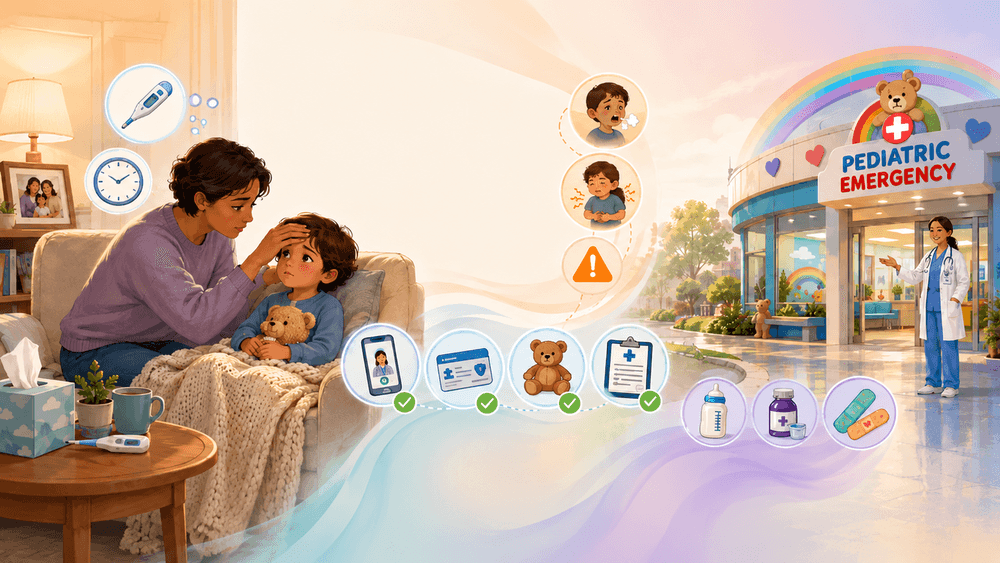
When to Take Your Child to the Emergency Room: A Parent's Guide to Pediatric ER Decisions
It is 2 AM, and your child's fever just spiked to 103°F. They are whimpering in your arms while you frantically Google symptoms with one hand and check the thermometer with the other. *Is this serious enough for the ER? Am I overreacting? What if I wait and something is really wrong? Knowing when to take your child to the emergency room is one of the hardest calls a parent ever makes, and this guide is designed to make it clearer.
Every parent knows this moment of panic. With your own health, you might wait it out and weigh decisions like whether chest pain means the ER or urgent care. But with your child, especially when they cannot tell you exactly what hurts, every decision feels enormous.
Here is what no one tells you: there is no prize for avoiding the emergency room. Pediatric ER doctors see worried parents every single day. They would rather evaluate a hundred children who turn out fine than miss the one child with something serious. You know your child better than anyone. If something feels wrong, that matters.
This guide breaks down pediatric emergency room decisions by severity, by symptoms, and by your child's age. Before you need it in a crisis, you can also check real-time ER wait times and locations near you, but we will get to that.
Key Takeaways
- Any fever of 100.4°F (38°C) or higher in an infant under 3 months old is an automatic ER visit, with no exceptions.
- Call 911 immediately for breathing problems, blue or gray lips, unresponsiveness, a seizure lasting over 5 minutes, or any first-time seizure, severe bleeding, or a severe allergic reaction.
- For urgent but stable symptoms, you have time to grab essentials and choose the right ER.
- In a true life-threatening emergency, the nearest ER is always the right ER. Time matters more than specialty.
- Trust your parental instinct. There is no penalty for a false alarm in pediatric emergency care.
Life-Threatening Emergencies: Go to the ER Immediately
Some symptoms mean you should not hesitate, should not call your pediatrician first, and should not check wait times. You go. If you need to monitor your child's breathing or consciousness, call 911 instead of driving in: the ambulance can start treatment en route.
Call 911 or go to the ER immediately if your child has:
Breathing Problems:
- Difficulty breathing, gasping for air, or severe wheezing
- Lips or face turning blue or gray
- Cannot speak full sentences due to breathlessness
Consciousness Issues:
- Unresponsive or extremely difficult to wake
- Loss of consciousness, even briefly
- Seizure lasting more than 5 minutes, or any first-time seizure
Severe Injuries:
- Heavy bleeding that will not stop after 10 minutes of pressure
- Deep cuts exposing bone, muscle, or fat
- Head injury with loss of consciousness, repeated vomiting, or severe worsening headache
- Suspected broken bone with visible deformity
Critical Symptoms:
- Severe allergic reaction: throat swelling, difficulty breathing, widespread hives
- Known poison ingestion or suspected overdose
- Signs of severe dehydration: no tears, no urination for 8+ hours, extreme lethargy
- Stiff neck with high fever and severe headache (possible meningitis)
- High fever over 100.4°F (38°C) in any infant under 3 months old
Behavioral Red Flags:
- Inconsolable crying for 2+ hours in infants
- Refuses all liquids and has not urinated in 12+ hours
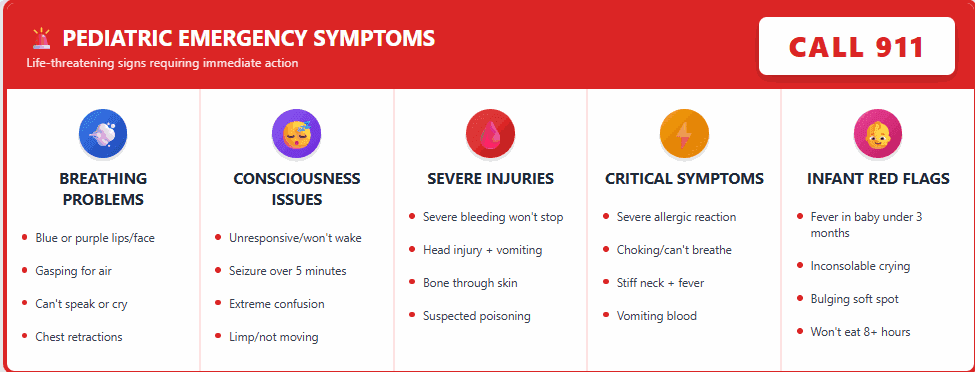
Pediatric emergency symptoms requiring 911: breathing problems, unresponsiveness or seizures over 5 minutes, severe injuries, severe allergic reaction, and infant red flags such as fever under 3 months or a bulging soft spot
Pediatric emergency physicians note that parents sometimes apologize for coming in with what turns out to be nothing serious. The reassurance they offer is consistent: if you were worried enough to bring your child in, you did exactly the right thing. ER teams would much rather see a hundred kids with fevers that break on their own than miss one child with something serious.
For these symptoms, the nearest emergency room is the right emergency room. Time matters more than specialty.
Urgent Situations: Go to the ER Today (But Not 911)
These symptoms are serious and need evaluation today, but your child is currently stable. You have time to grab essentials, possibly check wait times at pediatric emergency rooms near you, and choose the appropriate ER.
High Fever (Age-Dependent):
- Infant under 3 months: ANY fever over 100.4°F (38°C), an automatic ER visit
- 3 to 6 months: Fever over 101°F (38.3°C), or any fever lasting more than 24 hours
- Over 6 months: Fever over 104°F (40°C), fever lasting more than 3 days, or high fever with lethargy
- Any age: Fever with a rash that does not blanch when pressed
Injuries Needing Evaluation:
- Possible broken bone: significant swelling, will not use limb, severe pain
- Deep cuts likely needing stitches: gaping open, longer than half an inch
- Animal bites, especially if deep or on the face, hands, or genitals
- Head bumps followed by vomiting more than once, or behavior changes
Respiratory and Other Issues:
- Moderate difficulty breathing: breathing faster than normal, chest pulling in, but still able to talk
- Persistent vomiting of large amounts for 12+ hours
- Severe stomach pain lasting more than 2 hours
- Blood in stool or vomit
- Painful urination with fever
For these situations, you have a window of time. If your pediatrician's office is open and can see you quickly, call them first. But if it is evening, the weekend, or symptoms are worsening, head to the ER.
Consider a common scenario: a three-year-old falls off the monkey bars on a Saturday, and afterward, the arm is swollen, and they will not move it. A parent checks the wait time at the nearby pediatric ER, sees it is about 90 minutes, and decides to go. It turns out to be a fracture. Hesitating can feel silly in hindsight, but ER staff are used to it and understand it.
Call Your Pediatrician First (Not ER-Level)
Not every symptom requires emergency care. Many conditions need medical attention but can wait until your pediatrician's office hours, or can be handled through after-hours nurse lines or urgent care centers instead of the ER.
Medical Guidance Needed (Pediatrician During Office Hours):
- Low to moderate fever in a child over 6 months without other concerning symptoms
- Mild rash without fever or breathing issues
- Minor cuts not needing stitches
- Ear pain without high fever
- Mild vomiting or diarrhea with no dehydration signs
- Cold symptoms lasting more than 10 days
- Minor allergic reaction with localized hives
When the Pediatrician's Office Is Closed:
Many pediatrician offices have after-hours nurse lines. Telemedicine has become increasingly available for pediatric care. Urgent care centers handle many non-emergency pediatric issues. However, if you are genuinely uncertain whether something is ER-level, err on the side of caution and go to the emergency room.
The "Wait and Monitor" Middle Ground:
Set specific checkpoints for monitoring. For example: "If the fever is not down in two hours after medication, we will go to the ER." Write down what you are watching for. It helps you stay objective during stressful moments.
Even pediatric ER nurses admit they sometimes struggle with these decisions for their own kids. The advice they pass on to parents is simple: if your gut is screaming that something is really wrong, if your child just is not acting like themselves in a way that genuinely scares you, do not let any checklist talk you out of coming; your instinct matters.
Special Considerations for Infants (Under 12 Months)
The threshold for taking infants to the emergency room is much lower than for older children. Babies cannot tell you what hurts, their immune systems are still developing, and they dehydrate faster.
Infant-Specific ER Reasons:
Any fever in an infant under 3 months old (100.4°F/38°C or higher): This is an automatic emergency room visit with no exceptions. Do not give fever-reducing medication first. Do not wait. Do not call your pediatrician to ask. Just go. Young infants with fever need blood tests and sometimes spinal taps to rule out serious infections.
Other immediate concerns:
- Inconsolable crying for 2+ hours with no apparent cause
- Refusing to eat for multiple feedings in a row
- Fewer than 6 wet diapers in 24 hours
- Soft spot on the head appears sunken or bulging
- Difficulty breathing, grunting, or flaring nostrils
- Extreme lethargy (difficult to wake for feedings)
- Blood in stool or vomit
- Suspected injury from a fall
Infant Fever = Automatic ER Visit If your baby is under 3 months old and has a fever of 100.4°F (38°C) or higher, this is an emergency room visit with no exceptions. Young infants with fever need immediate medical evaluation to rule out serious bacterial infections. Do not try home remedies, and do not give medication first. Just go.
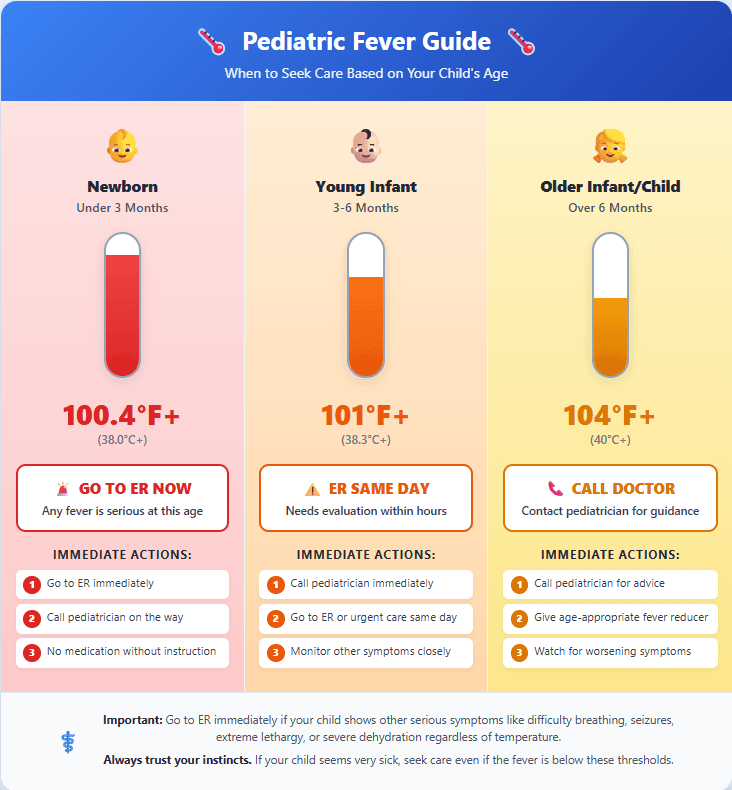
Pediatric fever guide by age: under 3 months any fever of 100.4F or above means go to the ER now, 3 to 6 months at 101F needs ER the same day, over 6 months at 104F means call the pediatrician
Pediatric ER vs. General ER: Which Should You Choose?
Not every community has a dedicated pediatric emergency room, but if you have options, understanding the differences helps. One rule trumps everything: in life-threatening emergencies, the nearest ER is always the right ER.
Here is how the two options compare:
| Factor | Pediatric ER | General ER |
|---|---|---|
| Staff training | Specially trained in pediatric care | General emergency clinicians |
| Equipment | Child-sized | Standard adult and pediatric mix |
| Environment | Designed to be less frightening | Standard ER setting |
| Specialists | Pediatric specialists on call | Pediatric specialists may be limited |
| Best for | Very young infants, complex conditions, less urgent child-friendly care | True life-threatening emergencies, trauma, simple stitches or broken bones |
When a Pediatric ER Is Your Best Choice:
Complex medical conditions requiring specialists, very young infants, conditions requiring pediatric specialists, or less urgent situations where the child-friendly environment significantly reduces trauma.
When a General ER Is Fine (or Better):
A true life-threatening emergency where every minute counts. Trauma situations. Late at night, when the pediatric ER may have reduced staff. Straightforward issues like stitches or simple broken bones.
Find the Right Emergency Room for Your Child Before an emergency happens, know your options:
- Which nearby ERs have pediatric specialists?
- Where is the nearest children's hospital with a pediatric ER?
- What are current wait times?
Check pediatric ER locations and current wait times near you and save locations in your phone so you are prepared when you need to make a quick decision.
Imagine living equidistant from a general ER and a children's hospital when a five-year-old breaks an arm, a quick wait-time check shows the pediatric ER at 90 minutes and the general ER at 30 minutes. The general ER is the smart pick because a broken arm does not require a pediatric specialist. But when a toddler has breathing issues, the pediatric ER is the better choice, because respiratory problems in little kids need specialists. Checking your options ahead of time helps you make these calls quickly.
What to Bring When Taking Your Child to the ER
In a true emergency, do not delay leaving. Grab your phone, your wallet, and go. For less critical situations where you have a few minutes, being prepared helps. Our complete ER packing checklist covers the essentials for any visit.
Quick Grab Essentials (30 Seconds):
- Phone and charger
- Insurance card and your ID
- Child's current medications
- Immunization records (if readily available)
Complete ER Bag (If You Have Time):
Keep a small backpack pre-packed with:
- Medical essentials: insurance card copy, medication list, allergy list, pediatrician contact
- Comfort items: favorite stuffed animal or blanket, small quiet toys
- Practical items: snacks, water, diapers and wipes, change of clothes, tablet with downloaded content
- Phone charger (essential)
What Not to Bring:
Siblings (if avoidable), valuables, and too many items.
Digital Preparation:
Take photos of insurance cards, immunization records, and medication bottles. Save pediatrician contact information. Bookmark erwaittimes.org on your phone for checking wait times at children's emergency rooms near you when needed. It is also worth browsing emergency rooms by state so you know your nearest pediatric options in advance.
What to Expect at the Pediatric Emergency Room
Understanding the process reduces anxiety for both you and your child.
Check-In and Triage:
You will register first (insurance and basic info). A triage nurse will assess severity by taking vital signs and asking about symptoms. Triage determines when your child is seen, not arrival order. Life-threatening conditions go first.
The Wait:
- Life-threatening: Seen immediately
- Urgent conditions: Typically 30 minutes to 2 hours
- Less urgent: Could be 2-4+ hours
You can check approximate wait times at pediatric emergency rooms before leaving home, though these are estimates.
Treatment Process:
You will be moved to a treatment area. A physician evaluates, orders tests if needed (blood work, X-rays, imaging), provides treatment, and either discharges you home or admits your child to the hospital.
Timeline Reality:
- Simple issues: 2-4 hours typical
- Complex issues needing multiple tests: 4-8 hours
- Total time varies significantly
Helping Your Child Cope:
Stay calm yourself, because your anxiety transfers to them. Explain what is happening in age-appropriate terms. Do not lie about pain. Comfort items matter enormously. Distraction works. Your presence is the biggest comfort.
Pediatric ER nurses often tell parents to expect a visit to take longer than they think. Staff are thorough because they cannot afford to miss things. And a parent staying calm helps the child stay calmer too, even when you are probably terrified inside.
Preparing in Advance: A Parent's ER Action Plan
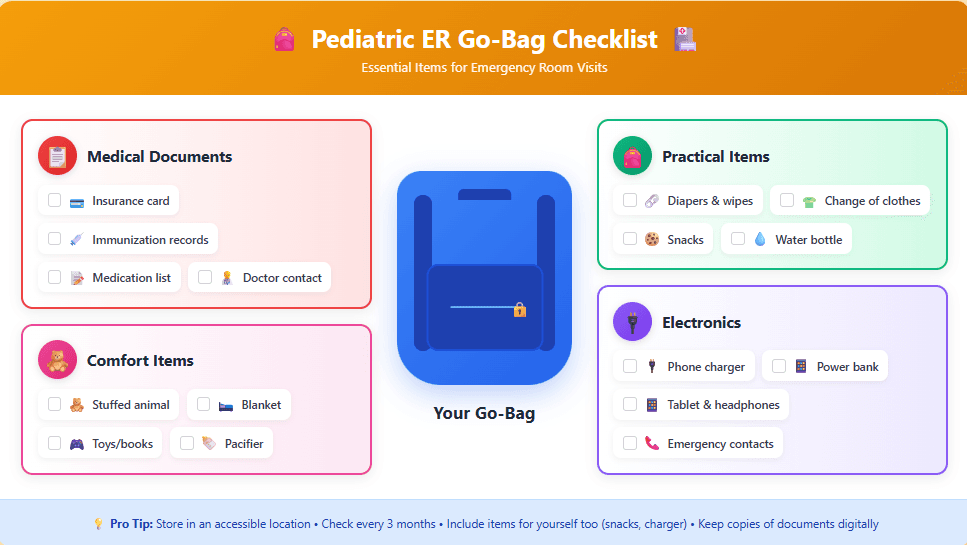
Pediatric ER go-bag checklist covering medical documents, practical items, electronics and comfort items such as insurance card, immunisation records, nappies, snacks, charger and a stuffed animal
The time to prepare is before you ever need emergency care.
Know Your Options (Do This Today):
Locate the nearest general ER and the nearest pediatric ER. Save addresses in your phone with clear labels. Check which ERs your insurance covers. Bookmark erwaittimes.org to check wait times at pediatric emergency rooms when you need to make decisions.
Document Preparation (Do This This Week):
Take photos of insurance cards (front and back). Create a document for each child listing current medications, allergies, chronic conditions, and immunization dates. Save pediatrician contact information.
Assemble an Emergency Go-Bag (Do This This Month):
Use a small backpack. Pack comfort items, medical information, snacks, a phone charger, and a change of clothes. Store it near your front door or in your car. Update it every few months.
Establish a Decision Framework:
Discuss with your partner: what is our ER threshold? Give caregivers clear guidelines. Create emergency cards with critical information.
Post Critical Information:
Put a list of life-threatening symptoms on your refrigerator. Add Poison Control (1-800-222-1222) to your phone contacts. Keep your pediatrician's after-hours number accessible.
Mental Preparation:
Permit yourself to "overreact." Discuss fears with your pediatrician at well visits. Remember that ER staff prefer false alarms to missed emergencies.
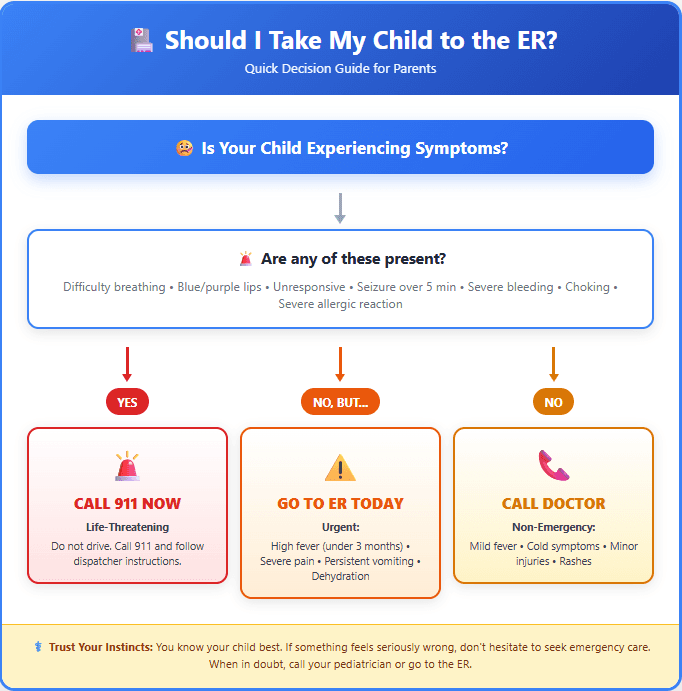
Quick decision guide for parents: call 911 for life-threatening signs, go to the ER today for high fever under 3 months, severe pain, persistent vomiting or dehydration, and call the doctor for mild fever, colds and minor injuries
Being prepared does not mean you are expecting disaster. Picture a child having a severe asthma attack: with a plan in place, there is no time wasted figuring out where to go. You grab the bag, check the fastest route, and go. That preparation lets you focus entirely on keeping your child calm.
Nobody wants their child to need emergency care. But being ready, by knowing when to go, where to go, and what to bring, transforms terrifying uncertainty into manageable action. You are not just a worried parent. You are an informed advocate for your child. When you have even a few minutes to plan, checking ER wait times near you helps you choose the best option and get your child seen faster.
Frequently Asked Questions: When to Take Your Child to the ER
When should I take my baby to the emergency room for a fever?
Any fever of 100.4°F (38°C) or higher in an infant under 3 months old is an automatic emergency room visit. Do not wait or give medication first. For babies 3 to 6 months, go if the fever is over 101°F (38.3°C) or lasts more than 24 hours. For children over 6 months, factors like fever height (over 104°F), duration (more than 3 days), and accompanying symptoms determine whether the ER is needed. When in doubt with young infants, always err on the side of caution.
Should I take my child to a pediatric emergency room or a regular emergency room?
For life-threatening emergencies, go to the nearest ER, because time matters more than specialty. For urgent but stable situations, a pediatric ER offers staff trained in children's care, child-sized equipment, and a less frightening environment. General ERs successfully treat many children, especially for straightforward issues. Consider distance, wait times, and severity. You can check wait times at pediatric emergency rooms near you before leaving to make informed decisions.
How do I know if my child's head injury requires an emergency room visit?
Go immediately if your child loses consciousness even briefly, vomits more than once, has a severe worsening headache, shows confusion or unusual behavior, or has a visible skull injury. Also, if they are under 2 years old and hit their head from a significant height. For minor bumps with no loss of consciousness and normal behavior, monitor at home but watch for worsening symptoms over 24 to 48 hours. When uncertain, err on the side of getting it evaluated.
What if I'm not sure whether my child's symptoms are serious enough for the ER?
Trust your parental instinct. If something feels seriously wrong, if your child just "is not acting right," that is reason enough to go. ER doctors would rather evaluate a child who turns out fine than miss something serious. You can call your pediatrician's after-hours line, but if it is late and you are truly concerned, do not let uncertainty keep you home. There is no penalty for false alarms in pediatric emergency care.
How long will we typically wait at a pediatric emergency room?
Wait times vary based on severity (triage determines order), time of day, and which ER. Life-threatening conditions are seen immediately. Urgent issues take 30 minutes to 2 hours to resolve. Less urgent issues take 2-4+ hours. Total visit time ranges from 2 to 8 hours for most conditions. When you have time to plan, you can check current wait times at pediatric emergency rooms in your area to set realistic expectations.
What should I bring when taking my child to the emergency room?
For emergencies, grab only essentials: phone, charger, insurance card, and ID. Do not delay leaving. For less urgent visits, also bring immunization records, a medication list, comfort items, snacks, diapers if applicable, a change of clothes, and a tablet. Have photos of insurance cards and records on your phone as backup. Leave siblings' homes if possible.
Will the ER turn us away if it's not serious enough?
No. Emergency rooms are legally required to evaluate every patient regardless of severity. If your concern is minor, they will provide reassurance and guidance. ER staff understand worried parents and see many children who are ultimately fine. They prefer you come for a false alarm rather than stay home with something serious. There is no judgment for being concerned about your child.
Can I stay with my child during emergency room treatment?
Yes, almost always. Parents are typically allowed and encouraged to stay throughout the ER visit, including during most procedures. Your presence provides crucial comfort. Some ERs limit visitors to one parent due to space. You may need to step out briefly for X-rays. For teens discussing sensitive issues, doctors may speak privately, but parents remain involved in care decisions. Your child needs you there, so plan to stay as much as allowed.
This article is for informational purposes only and is not a substitute for professional medical advice. In an emergency, call 911.