
When to Call 911 vs Go to ER: The Critical Decision
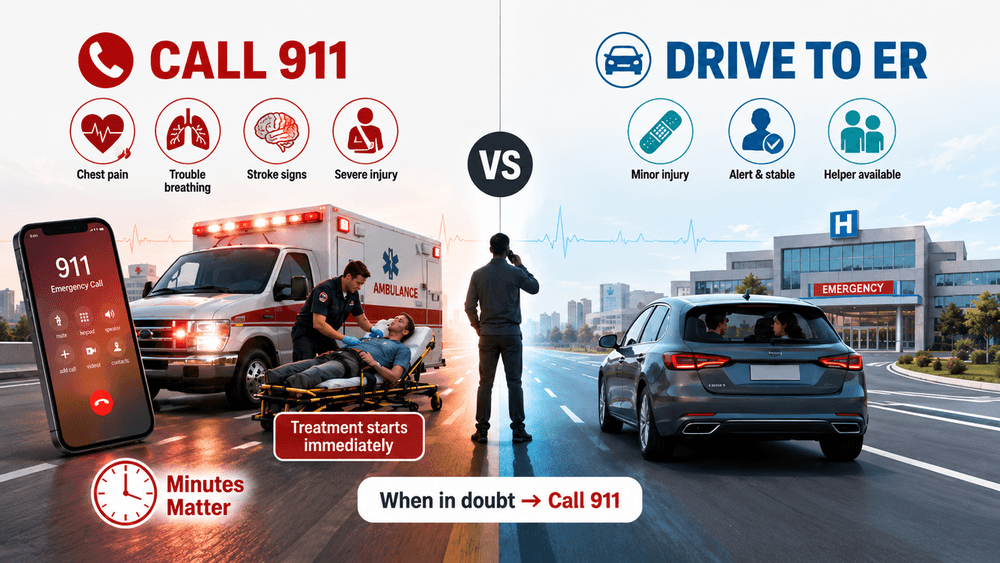
When to Call 911 vs Go to ER: The Critical Decision
When you face a medical crisis, knowing when to call 911 vs go to the ER can mean the difference between life and death. Whether you are experiencing symptoms yourself or helping someone else, the choice between calling an ambulance and driving to the emergency room can feel overwhelming, especially when you are scared, in pain, or worried about costs. This guide gives you a clear framework for when to call 911, when to drive to the ER, and when other options are appropriate. It is based on the American College of Emergency Physicians (ACEP) clinical guidelines, the American Heart Association (AHA) protocols, and the National Highway Traffic Safety Administration (NHTSA) emergency medical services standards.
In genuine emergencies, 911 is always the right answer. This article will help you recognize those situations instantly and navigate the gray areas with confidence. The decisions you make in the next few minutes could save a life.
Key Takeaways
- Call 911 immediately for any life-threatening emergency: unconsciousness, chest pain, stroke signs, severe bleeding, difficulty breathing, seizures, or major trauma.
- An ambulance is a mobile emergency room. Paramedics begin advanced treatment en route and alert the hospital so a team is ready before you arrive.
- Driving to the ER is appropriate only when the person is fully conscious, breathing normally, stable, and someone else can drive a short distance.
- When in doubt, call 911. Dispatchers are trained to help you decide, and they begin dispatching help while they ask questions.
- Never let cost stop you from calling 911 in a true emergency. You can negotiate an ambulance bill; you cannot negotiate away death or permanent disability.
Making the Decision Right Now
If you are in an emergency at this moment, start here. Is the person:
- Unconscious or unresponsive? CALL 911 NOW
- Not breathing or gasping? CALL 911 NOW
- Having chest pain? CALL 911 NOW
- Showing stroke signs (face droop, arm weakness, speech difficulty)? CALL 911 NOW
- Bleeding uncontrollably? CALL 911 NOW
- Having a seizure? CALL 911 NOW
- Severely injured from an accident or fall? CALL 911 NOW
If the person is conscious, breathing, and talking but needs urgent care, keep reading for guidance. If you are unsure whether it is life-threatening, keep reading or call 911 and they will advise.
When in doubt: call 911. Dispatchers are trained to help you decide.
The Golden Rules: 911 vs ER Decision Framework
Every emergency decision comes down to three fundamental principles. Memorize these rules. They will guide you through virtually any medical crisis.
Rule 1: Life-Threatening Equals 911 Always
If death or permanent disability could occur within minutes to hours without treatment, call 911 immediately. According to ACEP guidelines, this includes anyone who is not breathing, unconscious, having chest pain, showing stroke symptoms, experiencing severe bleeding, or suffering major trauma. These situations require advanced life support capabilities that only paramedics can provide during transport.
Rule 2: Time-Sensitive Equals 911 (Usually)
If a treatment delay causes worse outcomes, even if it is not immediately fatal, call 911. This includes broken bones with deformity, severe burns, possible internal injuries, difficulty breathing, high fever in infants, or severe pain. The American Heart Association emphasizes that for heart attacks and strokes, every minute without treatment causes permanent tissue damage. Paramedics begin critical interventions en route, improving survival rates.
Rule 3: Urgent but Stable Equals Drive to the ER (Maybe)
If the person is conscious, breathing normally, talking clearly, and the condition is not worsening rapidly, you might consider driving to the ER. Examples include moderate injuries, persistent vomiting in alert individuals, urinary issues, or moderate pain without concerning symptoms. However, someone else must drive. Never drive yourself if you are the patient.
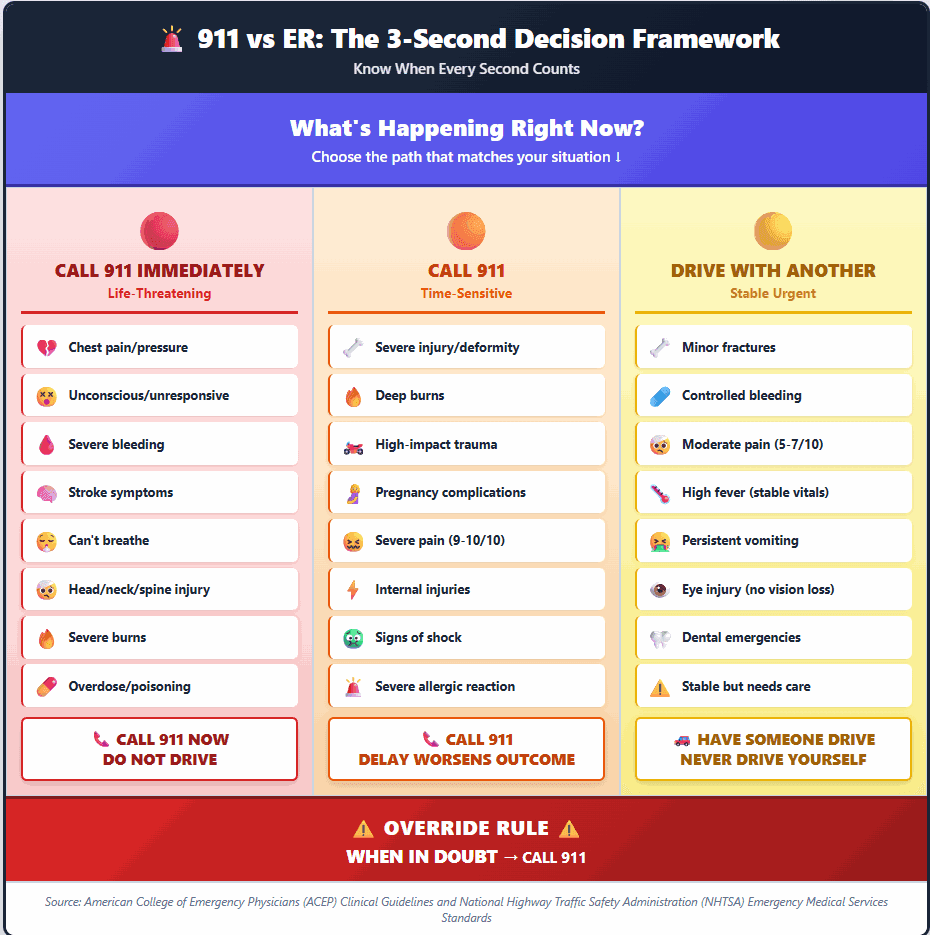
Three-tier framework: call 911 immediately for chest pain, unresponsiveness, severe bleeding or stroke signs; call 911 for time-sensitive severe injury or shock; have someone drive for stable urgent problems such as minor fractures
Override: when in doubt or if the condition changes, always default to 911.
These rules are not about saving ambulance costs or avoiding 911 "unnecessarily." According to NHTSA standards, the focus is on matching the right resource to the right emergency. For life-threatening situations, 911 provides capabilities you cannot get by driving. If you are weighing the decision for a specific symptom, our guide on chest pain: ER or urgent care walks through one of the most common gray areas.
Always Call 911: Non-Negotiable Emergency Situations
Certain symptoms and situations require immediate 911 calls: no exceptions, no delays, no driving yourself. The American College of Emergency Physicians identifies these as medical emergencies where minutes determine outcomes.
Cardiac Emergencies
Call 911 immediately for any chest pain, pressure, tightness, or discomfort, especially when accompanied by arm, jaw, or back pain, shortness of breath, sweating, nausea, or lightheadedness. The American Heart Association's 2024 guidelines emphasize that every 30-minute delay in treating heart attacks increases one-year mortality by 7.5%. Time is muscle, and permanent heart damage occurs within minutes of blood flow disruption. Do not wait to see if symptoms improve.
Neurological Emergencies
The American Stroke Association stresses calling 911 for stroke symptoms using the FAST acronym: Face drooping, Arm weakness, Speech difficulty, Time to call 911. Add sudden severe headache (possible aneurysm), seizures lasting over five minutes, or seizures where the person does not regain consciousness. For strokes, time is brain, and treatment within 90 minutes can prevent permanent disability, but only if you call 911 immediately.
Breathing Emergencies
Difficulty breathing or shortness of breath at rest requires an immediate 911 response. This includes choking (if the person cannot speak or breathe), severe asthma attacks not responding to inhalers, anaphylaxis (severe allergic reaction with throat swelling or difficulty breathing), or any situation where breathing is labored. Paramedics can provide advanced airway management and medications that prevent respiratory arrest.
Major Trauma
Call 911 for injuries from accidents, falls from height, violence, or significant force. This includes head injuries with any loss of consciousness, suspected spinal injuries (never move the person), severe bleeding that cannot be controlled with direct pressure, burns covering large body areas or affecting the face, hands, or genitals, or compound fractures with bone visible. According to NHTSA trauma care protocols, professional immobilization and transport prevent complications.
Altered Mental Status
Anyone unconscious, unresponsive, extremely confused, disoriented, having hallucinations, or exhibiting violent behavior needs an immediate 911 response. Sudden mental status changes often indicate life-threatening conditions like stroke, overdose, diabetic emergencies, or brain injuries.
Other Critical Situations
Suspected poisoning or overdose (also call Poison Control at 1-800-222-1222 if the person is conscious and stable), pregnancy complications with severe symptoms (bleeding, severe abdominal pain, severe headache, vision changes), and suicidal statements with specific means and a plan (also contact the 988 Suicide and Crisis Lifeline).
For any of these situations, call 911 immediately. Do not second-guess yourself, do not drive yourself to the ER, and do not wait to see if it gets better. Minutes matter. Hesitation costs lives.
Why Calling 911 Matters: The Paramedic Advantage
An ambulance is not just transportation to the hospital. It is a mobile emergency room that begins saving your life the moment paramedics arrive. Understanding what calling 911 provides helps explain why it is the right choice for serious emergencies.
Treatment Begins Immediately En Route
According to NHTSA emergency medical services standards, paramedics provide advanced life support (ALS) capabilities during transport. They can administer critical medications, including nitroglycerin for chest pain, epinephrine for severe allergic reactions, naloxone for overdoses, and various cardiac drugs. Paramedics perform cardiac monitoring, provide defibrillation for cardiac arrest, establish IV access for fluids and medications, manage airways for breathing difficulties, and provide continuous assessment with interventions adjusted as conditions change.
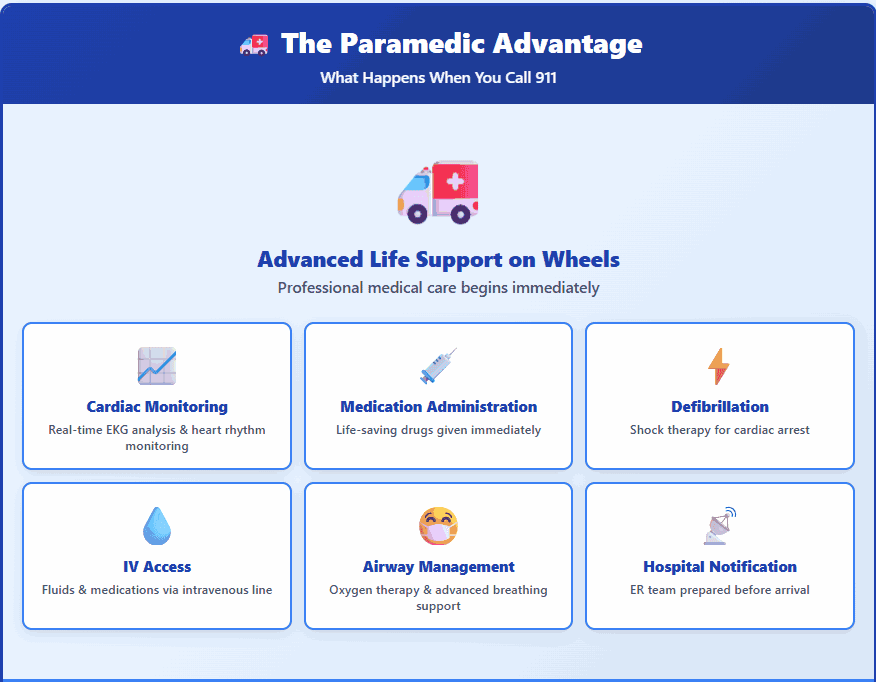
The paramedic advantage: cardiac monitoring, real-time EKG, medication administration, defibrillation, IV access, airway management and advance hospital notification
Hospital Receives Advance Notice
When paramedics transport a patient, they notify the receiving hospital before arrival with detailed patient information. The American Heart Association documents that this advanced notice allows hospitals to activate specialized response teams. For heart attacks, cardiac catheterization labs can be prepared before the patient arrives, reducing door-to-balloon time by an average of 15-30 minutes. For strokes, stroke teams assemble, and treatment protocols begin immediately upon arrival, helping hospitals meet the critical 60-minute door-to-needle time goal recommended by the American Stroke Association. For major trauma, entire trauma teams mobilize to the ER bay.
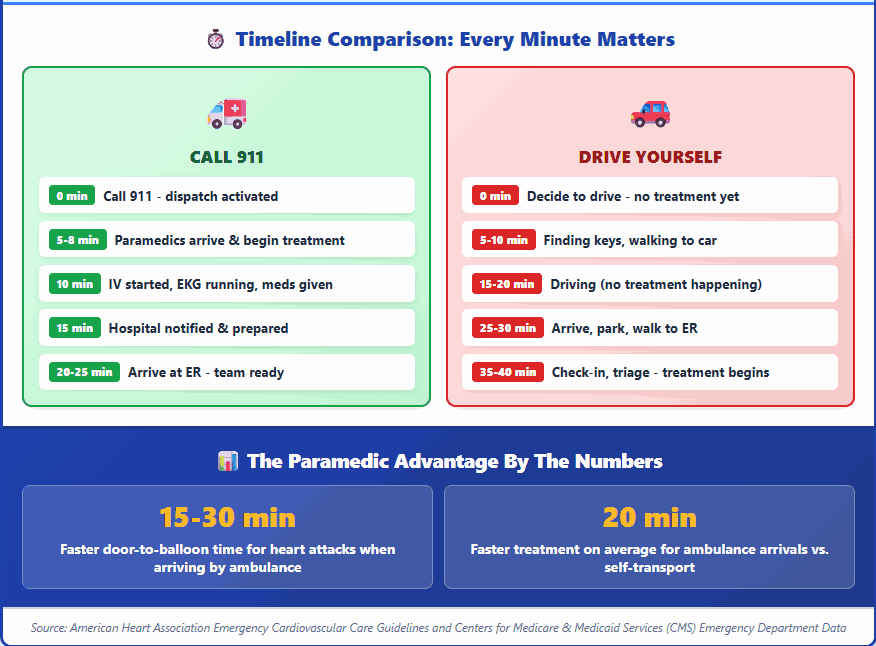
Timeline comparison showing treatment starting within 5 to 8 minutes when calling 911 versus 35 to 40 minutes when driving yourself, with ambulance arrival giving 15 to 30 minutes faster door-to-balloon time for heart attacks
Faster ER Triage and Treatment
Under Emergency Medical Treatment and Labor Act (EMTALA) regulations, ambulance arrivals receive immediate medical assessment. Patients transported by EMS typically bypass waiting rooms and go directly to treatment areas. The continuous handoff of care from paramedics to ER staff ensures no gaps in monitoring or treatment. According to Centers for Medicare and Medicaid Services (CMS) data, heart attack patients arriving by ambulance receive treatment an average of 20 minutes faster than those who drive themselves.
Safety and Professional Monitoring
Calling 911 prevents the significant risk of losing consciousness while driving, which endangers you and others. Paramedics provide professional monitoring during transport and can respond immediately if your condition worsens. They navigate the fastest routes using lights and sirens when appropriate, and have access to areas private vehicles cannot reach.
EMS directors describe seeing countless patients arrive by ambulance already receiving treatment who would have died in their car. That 10-minute ambulance ride is not just about getting you there. It is about keeping you alive during those critical minutes when your condition could deteriorate.
An ambulance is not transportation. Emergency medical care begins immediately and continues without interruption until you are in the ER.
When You Might Drive to the ER Instead
This is the shortest section in this article because very few emergencies are appropriate for driving instead of calling 911. If you are looking for permission to skip calling 911 for a serious emergency, you will not find it here.
According to ACEP guidelines, you might consider driving to the ER (with someone else driving, never yourself) only IF ALL of these conditions are true: the person is fully conscious and alert, breathing normally without any difficulty, has no chest pain or stroke symptoms present, the condition is stable and not worsening, the ER is very close (under 10 minutes), traffic is minimal, and another person can drive while you monitor the patient.
Examples that might be appropriate for driving include possible broken bones where the person is alert and stable, lacerations needing stitches with bleeding controlled, severe sprains or joint injuries, persistent vomiting where the person remains conscious and talking, high fever in older children or adults (not infants under 3 months), urinary retention or severe UTI symptoms, or moderate allergic reactions without breathing difficulty (not anaphylaxis). For many of these stable situations, our guide on the emergency room vs urgent care can help you choose the right level of care.
However, call 911 immediately if the condition suddenly worsens during the drive, the person becomes confused or less responsive, any difficulty breathing develops, you feel uncertain about the person's stability, or you realize you have misjudged the severity.
Critical warnings: never drive yourself if you are the patient. Pain and stress severely impair driving ability, and medical emergencies can cause sudden incapacitation. Driving while experiencing a medical crisis causes accidents that compound injuries and endanger others. When in doubt, call 911. There is no shame in starting to drive and then pulling over to call 911 if the situation worsens.
Special Populations: Higher Thresholds for 911
Certain groups require lower thresholds for calling 911. If you or your loved one falls into these categories, err on the side of calling 911 sooner rather than waiting.
Infants and Young Children
According to American Academy of Pediatrics guidelines, call 911 for any difficulty breathing, high fever in infants under 3 months, extreme lethargy or unresponsiveness, seizures, severe dehydration signs (no wet diapers, sunken fontanelle, no tears), or injuries from falls. Children can deteriorate rapidly, and symptoms that seem moderate can become critical within minutes. Trust your parental instinct if something feels seriously wrong despite "normal" vital signs; call 911. For a fuller breakdown of pediatric warning signs, see our guide on when to take your child to the ER.
Elderly Patients
Older adults often present with atypical emergency symptoms. According to geriatric emergency care protocols, confusion may indicate serious infections, heart attacks, or strokes. Falls, even from standing height, can cause life-threatening head injuries due to the blood thinners many elderly patients take. Call 911 for any fall with head impact, sudden weakness, behavior changes, new confusion, or chest discomfort. Elderly patients have higher complication rates from treatment delays.
Pregnant Women
Never hesitate to call 911 during pregnancy. Call immediately for vaginal bleeding beyond light spotting, severe abdominal pain, signs of preeclampsia (severe headache, vision changes, upper abdominal pain), significantly decreased fetal movement combined with other symptoms, or any signs of labor complications. Pregnancy emergencies can affect both mother and baby, so the threshold for 911 should be very low.
People with Chronic Conditions
Lower your threshold for calling 911 if you have diabetes (any altered consciousness requires an immediate 911 response), heart disease (any chest discomfort warrants 911, not just severe pain), asthma (difficulty breathing despite inhaler use), or seizure disorders (seizures lasting over five minutes). Always mention your chronic condition to the 911 dispatcher immediately. It helps paramedics prepare appropriate treatments.
People Who Are Alone
If you are alone and experiencing any emergency symptoms, always call 911. Never try to drive yourself. You cannot monitor yourself while driving, and losing consciousness alone in a car prevents anyone from helping you. The 911 dispatcher will stay on the line with you until help arrives, providing instructions and reassurance.
Making the 911 Call: What to Expect
Understanding what happens when you call 911 helps you provide the right information quickly and know what to expect while waiting for help.
When You Dial 911
Your call connects to a dispatch center, which may ask "police, fire, or medical emergency?" to route you to the appropriate dispatcher. According to NHTSA dispatcher training protocols, the call center may not be in your immediate area, but it connects you to the appropriate local emergency services. Stay calm and speak as clearly as possible. The dispatcher is trained to understand stressed callers.
Questions the Dispatcher Will Ask
The dispatcher will ask for your exact location (street address, apartment number, nearby landmarks, cross streets), the nature of the emergency, the patient's current condition (conscious? breathing?), and your relationship to the patient. These questions do not delay the ambulance. According to NHTSA standards, the ambulance is already being dispatched while the dispatcher gathers information. This questioning helps paramedics prepare appropriate equipment and treatment approaches before arrival.
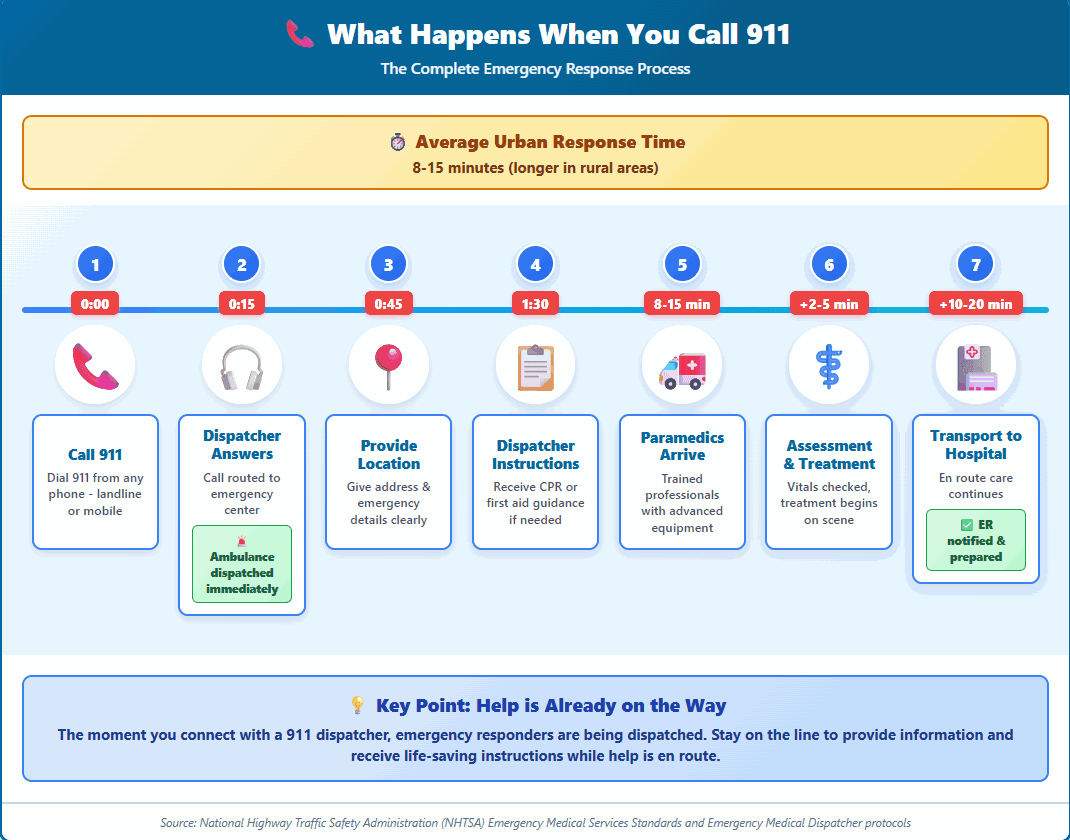
What happens when you call 911, from dialling through dispatcher instructions to paramedics arriving in an average 8 to 15 minutes in urban areas, then assessment, treatment and transport with the ER notified in advance
Dispatcher Instructions
The dispatcher may provide life-saving instructions while you wait, including CPR guidance, how to position the patient, how to control bleeding, or what to prepare before paramedics arrive. Follow these instructions carefully, because dispatchers are trained in emergency medical dispatch protocols. Stay on the line until the dispatcher says it is okay to hang up, or until paramedics arrive and take over care.
While Waiting for the Ambulance
Unlock your doors or send someone outside to flag down the ambulance so paramedics do not waste critical seconds trying to enter. Gather a list of current medications if possible, prepare insurance cards and identification (but do not delay care to search for these), secure any pets that might interfere with treatment, and if someone else is with you, have them watch for the ambulance while you stay with the patient. Our checklist of what to bring to the ER is worth reviewing in advance so this information is ready before an emergency happens.
Common Concerns
Will you be charged for calling 911 if it is not a true emergency? Generally, no, though some jurisdictions charge for ambulance transport. Can you cancel if you realize it is not needed? Yes. Inform the dispatcher,r and they will advise whether responders should still check the situation. Will the police come too? Sometimes, police or fire departments respond to medical calls for safety reasons or if they are closer and can arrive first.
911 dispatchers explain that the information you provide in the first 30 seconds of a 911 call helps them save lives. Tell them exactly where you are, whether the patient is breathing and conscious, and what the emergency is. They will guide you from there. Knowing your local options helps too: browse emergency rooms by state.
The Cost Reality: Ambulance Bills vs Driving
Let us address what everyone worries about: ambulance rides are expensive, often $1,000-$3,000 or more. That is a terrifying number when you are deciding whether to call 911. Here is the perspective you need.
Ambulance costs typically include a base rate of $500-$1,500, mileage charges of $15-$50 per mile, and advanced life support (ALS) service,s adding $500-$1,000. Total costs commonly reach $1,000-$3,000 or higher,e r depending on distance and services provided. Insurance coverage varies significantly by plan and situation.
According to the Centers for Medicare and Medicaid Services (CMS) guidelines, most insurance plans cover ambulance transport for true emergencies based on "medical necessity," meaning whether a reasonable person would believe the situation required emergency medical care. The federal No Surprises Act provides protections against surprise billing for emergency services, including ambulance transport. Out-of-network ambulance services must be covered at in-network rates for genuine emergencies under federal law.
However, compare ambulance costs to the consequences of delayed emergency care. Permanent brain damage from a stroke with delayed treatment costs $150,000 or more in initial care plus lifetime disability expenses exceeding millions. Heart damage from a delayed heart attack costs $100,000 or more initially and significantly shortens lifespan. A fatal outcome from delayed care during a preventable emergency is incalculable.
The brutal calculation: you can negotiate ambulance bills. Payment plans exist through most ambulance services. Financial assistance programs are available. Many EMS agencies offer income-based reductions. What you cannot do is negotiate away death or permanent disability from delayed emergency care when you needed immediate treatment.
If you are hesitating to call 911 for a true emergency due to cost concerns, call anyway. Medical billing specialists can help you manage the bill afterward through payment plans, financial assistance applications, and bill negotiation. You cannot manage being dead or permanently disabled because you tried to save $2,000.
Patient billing advocates who have helped many patients work out ambulance bills note that every one of those patients is glad to be alive to have that bill. Cost is real, but it comes after survival.
Alternative Resources: When NOT to Call 911
Not every urgent situation requires 911. Knowing the alternatives helps you use emergency resources appropriately and get help through the right channels.
Poison Control (1-800-222-1222)
Call Poison Control for ingestions, exposures, poisonings, or overdoses when the person is conscious and stable. Available 24/7, poison specialists provide expert guidance on immediate actions and whether ER care is needed. However, still call 911 if the person is unconscious, having difficulty breathing, having seizures, or showing severe symptoms. Poison Control and 911 can work together, and Poison Control often advises calling 911 for serious cases.
Suicide and Crisis Lifeline (988)
Contact 988 for suicidal thoughts without immediate means or a specific plan, mental health crises, or emotional support during psychiatric emergencies. Trained counselors provide crisis intervention and can dispatch emergency services if needed. However, call 911 immediately if the person has means available, has a specific plan, or is actively attempting suicide. Both resources exist to help. Use whichever matches the immediate danger level.
Nurse Triage Lines
Many insurance plans provide 24/7 nurse hotline numbers (check your insurance card) for guidance on "should I go to the ER?" when you are uncertain about symptom severity. These nurses can assess non-emergency situations and recommend appropriate levels of care. However, these lines are for planning and advice, not for active emergencies. If you are experiencing emergency symptoms, call 911 first.
Urgent Care Centers
Urgent care handles non-life-threatening injuries and illnesses, including sprains, possible minor fractures, lacerations needing stitches, infections, moderate fevers, and minor burns. Use urgent care when you need care today, but it is not an emergency requiring ER capabilities. If you have time to check real-time ER wait times near you, your situation probably is not a 911-level emergency.
Rural and Remote Considerations
In rural areas with longer ambulance response times, still call 911 to notify the EMS system of your emergency, even if you decide to start driving toward the hospital. Paramedics may meet you en route, and hospitals can prepare for your arrival. According to Emergency Medical Services Authority guidelines, coordination with 911 dispatch improves outcomes even when transport distances are significant.
Action Plan: Preparing for Emergencies
**If you are in an emergency right now: ** Use the decision tree from the beginning of this article. When in doubt, call 911, and the dispatcher will help you decide if you are uncertain about the severity.
For future preparation: keep accessible lists of current medications for all family members, known allergies, chronic medical conditions, emergency contacts, insurance information, and primary care physician contact information. Store this information on your phone and in a physical location that everyone knows.
Know your emergency resources before you need them. Identify the nearest ER locations, locate urgent care centers and their hours, save Poison Control (1-800-222-1222) and the Suicide and Crisis Lifeline (988) in your phone, and find your insurance's nurse triage line number.
Teach family members how to call 911 and provide the necessary information; ensure children know your home address; provide basic first aid training; and consider taking a CPR class through the American Heart Association or the Red Cross.
Plan for special situations, including medical alert systems for elderly parents living alone, documented care plans for children with special health needs, and research of emergency resources when traveling.
According to the Joint Commission emergency preparedness standards, consider checking ER wait times when planning (not during emergencies) to learn typical wait times at nearby facilities, identify the closest ERs to your home and work, and plan the fastest routes.
The time to learn about emergency resources is before you need them. But when a crisis strikes, remember: calling 911 is never wrong for a true emergency. Dispatchers would rather you call and not need help than not call when you desperately need it. Your safety matters more than any concern about "bothering" emergency services.
911 vs Driving to the ER: Comparison
| Factor | Call 911 | Drive to ER |
|---|---|---|
| Treatment start time | Immediate (en route) | After arrival at ER |
| Medical capabilities | Advanced life support, medications, cardiac monitoring, defibrillation | None during transport |
| Hospital notification | ER prepared before arrival, teams mobilized | No advance warning, standard triage |
| ER wait time | Bypass waiting room, direct to treatment | May wait depending on triage level |
| Safety during transport | Professional monitoring, interventions if worsening | Risk of collapse while driving, no monitoring |
| Appropriate for | Life-threatening, time-sensitive emergencies | Stable urgent conditions only |
| Typical cost | $1,000-$3,000+ | $0 for transport (ER visit costs apply) |
Always 911 vs Consider Driving: Scenarios
| Symptom or Situation | Call 911 | Consider Driving (with caution) | Never Appropriate to Drive |
|---|---|---|---|
| Chest pain | Yes, any chest pain | No | Driving yourself |
| Stroke symptoms | Yes, FAST signs | No | Any stroke symptoms |
| Difficulty breathing | Yes, any breathing difficulty | No | Gasping or severe shortness of breath |
| Severe bleeding | Yes, uncontrolled bleeding | Controlled minor bleeding | Severe or arterial bleeding |
| Broken bones | Compound fractures, hip, femur, or spine | Simple fractures if stable | Major trauma or multiple fractures |
| Lacerations | Deep cuts, uncontrolled bleeding | Minor cuts with bleeding controlled | Cuts to major vessels |
| High fever | Infants under 3 months | Older children or adults if alert | With confusion or altered consciousness |
| Abdominal pain | Severe with other symptoms | Moderate if stable | Severe with bleeding or pregnancy |
| Head injury | Any loss of consciousness | Minor bumps with full alertness | Loss of consciousness or confusion |
| Allergic reaction | Difficulty breathing, throat swelling | Mild reactions | Anaphylaxis signs |
Based on ACEP emergency care guidelines and AHA emergency response protocols.
Frequently Asked Questions
When should I call 911 instead of driving to the emergency room?
Call 911 for life-threatening emergencies: chest pain, stroke symptoms (FAST: face drooping, arm weakness, speech difficulty), difficulty breathing, unconsciousness, severe bleeding, major trauma, or seizures. Paramedics provide immediate treatment en route and notify hospitals to prepare for your arrival, significantly improving outcomes. When in doubt about severity, always call 911, because dispatchers can help you decide.
Is it faster to drive to the ER or call 911 for an emergency?
For true emergencies, calling 911 is faster and more effective for treatment, even if driving seems quicker. According to NHTSA, paramedics begin life-saving treatment immediately while hospitals prepare for your arrival, reducing door-to-treatment time by 15-30 minutes on average. Ambulances also bypass ER waiting rooms and can navigate traffic safely with lights and sirens.
How much does a 911 ambulance ride cost?
Ambulance rides typically cost $1,000-$3,000+, including base rates ($500-$1,500), mileage charges, and advanced life support services. Most insurance plans cover ambulance transport for true emergencies according to CMS guidelines. Payment plans and financial assistance are available, so never let cost prevent calling 911 for a life-threatening emergency. The consequences of delayed care far exceed ambulance costs.
What happens when I call 911 for a medical emergency?
The 911 dispatcher asks for your location and emergency details while simultaneously dispatching an ambulance, so the questions do not delay the response. They may provide instructions, such as CPR guidance, while you wait. Paramedics typically arrive within 8-15 minutes in urban areas, according to NHTSA standards, assess the patient, begin treatment, and transport the patient to the appropriate hospital while providing continuous care.
Can I cancel a 911 call if I decide it is not an emergency?
Yes. You can inform the dispatcher that the situation has been resolved or is not an emergency, though they may still send responders to verify that everyone is safe. There is typically no charge for canceled calls made in good faith. It is better to call and cancel than not call when help is truly needed.
Should I call 911 if I am not sure it is a real emergency?
Yes. When in doubt, call 911. Dispatchers are trained to assess situations and can advise whether you need an ambulance, should drive to the ER, or can wait for other care. According to ACEP guidelines, it is better to call for guidance than to delay treatment for a genuine emergency. Dispatchers would rather assess non-emergencies than miss life-threatening situations.
Will my insurance cover a 911 ambulance for a non-life-threatening emergency?
Insurance coverage depends on "medical necessity," meaning whether a reasonable person would believe the situation required emergency care. Most plans cover ambulance transport when symptoms suggest a serious emergency, even if it is not ultimately life-threatening. Pre-authorization is not required for genuine emergency calls, according to federal regulations protecting access to emergency care under EMTALA.
What should I tell the 911 dispatcher about my emergency?
Provide your exact location (address, apartment number, landmarks), state whether the patient is conscious and breathing, describe the chief complaint (chest pain, difficulty breathing, injury), mention when symptoms started, and list any relevant medical conditions or medications. Stay on the line, because the dispatcher will guide you and may provide life-saving instructions while help is en route.
Related Reading
- Emergency room vs urgent care: how to choose
- Chest pain: ER or urgent care
- What to bring to the ER
- When to take your child to the ER
For non-emergency situations where you have determined ER care is needed but 911 is not required, check current ER wait times at nearby facilities to help choose which emergency room to visit.
This article is for informational purposes only and is not a substitute for professional medical advice. In an emergency, call 911.