
Emergency Room vs Urgent Care: Which One Do You Need?
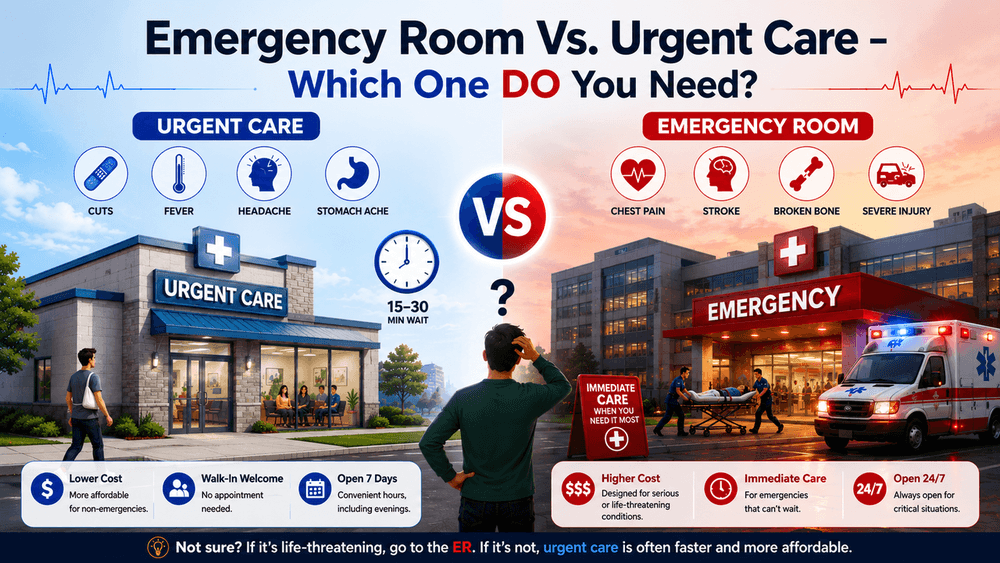
Emergency Room vs Urgent Care: Which One Do You Need?
It is 9:47 PM on a Saturday. You are sitting on your couch with chest tightness that has been building for twenty minutes. Your phone is in your hand, and you have just typed "chest pain emergency room or urgent care" into Google. Forty-seven conflicting answers later, you are more confused than when you started. Choosing correctly in the emergency room vs urgent care decision matters, because the wrong call can mean either hours wasted in a waiting room with a large bill, or a real health risk at a facility without the right equipment to help you.
Or maybe you are standing in your driveway with a child who fell off the playground equipment. There is no blood, but they are crying and will not move their arms. Urgent care is five minutes away. The ER is twenty. And you, not a doctor, have to judge your own child's urgency level and make the call. We are going to make this simple. You will start with one question that clarifies most situations, then use specific symptom guidance for the gray areas.
Key Takeaways
- Ask one question first: "Could this kill me or cause permanent damage in the next hour?" If yes or maybe, choose the ER.
- The ER is open 24/7 and equipped for life-threatening emergencies; urgent care handles non-life-threatening illness and minor injuries, usually 8 AM to 8 PM.
- Urgent care typically costs $100-$300; ER visits run $500-$3,000+ (or $10,000-$30,000+ with admission).
- Chest pain, trouble breathing, stroke symptoms, severe bleeding, and major trauma always mean the ER or 911.
- When you are genuinely uncertain, the ER is the safer choice.
The Quick Decision Framework: Start Here
Before anything else, ask yourself this one question:
"Could this kill me or cause permanent damage in the next hour?"
- YES or MAYBE -> Emergency Room (call 911 if severe)
- NO, but needs medical attention today -> Urgent Care
- NO, can wait a few days -> Primary Care Doctor
Go to the ER Immediately (or Call 911) If You Have:
- Chest pain or pressure, especially with arm pain, jaw pain, sweating, nausea, or shortness of breath. Heart attacks do not always feel dramatic.
- Difficulty breathing or shortness of breath at rest.
- Sudden severe headache, the "worst headache of your life."
- Stroke symptoms, such as sudden weakness, numbness, difficulty speaking, facial drooping, or confusion.
- Major trauma, including a car accident, a significant fall, or a penetrating injury.
- Heavy bleeding that will not stop, such as arterial bleeding or bleeding that soaks through multiple towels.
- Severe burns, larger than your palm, on your face, or third-degree burns.
- Possible broken bone with visible deformity, where you can see the bone or the limb looks wrong.
- Poisoning or overdose, including any suspected poisoning, drug overdose, or toxic exposure.
- Loss of consciousness, even if brief, which needs ER evaluation.
- Severe allergic reaction, such as throat swelling, difficulty breathing, or widespread hives after exposure.
- High fever with severe symptoms, such as a fever over 103°F with stiff neck, severe headache, confusion, or rash. In infants under 3 months, any fever over 100.4°F requires ER evaluation, according to the American Academy of Pediatrics.
If the situation looks severe, do not drive yourself. Our guide on when to call 911 vs go to the ER explains when an ambulance is the right call.
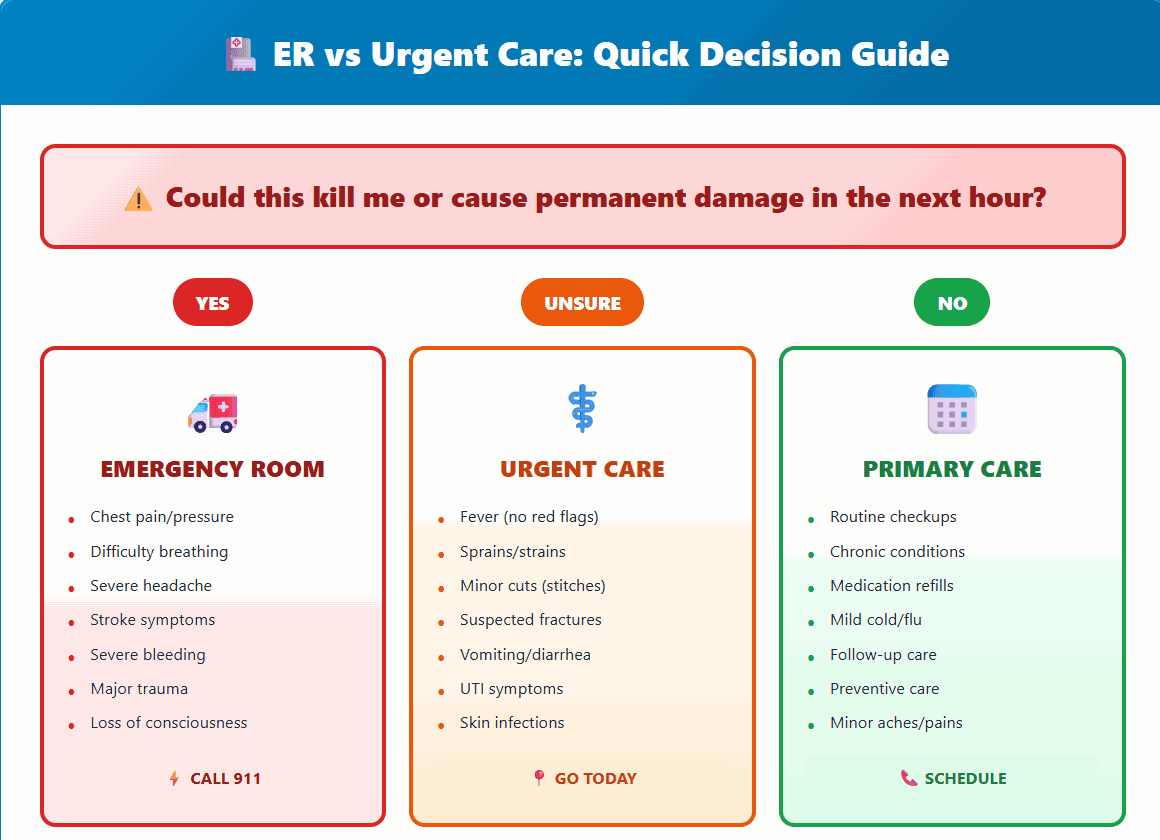
Quick decision guide asking whether a condition could cause death or permanent damage within the hour, routing to the emergency room, urgent care today, or a scheduled primary care visit
Urgent Care Is Appropriate For:
Minor broken bones (fingers, toes), cuts needing stitches (controlled bleeding), moderate burns (smaller than your palm), infections (UTI, ear, sinus, pink eye), rashes without breathing issues, moderate fever without severe symptoms, vomiting and diarrhea with mild dehydration, minor allergic reactions, back pain, cold, flu, or COVID symptoms, strep throat, and minor injuries needing X-rays.
The Gray Area
When you are truly uncertain, the ER is the safer choice. Urgent care doctors can always send you to the ER if needed, but that delays critical care. Emergency physicians regularly see patients who waited too long trying to figure out whether they "really needed" the ER. The guidance they consistently give is simple: if you are genuinely unsure, come to the ER. They would rather check you and send you home than have you guess wrong.
ER vs Urgent Care at a Glance
Here is how the two facilities compare:
| Factor | Emergency Room | Urgent Care |
|---|---|---|
| Hours | Open 24/7 | Typically 8 AM to 8 PM (some 24/7) |
| Best for | Life-threatening or potentially serious conditions | Non-life-threatening illness and minor injuries |
| Capabilities | Advanced imaging (CT, MRI, X-ray), emergency surgery, cardiac catheterization, ICU admission, blood banks, specialists | Basic labs, X-rays, stitches, splinting, IV fluids, rapid strep, flu, and COVID tests |
| Cannot do | Handles essentially all acute care | Surgery, advanced imaging, hospital admission, unstable patients |
| Typical cost | $500-$3,000+ ($10,000-$30,000+ with admission) | $100-$300 |
| After insurance | $250-$500+ copay | $50-$100 copay |
| Typical wait | 15 minutes to 4+ hours, varies widely | 30 minutes to 2 hours |
Understanding What Each Facility Can (and Cannot) Do
Emergency Room Capabilities
Emergency rooms are open 24/7 and equipped for life-threatening situations. They have advanced imaging (CT scans, MRI, X-rays), cardiac catheterization labs, emergency surgery capabilities, ICU admission, and specialists in every field. ERs have blood banks for transfusions, and by law they must evaluate every patient regardless of ability to pay under EMTALA (the Emergency Medical Treatment and Labor Act, a federal law enacted in 1986).
All patient information at both ERs and urgent care facilities is protected under HIPAA (the Health Insurance Portability and Accountability Act), so your medical privacy is maintained across all healthcare settings.
Urgent Care Capabilities and Limitations
Urgent care centers excel at non-life-threatening issues. They typically operate 8 AM to 8 PM, though some run 24/7. They provide basic lab tests, X-rays (not CT or MRI), stitches, splinting, IV fluids, medications, and rapid tests for strep, flu, and COVID.
Critical limitations: urgent care cannot handle life-threatening emergencies, perform surgery, do advanced imaging, or admit patients to hospitals. Most do not accept ambulances and may refuse unstable patients.
Urgent care providers explain that when someone comes in with chest pain, the response is immediate: "You need the ER, we are calling an ambulance right now." If they are wrong, the responsibility is on them, and they do not have the equipment to fix a true cardiac emergency.
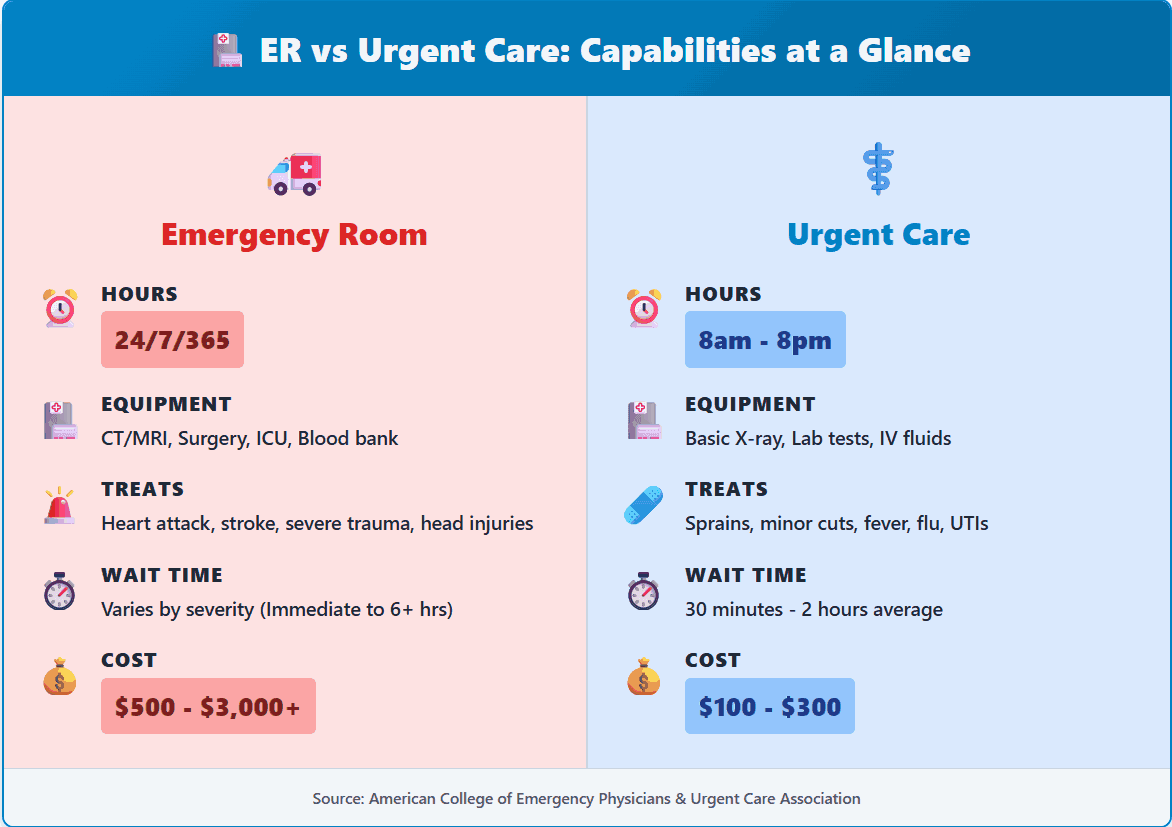
ER versus urgent care capabilities: the ER is open 24/7 with CT, MRI, surgery and ICU at $500 to $3,000, while urgent care runs 8am to 8pm with basic X-ray and lab tests at $100 to $300
Common Conditions: ER or Urgent Care?
Chest Pain
ER: Any chest pain, pressure, or tightness. According to the American Heart Association, heart attacks present with varying symptoms, sometimes just uncomfortable pressure or pain radiating to the jaw or arm.
Urgent Care: Only if you are absolutely certain it is muscular pain from exercise.
Chest pain is the single most common situation people second-guess. For a deeper breakdown, see our guide on chest pain: ER or urgent care.
Abdominal Pain
ER: Severe pain where you cannot stand up straight, sudden onset, lower right quadrant pain (possible appendicitis), or pain with vomiting and fever.
Urgent Care: Mild to moderate pain with no severe symptoms.
Head Injury
ER: Any loss of consciousness, vomiting after injury, confusion, severe headache, or clear fluid from the ears or nose. The CDC reports that traumatic brain injuries require immediate imaging to check for internal bleeding.
Urgent Care: Minor bump with no loss of consciousness and the person acting normally.
Breathing Problems
ER: Shortness of breath at rest, chest tightness, lips turning blue, or severe wheezing not responding to an inhaler.
Urgent Care: Mild asthma flare-up responding to treatment, or a minor respiratory infection.
Cuts and Injuries
ER: Heavy bleeding after 10 minutes of pressure, deep cuts exposing muscle or bone, facial cuts needing plastic surgery, or nerve or tendon damage.
Urgent Care: Cuts needing stitches but with bleeding controlled, minor cuts, or small burns.
Broken Bones
ER: Visible deformity, bone protruding, complete inability to move the limb, or injuries to the spine, skull, pelvis, or femur.
Urgent Care: Suspected broken finger or toe, possible hairline fracture, or an injured ankle you can still walk on.
Fever
ER: Fever over 103°F with stiff neck, severe headache, confusion, rash, or difficulty breathing. Young infants with fever need immediate ER evaluation.
Urgent Care: Moderate fever with typical cold or flu symptoms in otherwise healthy adults.
The Wait Time Factor: When It Matters
For Life-Threatening Emergencies: Do Not Check Wait Times
If you are having chest pain, stroke symptoms, or difficulty breathing, go to the nearest ER or call 911 immediately. ER triage does not work first-come, first-served: the sickest patients get seen first, regardless of arrival time. To understand how that prioritization works, read our overview of emergency room triage.
For Urgent (But Not Emergency) Situations
When the ER is appropriate but not 911-level urgent (a suspected broken finger, a cut needing stitches with controlled bleeding, or kidney stone pain), checking current wait times can save hours of suffering. At 10 PM on a Saturday, Hospital A might have a 45-minute wait while Hospital B has 3 hours.
For non-life-threatening situations where you have decided on the ER, check real-time emergency room wait times near you before leaving home.
Urgent care centers generally have shorter, more predictable waits (30 minutes to 2 hours). Many let you call ahead or use online check-in systems. According to a 2024 study published in the Journal of Emergency Medicine, ER wait times fluctuate dramatically based on time of day, day of week, and season: flu season overwhelms ERs, while nice weekend weather means fewer visits. You can also find an urgent care near you and compare options before you leave.
The Cost Factor: What You Need to Know
An urgent care visit typically costs $100-$300, while ER visits range from $500-$3,000+ (or $10,000-$30,000+ with admission). After insurance, urgent care copays run $50-$100 versus $250-$500+ for ER visits. For a full breakdown of what a visit runs and how to plan for it, see our guide to urgent care costs.
Here is what healthcare providers wish you knew: if you are weighing cost against a potentially serious condition, the "savings" from avoiding the ER can cost vastly more than any medical bill. The person who delays ER care for chest pain and suffers a heart attack faces lifetime cardiac medications, reduced quality of life, and actually higher lifetime healthcare costs.
When Cost Should (and Should Not) Influence Your Decision
Cost is reasonable to consider for clearly minor injuries, such as a sprained ankle from days ago, a minor rash, or cold symptoms. Cost should never be the primary factor for potentially life-threatening symptoms, anything on the "go to ER immediately" list, or when you are genuinely uncertain about severity.
Some insurance plans require pre-authorization for ER visits except for true emergencies, though the No Surprises Act (effective January 2022) provides some protection against surprise balance billing from out-of-network ERs. You can browse emergency rooms and urgent care centers by state to see in-network options near you.
Emergency physicians describe a common and costly pattern: a patient feels chest pressure but delays the ER because of the cost, spends hours trying to convince themselves it is indigestion, and turns out to be having a heart attack. Those lost hours can cause permanent heart damage, and the bill they worried about ends up being nothing compared to losing their career and health.
Special Situations and Gray Areas
After-Hours and Pediatric Considerations
At 11 PM, when primary care is closed and most urgent cares have closed by 8 or 9 PM, your options are the ER or waiting until morning. If symptoms are worsening, do not wait. Many urgent care centers do not treat young children, especially infants under 2. Children's symptoms are harder to assess, and they can deteriorate quickly, so the threshold for ER visits should be lower.
Elderly, Pregnancy, and Chronic Conditions
Older adults have a higher risk for serious complications, and falls are more dangerous due to osteoporosis and blood thinners. Pregnancy complicates everything; when in doubt, call your OB first. For chronic conditions like diabetes with uncontrolled blood sugar, heart disease with new symptoms, or cancer patients with fever, ER evaluation is typically appropriate.
Mental Health Crises
Suicidal thoughts with a plan constitute a medical emergency: go to the ER or call 988 (the Suicide and Crisis Lifeline). Severe panic attacks can mimic cardiac events. When uncertain or when symptoms are severe, the ER is safer.
When Urgent Care Sends You to the ER
This happens regularly. Urgent care providers report sending two or three patients to the ER on a typical shift, usually because a fracture is worse than it first appeared or something concerning shows up on the EKG. They are not passing the buck; they are recognizing when someone needs higher-level care.
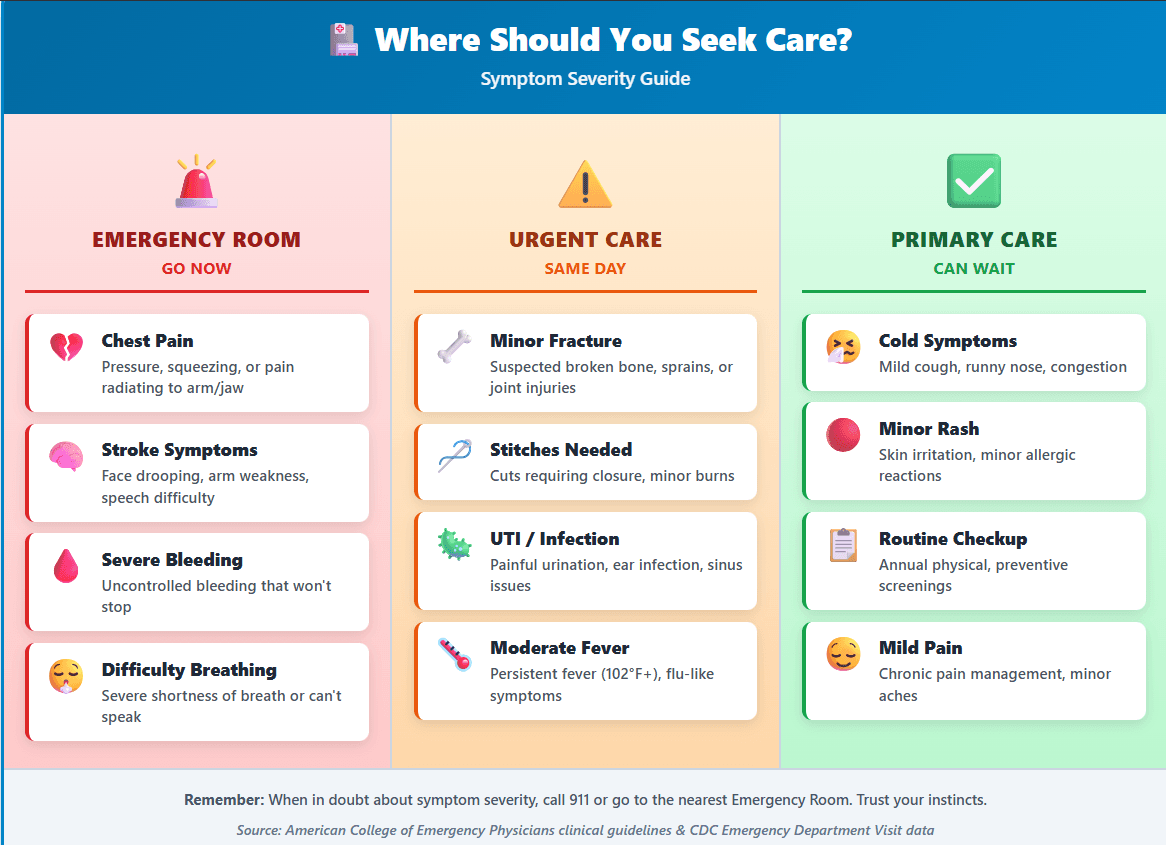
Symptom severity guide: emergency room now for chest pain, stroke signs, severe bleeding and difficulty breathing; urgent care same day for minor fractures, stitches, UTIs and moderate fever; primary care for colds, minor rashes and routine checkups
What to Expect at Each Facility
Urgent Care Process
Walk in or check in online. Registration captures basic information. After a brief wait (15-60 minutes), a nurse checks your vitals. A provider (NP, PA, or physician) evaluates you, runs testing if needed, provides treatment, and gives discharge instructions. Total time is usually 1-2 hours.
ER Process
You arrive by ambulance or as a walk-in. An immediate triage assessment determines priority. You wait based on severity, then move to a treatment area when ready. A physician evaluates you, orders testing, waits for results, treats you, then discharges or admits you. Total time is 2-8+ hours, sometimes longer for admission.
The ER's triage system means sicker patients go first, which is medically necessary but not "fair" in the traditional sense. Bring ID, your insurance card, a medication list, a medical history summary, and a phone charger to either facility. Our checklist of what to bring to the ER covers everything that speeds up your visit.
Making the Choice Under Pressure: The 60-Second Protocol
Step 1 (15 seconds): Is this potentially life-threatening? -> ER. Am I getting worse rapidly? -> ER. Have I been managing this for days? -> Urgent Care.
Step 2 (10 seconds): Is it after 8 PM? -> Options limited, probably ER. Can this safely wait until morning? -> Consider waiting.
Step 3 (15 seconds): Will I need surgery, advanced imaging, or admission? -> ER. Is this straightforward stitches, X-rays, or antibiotics? -> Urgent Care.
Step 4 (10 seconds): Am I genuinely scared? -> ER. Am I annoyed but not worried? -> Urgent Care.
Step 5 (10 seconds): Call your insurance nurse line if available. Check ER wait times if time allows.
When You Are Still Uncertain
Default to the ER. If you are wrong and go unnecessarily, you have wasted time and money, which is annoying but not catastrophic. If you are wrong and skip the ER when needed, you have potentially risked your health or life. That is not an equal trade-off.
Questions to ask: "If this were my child with these symptoms, where would I send them?" "Will I be mad at myself tomorrow if I do not get this checked?" "What is the worst this could be?"
Your primary care doctor often has an after-hours line. Many insurance plans offer 24/7 nurse lines trained in triage. For poisonings, call Poison Control at 1-800-222-1222. For mental health crises, call 988. If you have decided on the ER but it is not a 911 situation, take two minutes to check current ER wait times at nearby hospitals.
Being Prepared: Your Action Plan
Digital Preparation (Do This Today)
Bookmark a real-time wait time tool on your phone. Photograph insurance cards (front and back). Add the nearest ER and urgent care addresses to your phone maps. Save ICE (In Case of Emergency) contacts. Download your insurance app.
Information Gathering (Do This Week)
Find which ERs and urgent cares are in-network. Identify hospitals with specialized services (stroke centers, trauma centers, pediatric ERs). Locate your insurance nurse line number. Get your primary care office's after-hours protocol. Verify urgent care hours and age restrictions.
Document Preparation (Do This Month)
Create a medication list on your phone (names, doses, purposes). List all allergies. Write a brief medical history summary (surgeries, chronic conditions). Add emergency contacts with relationships. Include your blood type if known.
Discuss as a Family
Talk through the protocol before emergencies: "Here is what we do if someone needs medical care." Save a symptom checklist on your phone. Identify decision-makers for children or elderly parents. Have backups for childcare, pet care, and work notification.
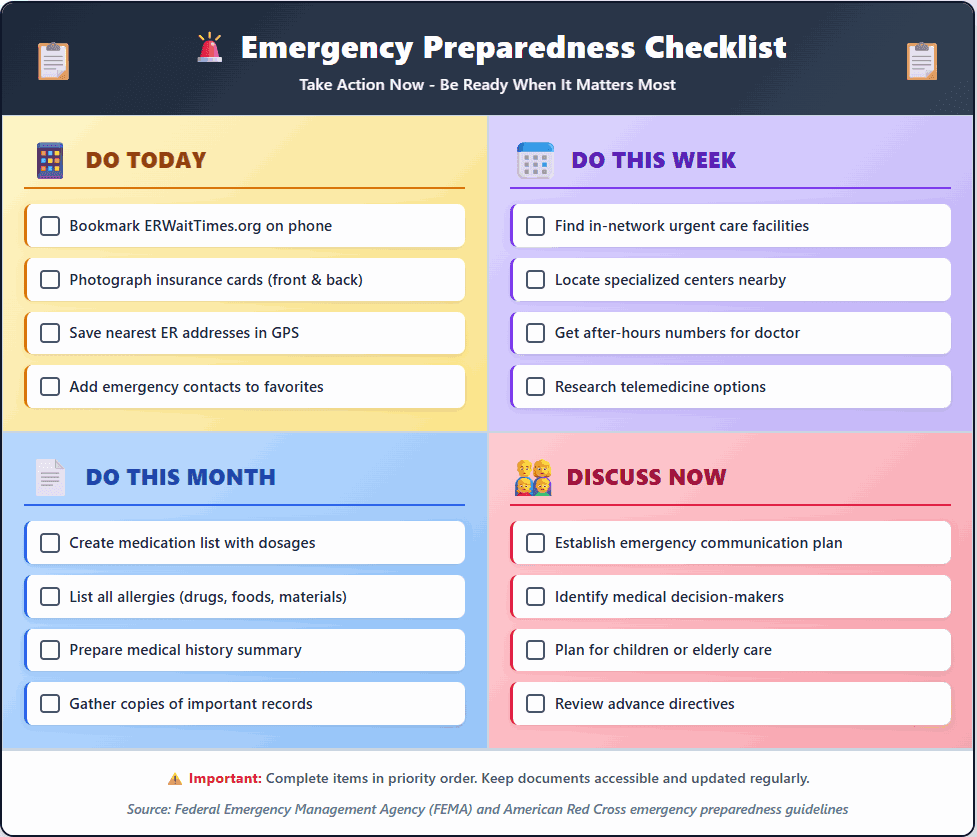
Emergency preparedness checklist grouped by do today, do this week, do this month and discuss now, covering insurance photos, nearby ER addresses, medication lists and advance directives

Decorative section divider
Final Reality Check
You cannot predict emergencies, but you can prepare for them. Know your options before you are in pain or scared. When the moment comes to decide between the ER and urgent care, check wait times if you have a minute, because it might save hours. And remember: when you are genuinely uncertain, the ER is always the safer choice.
You are not bothering anyone by going to the ER if you are truly concerned. You are not overreacting by choosing urgent care for something minor. You are making the best decision you can with the information you have.
Frequently Asked Questions
Should I go to the emergency room or urgent care for chest pain?
Always go to the ER for any chest pain, pressure, or tightness. Heart attacks do not always present dramatically, and urgent care will just send you to the ER anyway, wasting critical time when every minute matters.
How do I know if my symptoms are serious enough for the ER?
Ask yourself: "Could this kill me or cause permanent damage in the next hour?" Red flags include chest pain, difficulty breathing, severe bleeding, stroke symptoms, loss of consciousness, or severe sudden pain. When uncertain, choose the ER.
Can urgent care handle broken bones?
Urgent care can handle minor fractures (fingers, toes, possible hairline fractures) with X-rays and splinting. Go to the ER for visible deformity, bone protruding through skin, major bone fractures (femur, pelvis, spine, skull), or complete inability to move the limb.
Is it okay to go to the ER just to be safe, even if I am not sure I need it?
Yes, absolutely. Emergency physicians would rather see patients with symptoms that turn out fine than miss one serious condition because someone hesitated. Do not use the ER for clearly non-urgent issues, but for acute symptoms where you are uncertain, always err on the side of getting checked.
Should cost influence my decision between the ER and urgent care?
Cost should never be the primary factor for potentially serious conditions, because permanent disability from delayed care vastly outweighs any medical bill. For clearly minor conditions (a sprained ankle from days ago, a minor rash), urgent care is both appropriate and cost-effective, but when uncertain, default to the ER.
How long will I wait at the ER vs urgent care?
Urgent care typically has shorter waits (30 minutes to 2 hours), while ER waits vary dramatically (15 minutes to 4+ hours). For non-life-threatening ER visits, checking current wait times before leaving can save you hours, since one ER might have 45 minutes while another has 3 hours.
What if urgent care sends me to the ER anyway?
This happens regularly because urgent care doctors know their limitations. If symptoms suggest something serious or need capabilities they do not have, they will direct you to the ER. While frustrating, you have received an initial evaluation and triage, and they are protecting your health by recognizing when you need higher-level care.
Can I check ER wait times before I go?
Yes, for non-life-threatening situations where you have decided the ER is appropriate, checking current wait times can save you hours. Never delay care to check wait times for chest pain, difficulty breathing, stroke symptoms, or severe bleeding; just go to the nearest ER or call 911 immediately.
This article is for informational purposes only and is not a substitute for professional medical advice. In an emergency, call 911.