
What to Bring to the ER: Complete Checklist for 2026
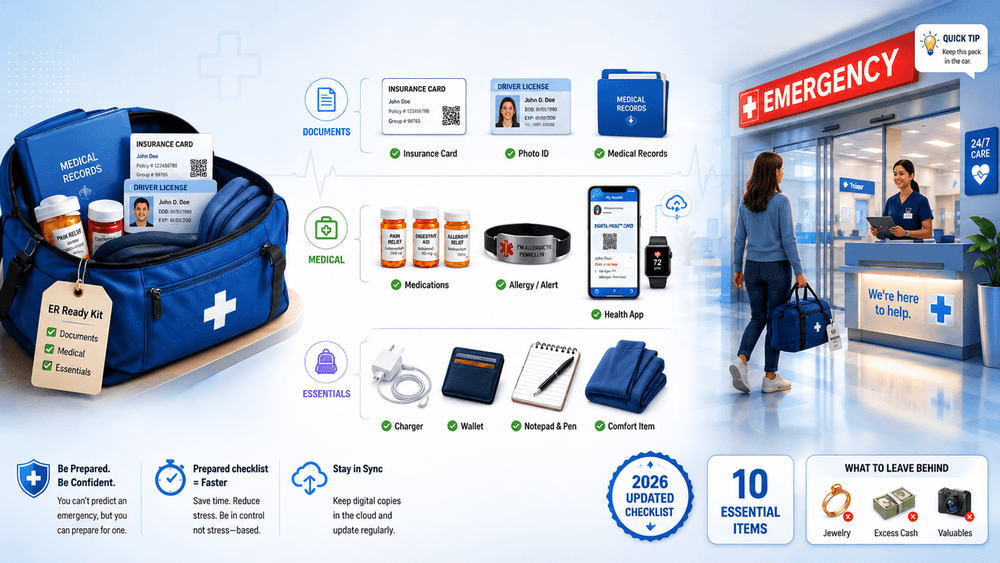
What to Bring to the ER: Complete Checklist for 2026
Your daughter just fell off her bike. There is blood running down her arm. Your hands are shaking as you dump your purse onto the kitchen table: phone, keys, and wallet tumbling out—insurance card. You need your insurance card. Where is it? Should you grab her medical records? A change of clothes? Knowing what to bring to the ER before a crisis hits is the difference between panic and a plan.
Your mind is racing. Your kid is crying. You cannot think straight.
This is the reality of most ER visits. Nobody plans for them. They happen when you are scared, in pain, or watching someone you love hurt. In that moment of panic, you cannot remember what you actually need.
That is exactly why having a plan and a checklist matters. Some ER visits are true emergencies where seconds count. Others are urgent but give you a few minutes to prepare. This guide covers both scenarios.
Before you rush out the door, consider one more thing: not all emergency rooms have the same wait times right now. The hospital five miles away might have a two-hour wait w, while one eight miles away has just 30 minutes. When you have even a few minutes, checking current ER wait times near you can save you hours of waiting.
Key Takeaways
- If it is a true emergency, grab only four things: your phone, wallet (ID and insurance card), phone charger, and a medication list. Then leave immediately.
- For non-critical visits, bring identification, a current list of medications and allergies, your phone and charger, a light jacket, and any essential medical devices.
- Leave valuables, weapons, all your medication bottles, and large bags at home.
- Hospitals are legally required under EMTALA to evaluate and stabilize you regardless of insurance or ability to pay.
- Prepare a digital backup and a pre-packed go-bag now, so you are ready before an emergency happens.
Why an ER Checklist Matters
ER visits do not happen when you are calm and prepared. They happen when you are panicked, when your blood pressure is spiking, when you can barely remember your own phone number. Having a pre-made checklist removes one major source of stress.
But here is the critical distinction: not all ER visits are the same.
True emergencies are situations where every second counts: chest pain, stroke symptoms, severe bleeding, or difficulty breathing. In these situations, you grab your absolute essentials and leave immediately. Do not waste precious time looking for paperwork. If you are unsure whether your symptoms warrant a hospital visit, see our guide on when to call 911 versus going to the ER.
Less urgent situations give you 5 to 10 minutes to prepare: possible broken bones, deep cuts needing stitches, high fever, or severe vomiting. These are serious and need ER attention, but you have time to check wait times, pack properly, and gather documents.
ER nurses note that many people show up not knowing which category they are in. Someone arrives with a twisted ankle from three days ago and rushes in as if it were a heart attack. Understanding the urgency level changes everything about how you prepare.
If you are reading this in crisis mode right now, skip directly to the next section.
The Emergency Room Quick-Grab Essentials
When it is a true emergency and seconds matter, here is what you grab in 30 seconds or less.
Grab these if it is a true emergency:
- Phone (call 911 from the car if needed)
- Wallet (ID and insurance card inside)
- Phone charger
- Medication list (if immediately accessible)
That is it. Do not delay leaving for anything else.
Emergency physicians would rather you arrive alive without your insurance card than delay treatment by three minutes looking for it. Staff can treat you initially without any paperwork. They cannot undo brain damage from a stroke because someone spent five minutes searching for documents.
Hospitals are legally required under EMTALA to evaluate and stabilize all patients regardless of insurance status or ability to pay.
The Complete ER Checklist (For Non-Critical Situations)
When you have time to prepare, bringing the right items can dramatically speed up your ER visit and improve your care. Knowing what to expect from ER wait times also helps you pack for a visit that often runs several hours.
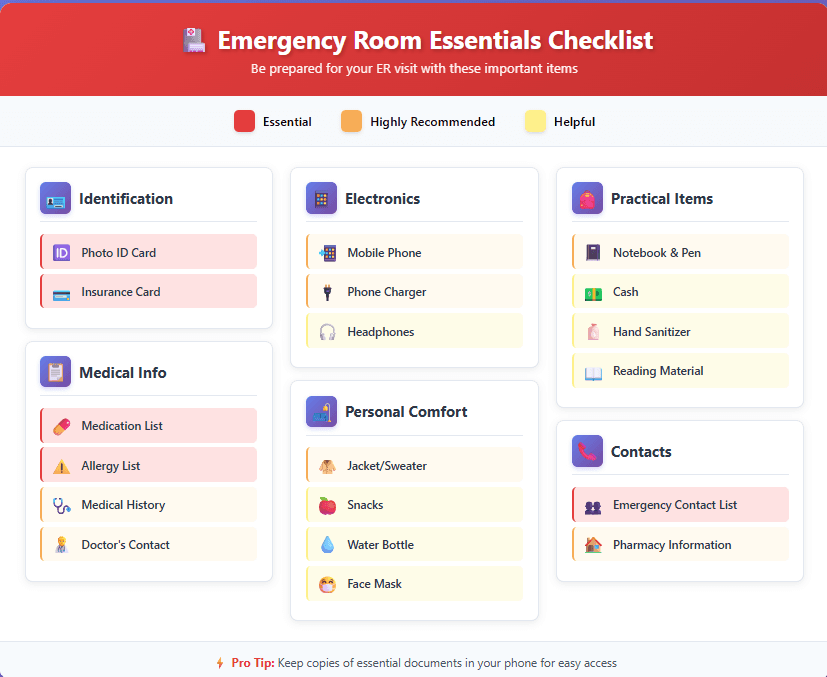
Emergency room essentials checklist grouped as essential, highly recommended and helpful: photo ID, insurance card, medication and allergy lists, phone and charger, notebook, jacket, snacks and emergency contacts
| Category | What to Bring | Why It Matters | Priority |
|---|---|---|---|
| Identification | Driver's license or government ID | Required for registration, treatment authorization | ESSENTIAL |
| Insurance card (front and back) | Speeds up registration, prevents billing delays | ESSENTIAL | |
| Medical Information | Current medication list (names, doses, frequency) | Prevents dangerous drug interactions | CRITICAL |
| List of allergies (medications, foods, latex) | Prevents allergic reactions during treatment | CRITICAL | |
| Medical history summary | Helps doctors make informed decisions | IMPORTANT | |
| Electronic Devices | Phone (fully charged if possible) | Contact family, pass time during wait | ESSENTIAL |
| Phone charger | ER visits often take 3 to 6 hours | HIGHLY RECOMMENDED | |
| Portable battery pack | Outlets may not be accessible | HELPFUL | |
| Personal Comfort | Light jacket or sweater | ERs are typically cold | RECOMMENDED |
| Small snacks (non-perishable) | For long waits (ask before eating) | SITUATION-SPECIFIC | |
| Empty water bottle | Stay hydrated | RECOMMENDED | |
| Practical Items | Small notebook and pen | Track information doctors tell you | HELPFUL |
| Cash in small bills ($20-$40) | Vending machines, parking | HELPFUL | |
| Necessary medical devices | Hearing aids, inhaler, EpiPen | CRITICAL |
Registration staff says the biggest difference is between people who bring a medication list and people who do not. Hand over a typed list with every medication, dose, and frequency, and registration is done in 30 seconds. Say "I take a little white pill for my blood pressure," and the staff can spend ten minutes trying to figure it out.
What Not to Bring to the Emergency Room
- Valuables (jewelry, large amounts of cash, expensive electronics beyond your phone): risk of loss or theft
- All your medications (bring a list instead, or 1 to 2 bottles for reference): risk of loss and confusion
- Weapons (knives, firearms, pepper spray): security will confiscate them, creating delays
- Large bags or suitcases: no space in treatment rooms, cumbersome
- Outside food or drinks (beyond small snacks): you may need to be NPO for procedures
ER security staff report that nearly every week, someone brings a pocketknife they forgot was in their bag. It cannot come in, and now the patient is trying to figure out what to do with it, delaying their care when they are already in pain.
Digital Essentials: What to Have on Your Phone
Your smartphone can serve as your backup insurance card and portable medical record if you prepare it in advance.
Digital ER preparation checklist:
- Photos of insurance cards (front and back, updated annually)
- Photos of your ID (backup in case you forget your wallet)
- Digital medication list (Notes app or health app)
- Emergency contacts with ICE designation
- Medical history document (allergies, conditions, surgeries)
- Primary care doctor contact saved
- Pharmacy contact saved
- Health insurance app downloaded
- ERWaitTimes.org bookmarked
Set up your phone's Medical ID feature (iPhone: Health app; Android: Emergency Information). This information is accessible even when your phone is locked, so ER staff can see critical details if you are unconscious.
Creating Your Personal ER Go-Bag
The single best thing you can do to prepare for unexpected ER visits is to create a dedicated emergency room go-bag: a pre-packed bag stored in an accessible location, ready to grab at a moment's notice.
Go-bag essentials:
- Photocopies of your ID and insurance card
- Printed medication list
- Printed medical history summary
- List of emergency contacts
- Phone charger and portable battery
- Small notebook and pen
- $40 in small bills
- Light jacket
- Hand sanitizer
- Small first aid kit
Consider someone who, after a third ER visit in two years, finally made a go-bag. Now, when the kidney stone pain hits, they just grab it and go. It is one less thing to stress about.
Maintenance: Update medication lists every 3 months, check battery charge every 6 months, and update insurance card copies annually.
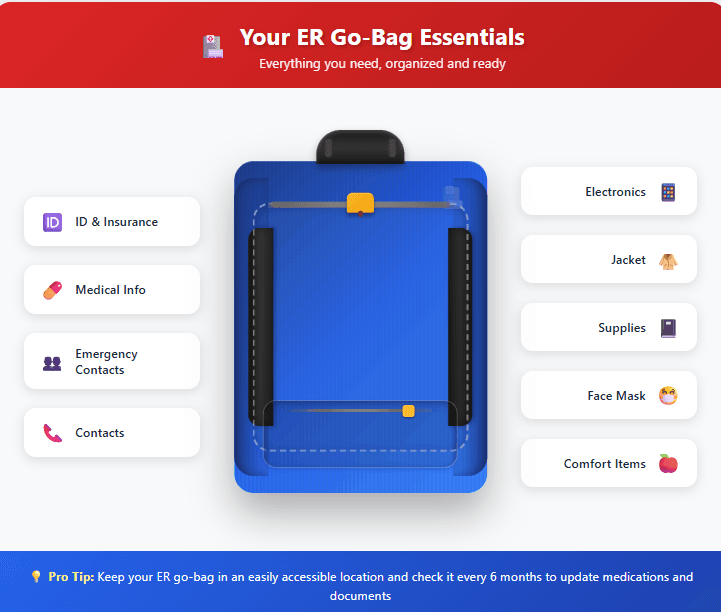
ER go-bag essentials organised into ID and insurance, medical info, emergency contacts, electronics, supplies and comfort items, with advice to check it every 6 months
Special Considerations for Parents and Elderly Patients
For children, add:
- Child's insurance card
- Immunization records
- Favorite comfort item
- Snacks and diapers (if applicable)
- Tablet with downloaded content
For elderly patients, add:
- All medication bottles
- Medical power of attorney documents
- DNR or advance directive (if applicable)
- List of specialists
- Hearing aids and glasses
- Walker or cane
Emergency physicians say that with elderly patients, medication interactions are one of their biggest concerns. They need to know everything a patient is taking before adding anything new.
What the ER Registration Desk Needs Most
Having these 10 pieces of information ready speeds up your visit. It also helps the staff move you through emergency room triage and registration faster.
- Full legal name (as on your ID)
- Date of birth
- Current address
- Best contact phone number
- Insurance information (member ID, group number)
- Reason for visit (brief, specific)
- Primary care physician
- Pharmacy information
- Emergency contact
- Current medications
Registration staff say a prepared patient who walks up, hands over their ID and insurance card together, and has a printed medication list can be checked in within about three minutes. It also helps to browse emergency rooms by state so you know where you are heading before you leave.
Timing Your ER Visit: When to Check Wait Times
Not all ER visits allow planning, but many situations give you 5 to 10 minutes to check options.
When checking wait times makes sense:
- Possible broken bone (painful but stable)
- Deep cut needing stitches
- High fever with other symptoms
- Severe vomiting or dehydration
- Kidney stone pain
Imagine a child falls off the monkey bars with an arm that looks broken but is not in shock. A parent takes two minutes to check wait times, then drives ten minutes farther to an ER with a 30-minute wait, instead of the closer one with a three-hour wait. They are done in 90 minutes total.
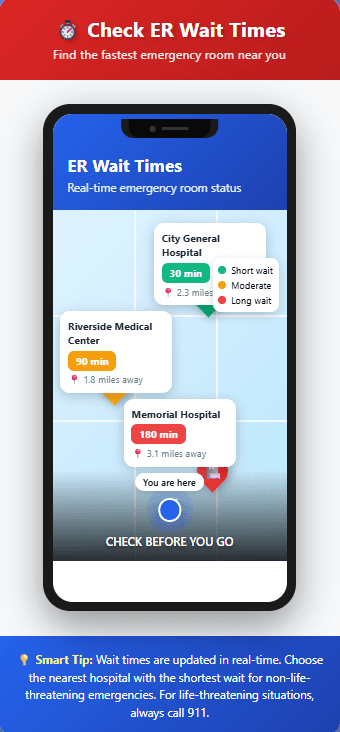
Phone screen comparing nearby emergency room wait times, showing a 30 minute short wait, a 90 minute moderate wait and a 180 minute long wait, with advice to call 911 for life-threatening situations
Check Wait Times Before You Leave Different ERs have different wait times right now. The hospital five miles away might have a two-hour wait, while one eight miles away has just a 30-minute wait. Check real-time wait times at emergency rooms near you before deciding where to go. It could save you hours of waiting.
When not to check wait times, go immediately:
- Chest pain or pressure
- Signs of stroke (facial droop, arm weakness, slurred speech)
- Difficulty breathing
- Severe bleeding that will not stop
- Loss of consciousness
- Severe allergic reaction
In true emergencies, call 911. Do not drive yourself. If you are weighing whether chest pain needs the ER, our guide on chest pain: ER or urgent care explains the warning signs.
Your Action Plan: What to Do Today
- Right now: Add ICE contacts to your phone and bookmark a real-time ER wait time tool.
- This week: Create a digital medication list and photograph your insurance cards.
- This month: Assemble an ER go-bag with essential documents.
- Before you need it: Set reminders to update your information quarterly.
Nobody wants to go to the ER. But if you have to, being prepared turns panic into process. You know what to grab, what information you need, and where to go.
You have got this.
Frequently Asked Questions: What to Bring to the ER
What should I bring if I do not have time to pack?
Grab only four essentials: your phone, wallet (with ID and insurance card), phone charger, and medication list, if immediately accessible. Do not delay leaving for anything else. Hospitals will treat you without complete paperwork.
Can I be treated without insurance or my insurance card?
Yes. Federal EMTALA law requires ERs to evaluate and stabilize all patients regardless of insurance or ability to pay. However, bringing insurance information speeds up registration. You can provide details later if needed.
Should I bring all my medication bottles?
No. Bring a written list instead. If needed for reference, bring only the 1 to 2 most important bottles. Exception: always bring critical rescue medication, such as inhalers, EpiPens, or insulin, that you might need immediately.
Can I bring my own food and drinks?
You can bring small snacks, but ask the triage nurse before eating anything. Depending on your condition, you may need to be NPO (nothing by mouth) for procedures. Eating when you should not can delay treatment by 6 or more hours.
Should I bring someone with me?
If possible, yes, especially if you are in significant pain, elderly, or bringing a child. A support person can advocate for you and remember instructions. However, many ERs limit visitors to one person due to space and infection control.
How do I create a medication list if I do not know all my medications?
Check your pharmacy's website or app, since most show your active prescriptions with doses. Alternatively, call your pharmacy and ask them to print or email your current medication list. Include over-the-counter medications and supplements,s too.
What if I forgot something important after I am already at the ER?
Tell registration staff or your nurse immediately. They can often contact your pharmacy or doctor for critical information. Do not leave the ER to retrieve items, as you will lose your place. Send someone else if possible.
Is it better to keep an ER go-bag at home or in my car?
It depends on your situation. At home, near the front door, it works if most ER trips start from home. In your car works if you are often out when emergencies happen. The best solution is a primary go-bag at home, plus a smaller car kit with copies of documents.
What should I put in my phone's emergency contact section?
Add at least two ICE contacts, each with a full name, relationship, and phone number. Use your phone's Medical ID feature to include allergies, chronic conditions, current medications, blood type, and emergency contacts, all accessible even when your phone is locked.
This article is for informational purposes only and is not a substitute for professional medical advice. In an emergency, call 911.