
Urgent Care Costs: What to Expect & How to Save Money
Urgent Care Costs: What to Expect & How to Save Money
Urgent care costs typically range from $150 to $500 per visit, depending on the treatment you need and your insurance status. Knowing what to expect helps you avoid bill shock and find the most affordable option before you walk in the door.
Rachel pulled into the parking lot with a throbbing wrist after a fall during her morning run. Her insurance deductible had reset in January, and she had not met it yet. Would this visit cost $100 or $500? Questions like hers are exactly why understanding urgent care costs matters.
Key Takeaways
- Without insurance, a basic urgent care visit runs $150-$200; add an X-ray and it climbs to $300-$500, or $250-$400 with lab work.
- With insurance, expect a $25-$75 copay, or the full negotiated rate of $150-$350 before your deductible is met.
- Ask about self-pay discounts upfront: most centers offer 15-30% off for uninsured patients who pay the full amount on the same day.
- Urgent care costs 3-10 times less than the ER for the same conditions, making it the smarter choice for non-emergencies.
This guide breaks down real pricing, explains why bills differ so much, and gives you concrete strategies to reduce what you pay. Whether you have insurance or not, finding urgent care near you and comparing wait times before you go saves both time and money.
What You'll Pay: Typical Urgent Care Costs in 2026
Basic urgent care visits cost $150 to $200 for patients paying out of pocket. That covers the facility fee, provider examination, and basic consultation. Add diagnostic tests or procedures, and your bill climbs quickly.
Insured patients with low copays fare better. HMO plans typically charge $25 to $50 copays. PPO plans run from $35 to $75. High-deductible plans often require you to pay the full cost until you meet your deductible, usually $1,500 to $3,000 for individuals.
The median urgent care visit costs $171 for self-pay patients, but 25% of visits cost more than $265 and 10% exceed $400 when diagnostic services are included. (Urgent Care Association, 2025)
Services beyond the basic exam drive cost more. X-rays add $100 to $250 per view. Lab tests range from $25 to $150 depending on complexity. Procedures like stitches, splinting, or IV fluids can double or triple your total bill.
Location matters significantly. Urban coastal facilities charge 25-40% more than rural Midwest clinics. A basic visit in San Francisco averages $215. The same visit in rural Kansas costs $145.
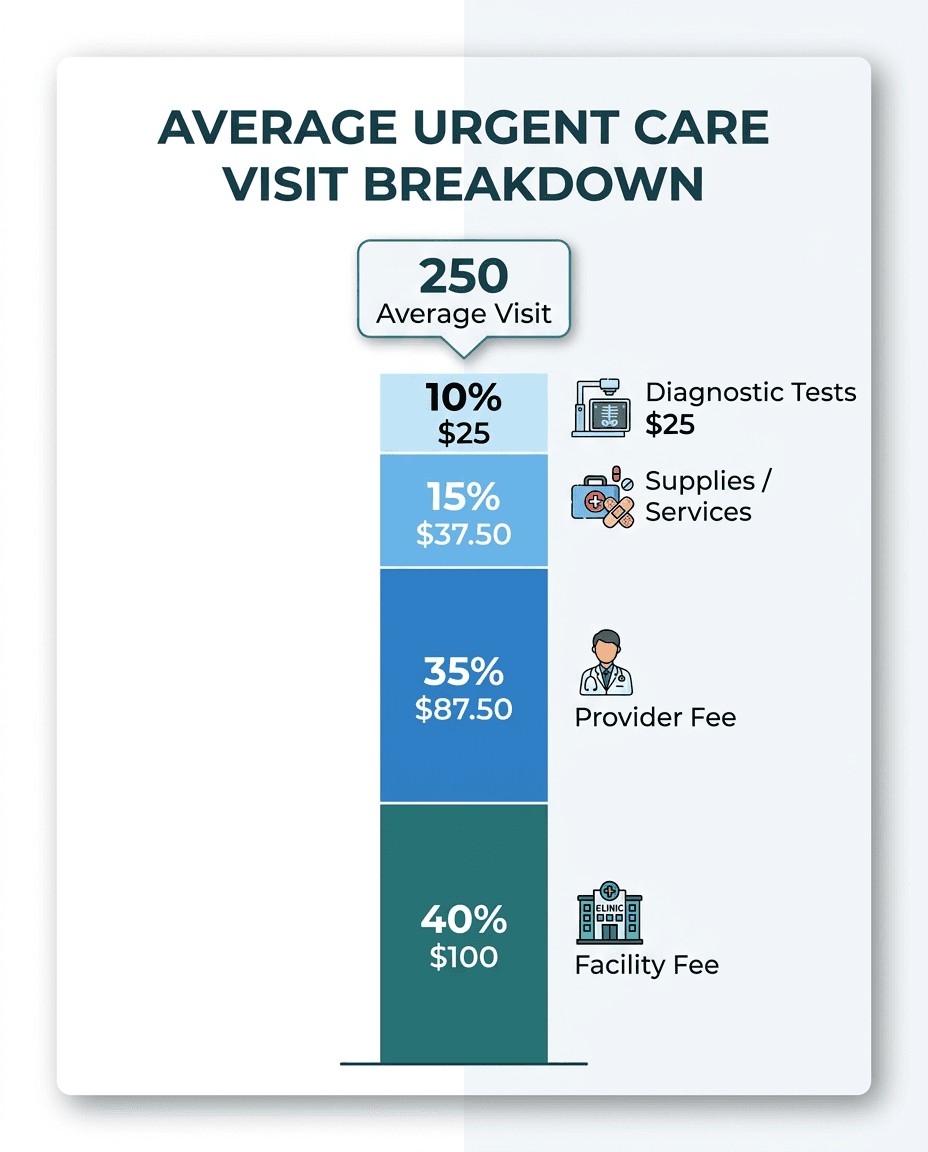
Bar chart breaking down an average $250 urgent care visit: 40 percent facility fee at $100, 35 percent provider fee at $87.50, 15 percent supplies and services at $37.50 and 10 percent diagnostic tests at $25
Why Your Urgent Care Bill Might Surprise You
Pricing opacity creates confusion. Most facilities do not post complete price lists online. You often will not know your total cost until after treatment ends. This lack of transparency makes comparison shopping difficult.
Insurance complexity adds another layer. Your explanation of benefits (EOB) arrives weeks later, showing negotiated rates, allowed amounts, and your responsibility. The initial bill rarely matches what you ultimately owe.
Bundling practices differ between clinics. Some charge one comprehensive fee. Others itemize everything: the room, the provider, medical waste disposal, and even the bandage. These billing philosophies create wide price variations for identical care.
Corporate chains versus independent clinics show different patterns. Chains often have standardized pricing but higher base rates. Independent practices sometimes offer more flexibility and lower costs, especially for self-pay patients willing to negotiate.
The time of visit can affect costs at some facilities. A few clinics charge premium rates for evenings, weekends, or holidays. Always ask if timing impacts the price before agreeing to treatment.
Urgent Care Costs Without Insurance: The Real Numbers
Consider a common scenario for someone who has just lost employer health coverage. A few weeks later, their child develops a fever and sore throat and needs a strep test, with no clear sense of what it will cost.
Many people in this position expect to pay maybe $100. But the strep test is often billed as an extra, along with the prescription, and these charges are rarely explained up front. A visit like this might be billed at $287. Paying immediately can qualify for a 20% cash discount, bringing the total down to $230.
Self-pay patients face higher sticker prices than insured patients for the same services. Clinics often inflate list prices,s knowing insurance companies negotiate down. Uninsured people see those inflated rates unless they ask specifically about self-pay discounts.
Common scenarios for patients without insurance:
- Sore throat with strep test: $175-$250 total
- Minor cut requiring stitches: $300-$500
- Sprained ankle with X-ray: $400-$600
- Respiratory infection with breathing treatment: $275-$425
Most centers offer 15-30% discounts for uninsured patients who pay in fullon the same dayy. Some facilities provide sliding scale fees based on income. Others operate charity care programs that can reduce bills by 50-100% for qualifying patients.
Membership programs present another option. Pay $50-$150 annually and receive 20-40% off each visit. These work well for families with kids who need frequent care. For detailed pricing when you do not have coverage, see our comprehensive guide on how much urgent care costs without insurance.
How Insurance Affects Your Final Bill
Insurance changes everything about urgent care pricing. Your out-of-pocket cost depends on your plan type, deductible status, copay amount, and the facility's network status.
In-network versus out-of-network makes a huge difference. In-network visits cost you just the copay after you meet your deductible. Out-of-network visits might require 30-50% coinsurance plus the full charge until you hit your out-of-network deductible.
Deductible timing matters tremendously. Early in the calendar year, before meeting your deductible, you pay the full negotiated rate, typically $150-$350 for basic visits. After meeting your deductible, you pay only the copay.
Plan types show distinct patterns:
- HMO plans: $25-$50 copay, strict network requirements
- PPO plans: $35-$75 copay, more flexibility
- High-deductible plans: $50-$100 copay or full cost until deductible met
- Medicare Advantage: Usually $35-$65 copay
Coverage details vary by carrier, so it pays to confirm your benefits ahead of time. If you are insured through one of the big national plans, our guide to how Blue Cross Blue Shield covers urgent care walks through copays and network rules.
Insurance explanation of benefits statements arrive 2-4 weeks after the visit. They show what the clinic charged, what insurance approved, what they paid, and what you owe. These amounts rarely match the estimate you received at checkout.
Cost Breakdown: Common Visits and Procedures
Minor Illness Visits (Cold, Flu, Strep)
Basic illness visits cost $150-$200 without insurance and a $25-$75 copay with insurance. Rapid diagnostic tests add $25-$60 each. Prescriptions written during the visit are separate; you pay at the pharmacy.
Flu testing runs $30-$60. Strep throat rapid tests cost $25-$50. COVID-19 tests may be free or $25-$75 depending on the clinic and your insurance. Most facilities can tell you the test costs before performing the tests if you ask.
Injury Treatment (Cuts, Sprains, Minor Burns)
Injury evaluation starts at the basic visit fee plus procedure costs. Simple laceration repair costs $150-$300 for suturing, plus supplies ($20-$40). Complex repairs requiring multiple layers can reach $400-$600.
Sprains require examination plus potential imaging. Without X-rays, expect $175-$250. With X-rays, total costs jump to $350-$550. Splinting or soft casting adds another $75-$200.
Minor burns typically need only examination and wound care supplies, totaling $175-$275. Severe burns requiring specialized dressings or referral cost more, in the $300-$450 range.
Diagnostic Services (X-rays, Lab Tests)
X-rays represent the biggest cost driver at urgent care. Single-view X-rays cost $100-$250. Multiple views run $200-$400. Chest X-rays typically fall on the lower end while extremity X-rays with multiple angles cost more.
Laboratory testing varies widely:
- Urinalysis: $25-$75
- Complete blood count: $50-$100
- Basic metabolic panel: $75-$150
- Pregnancy test: $15-$35
- Drug screening: $50-$150
Most labs are sent to outside facilities, with results available in 24-48 hours. Point-of-care tests performed on-site cost slightly more but deliver immediate results.
Specialized Treatments (Stitches, IV Fluids, Casts)
Advanced procedures push bills substantially higher. IV fluid administration for dehydration costs $150-$300 per bag plus the visit fee. Breathing treatments run $75-$150 each. EKGs add $75-$150.
Casting and splinting vary by complexity. Simple finger splints cost $75-$125. Full-arm or full-leg casts run $150-$300. Removal and replacement at follow-up visits typically cost 50% of the initial application fee.
Medications administered on-site carry separate charges. Toradol injections for pain cost $25- $50. Steroid injections range $50-$125. Prescriptions you fill elsewhere are not included in these totals.
Cost Comparison by Insurance Status
| Service Type | With Insurance (Copay) | With Insurance (Before Deductible) | Without Insurance (Full Price) | Without Insurance (With Discount) |
|---|---|---|---|---|
| Basic consultation | $25-$75 | $150-$250 | $150-$200 | $105-$140 |
| Strep throat test + visit | $35-$75 | $175-$275 | $175-$250 | $125-$175 |
| Minor cut with stitches | $50-$100 | $250-$450 | $300-$500 | $210-$350 |
| Sprained ankle + X-ray | $50-$100 | $350-$550 | $400-$600 | $280-$420 |
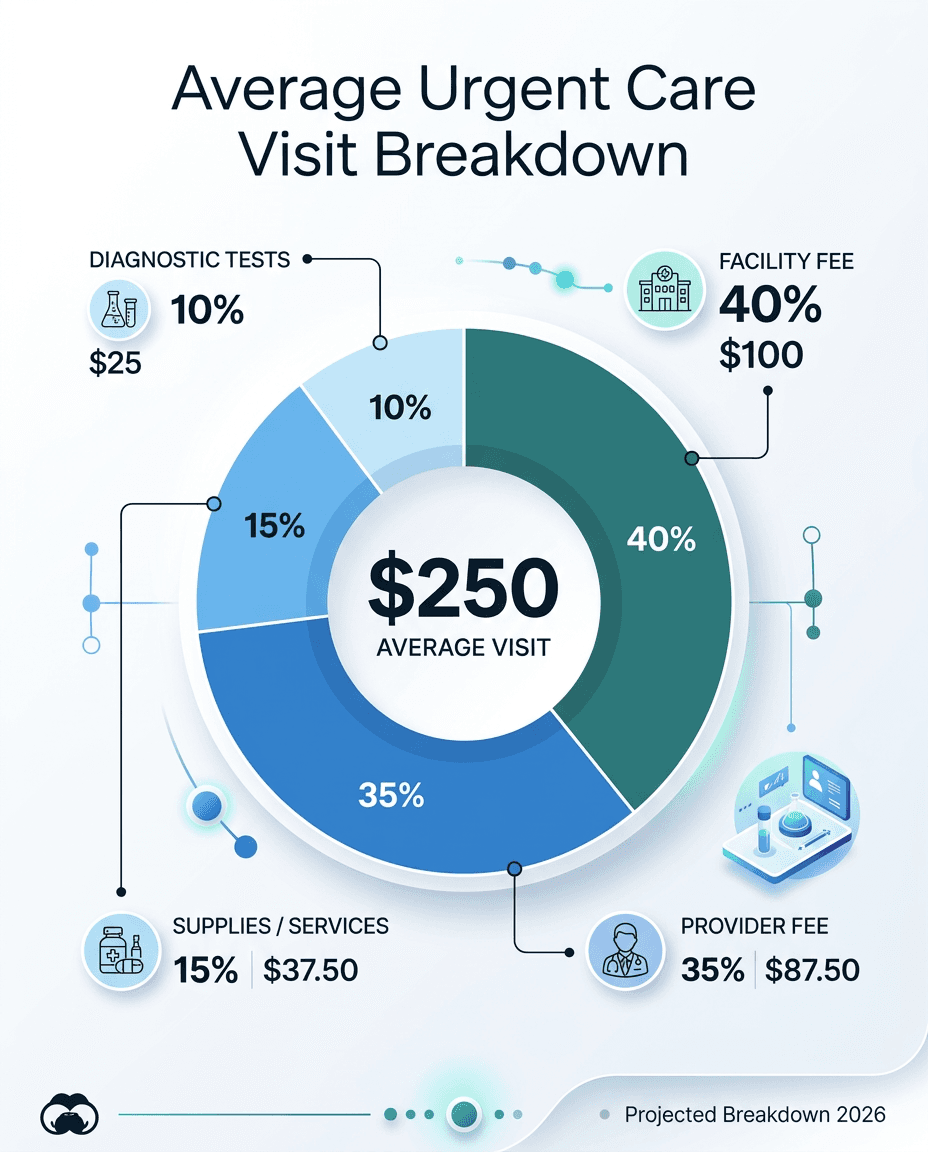
Donut chart of an average $250 urgent care visit split into facility fee 40 percent, provider fee 35 percent, supplies and services 15 percent and diagnostic tests 10 percent
Seven Proven Ways to Lower Your Urgent Care Costs
Strategy 1: Ask About Self-Pay Discounts Before You're Seen
Request cash pricing at check-in, before any treatment begins. Most facilities offer 15-30% off immediately if you pay the full amount the the same day. This single question can save you $50-$150 on a typical visit.
Tell the receptionist: "I'm paying out-of-pocket today. What self-pay discounts do you offer?" Some clinics require you to ask explicitly; they will not volunteer the information. Get the discounted price in writing if possible.
Barriers: You need to pay immediately, usually in cash, by debit card, or by credit card. Payment plans typically do not qualify for maximum discounts.
Strategy 2: Use Price Comparison Tools
Check prices at multiple facilities before choosing where to go. Healthcare Bluebook and Fair Health Consumer provide cost estimates by ZIP code. Some clinics now post prices on their websites; compare at least three options.
Call facilities directly and ask: "What's your self-pay rate for a level-2 visit with a strep test?" Get specific. Vague questions yield vague answers. It is like asking "How much is a car?" You need details to get useful information.
Potential savings: 20-50% by choosing lower-priced facilities. A service costing $400 at one clinic might cost $250 at another three miles away.
Strategy 3: Time Your Visit Strategically
Some clinics charge premium rates during evenings, weekends, or holidays. If your condition allows it, visit Tuesday through Thursday during daytime hours. Ask whether timing affects pricing when you call ahead.
Using wait time tools to find urgent care with shorter delays saves money indirectly. Long waits waste your time and may push you toward an expensive ER if your condition worsens while waiting.
Savings: $25-$75 by avoiding premium-rate time slots. More importantly, you avoid the $1,000+ ER bill you would face if delays force you to seek emergency care.
Strategy 4: Negotiate Bills After Service
Call the billing office within 30 days of your visit. Explain your financial situation. Ask: "Can you reduce this bill or offer a payment plan?" Many facilities will discount 10-25% just for asking, especially if you can pay immediately.
Script: "I received a bill for $385. I'm paying out of pocket, and this is a significant burden. Can we discuss reducing this amount or setting up a payment plan?"
Success rate improves if you are pleasant, persistent, and willing to pay something immediately. Many providers offer a prompt-pay discount. Offering to settle quickly, for example paying within 48 hours, can sometimes reduce a bill by 15 to 30 percent.
Strategy 5: Enroll in Payment Plans (Usually Interest-Free)
Most urgent care centers offer payment plans spanning 3-12 months with 0% interest if arranged upfront. Expect to pay 10-25% down and set up automatic monthly payments. This does not reduce your total cost but makes it manageable.
Some facilities offer small discounts (5-15%) for enrolling in payment plans within 30 days. Ask specifically: "Do you offer any discount if I set up a payment plan today?"
Requirements: A credit check may apply for plans over $500. You will need bank account information for automatic withdrawals.
Strategy 6: Check for Charity Care Programs
Nonprofit urgent care facilities and hospital-owned clinics often operate charity care programs. If your income falls below 200-300% of the federal poverty level, you might qualify for a 50-100% bill reduction.
The application process takes 2-6 weeks. You will provide pay stubs, tax returns, or other income documentation. Approval is retroactive, so apply even if you have already received your bill. Learn more about paying for urgent care without insurance options.
Potential savings: Hundreds to thousands of dollars. One patient with a $780 bill paid $0 after charity care approval.
Strategy 7: Consider Urgent Care Membership Programs
Some clinics offer annual memberships ($50-$150/year), providing 20-40% off each visit. These work best for families with frequent minor illnesses or people with chronic conditions requiring regular monitoring.
Math check: If you visit urgent care 3-4 times yearly, a $100 membership saving you $50 per visit ($200 total) covers the membership fee and saves you $100. For single visits, memberships do not make financial sense.
Cost-Saving Strategies Comparison
| Strategy | Potential Savings | When to Use | Requirements |
|---|---|---|---|
| Self-pay discount | 15-30% | Before treatment | Pay same-day, full amount |
| Payment plan | 5-15% discount | After treatment | Credit check may apply |
| Charity care | 50-100% | Income-based | Proof of income required |
| Membership program | 20-40% per visit | Frequent users | Annual fee $50-$150 |
| Price comparison shopping | Varies widely | Before choosing facility | Time to research |
| Negotiation | 10-25% | After receiving bill | Persistent communication |
Finding Affordable Urgent Care Near You
Price transparency varies dramatically between facilities. Corporate chains like CityMD and GoHealth sometimes post pricing online. Independent clinics rarely do. You will need to call and ask directly about costs.
Questions to ask when calling:
- "What's your self-pay rate for a level-2 visit?"
- "Do you offer same-day payment discounts?"
- "What's your current wait time?"
- "Are X-rays and labs included or separate charges?"
Geographic differences matter. Shopping for urgent care is like shopping for gas: prices can vary 30% within a five-mile radius for the same service. The clinic next to the mall charges more than the one in a strip center three miles away.
Using price comparison tools before your visit can save uninsured patients $75-$200 per visit by identifying lower-cost nearby facilities.** (Kaiser Family Foundation, 2025)
Check real-time wait times at nearby facilities before heading out. Some clinics let you reserve a spot online or via app. This prevents wasted trips to facilities with 90-minute waits, saving you time and potential complications.
Community health centers provide affordable alternatives. They charge sliding-fee scales based on income, often $25- $75 per visit for uninsured patients. Find them through HRSA's health center locator.
Illustration of an urgent care center building surrounded by cost and billing icons
When Urgent Care Saves You Money (vs. ER or Primary Care)
Urgent care occupies the middle ground between primary care and emergency rooms, both in capability and cost. Choosing the right setting prevents overpaying for routine care or underpaying for true emergencies. Our guide on emergency room vs urgent care explains exactly which conditions belong where.
Emergency rooms cost 3-10 times as much as urgent care for identical conditions. A strep test costs $175 at urgent care versus $900-$1,800 at the ER (Health Care Cost Institute, 2025). ERs charge facility fees starting at $500 before any treatment.
Primary care costs less than urgent care when available. A sick visit with your regular doctor runs $100-$180 versus $150-$200 at urgent care. But primary care requires appointments, which are often impossible for same-day needs.
Choose urgent care when:
- You need care within 2-4 hours, but it is not life-threatening
- Your primary doctor cannot see you today
- You need the services urgent care provides: X-rays, stitches, IV fluids
- Cost matters, and you want to avoid ER pricing
- It is evening or weekend, and primary care is closed
Skip urgent care for the ER when:
- Chest pain or difficulty breathing
- Severe injuries with heavy bleeding
- Suspected stroke or heart attack symptoms
- Loss of consciousness
- Severe allergic reactions
Understanding what urgent care treats helps you choose the right option. Most facilities handle minor fractures, lacerations, infections, asthma attacks, and common illnesses. They cannot handle major trauma, heart attacks, or strokes.
Frequently Asked Questions About Urgent Care Costs
How much does an urgent care visit cost on average?
The average cost of an urgent care visit is $150-$200 for uninsured patients and a $25-$75 copay for insured patients. Costs increase to $300-$600 if you need X-rays, lab tests, or procedures like stitches. Check real-time pricing and wait times at facilities near you before choosing where to go.
Is urgent care expensive without insurance?
Urgent care without insurance costs significantly less than emergency room care but more than primary care. Basic visits run $150-$200, which is manageable for many people compared to $800-$1,500 ER visits. Most facilities offer 15-30% self-pay discounts if you ask upfront and pay the same day.
Do urgent care centers accept walk-ins without insurance?
Yes, all urgent care centers accept walk-ins regardless of insurance status. You do not need insurance or even identification to receive treatment, though you will need to pay. Many facilities offer payment plans and charity care programs for uninsured patients who cannot pay the full amount immediately. You can compare urgent care options near you in real time before you go.
What's the cheapest urgent care option near me?
The cheapest option varies by location and your insurance status. Community health centers typically offer the lowest rates ($25- $75 on sliding scales). Among traditional urgent care facilities, independent clinics often charge less than corporate chains. Call 3-4 nearby facilities and compare their self-pay rates for basic visits.
Can I get a discount if I pay cash at urgent care?
Yes, most urgent care centers offer 15-30% discounts for cash or debit card payments made in full at the time of service. Always ask: "What's your self-pay discount for paying today?" before treatment begins. Some facilities require you to request this explicitly; they will not offer it automatically.
Does urgent care cost less than the emergency room?
Yes, urgent care costs dramatically less than emergency rooms for the same conditions. Urgent care visits average $150-$400 while ER visits start at $800 and often exceed $2,000 for minor conditions. ERs charge facility fees of $500+ before any treatment, making urgent care the better financial choice for non-emergencies.
Will urgent care give me if I don't have insurance?
Yes, you will receive a bill whether you have insurance. Without insurance, you can pay at the time of service (often with a discount) or receive a bill by mail 1-2 weeks later. Paying immediately usually qualifies you for 15-30% discounts. If you cannot pay in full, ask about payment plans before leaving the facility.
How can I find urgent care prices before I go?
Call facilities directly and ask for their self-pay rates for specific services. Use online tools like Healthcare Bluebook (healthcarebluebook.com) or Fair Health Consumer (fairhealthconsumer.org) for cost estimates. Some clinics post prices on their websites. Comparing prices at 3-4 facilities helps you find the best value in your area.
Take Control of Your Healthcare Spending
Urgent care costs do not need to be a mystery. Armed with information about typical prices, insurance effects, and money-saving strategies, you can make informed decisions about where to seek treatment.
Remember these key points:
- Basic urgent care visits cost $150-$200 without insurance, $25-$75 copay with insurance
- Self-pay discounts of 15-30% are available at most facilities, just ask
- Comparison shopping can save you $75-$200 per visit
- Payment plans, charity care, and negotiation all offer ways to reduce bills
- Urgent care saves you $700-$1,400 compared to ER visits for non-emergencies
Take action before you need urgent care. Research facilities in your area. Save phone numbers and pricing information. Know which clinics offer the best combination of cost, convenience, and quality. This preparation pays off when illness or injury strikes unexpectedly.
Ready to find affordable care? Compare urgent care costs and wait times at facilities near you on ERWaitTimes.org. See pricing estimates and availability before you leave home.
This article is for informational purposes only and is not a substitute for professional medical advice. In an emergency, call 911.