
Blue Cross Blue Shield Urgent Care: Complete Coverage Guide (2026)
Blue Cross Blue Shield Urgent Care: Complete Coverage Guide
QUICK ANSWER: Yes, Blue Cross Blue Shield covers urgent care visits for medically necessary treatment. Here's what you'll typically pay in 2026:
Common BCBS Urgent Care Copays:
- PPO plans: $35-$75 copay for in-network urgent care
- HMO plans: $25-$50 copay (may require network use)
- EPO plans: $35-$65 copay for in-network only
- High-deductible plans: Full cost until deductible met, then 20-30% coinsurance
Important Details:
- No referral required for most BCBS plans (check HMO exceptions)
- In-network urgent care centers provide the lowest costs
- Out-of-network coverage varies by plan; PPO plans typically cover at reduced rates
- Coverage applies nationwide for most BCBS plans
- X-rays, lab tests, and procedures may have additional costs beyond your copay.
Before you go: Check your specific plan details in your member portal or call the number on your insurance card. Copays and coverage can vary significantly between BCBS plans and states.
Coverage details are current as of March 2026. Verify benefits with your specific BCBS plan.
Maria's six-year-old woke up Sunday morning with a 103-degree fever. Her pediatrician's office was closed, and the ER seemed excessive for flu symptoms. She wondered whether her Blue Cross Blue Shield urgent care coverage would apply, and what she'd actually pay at the clinic down the street.
Understanding Blue Cross Blue Shield urgent care benefits helps you get care when you need it without billing surprises. Your specific coverage depends on your plan type, whether facilities are in-network, and what services you receive. Most BCBS members pay $25 to $75 for urgent care visits, but the details matter significantly.
This guide breaks down exactly how your BCBS plan covers urgent care. We'll cover copays, network requirements, and how to maximize your benefits while avoiding unexpected costs.
How Blue Cross Blue Shield Covers Urgent Care Visits
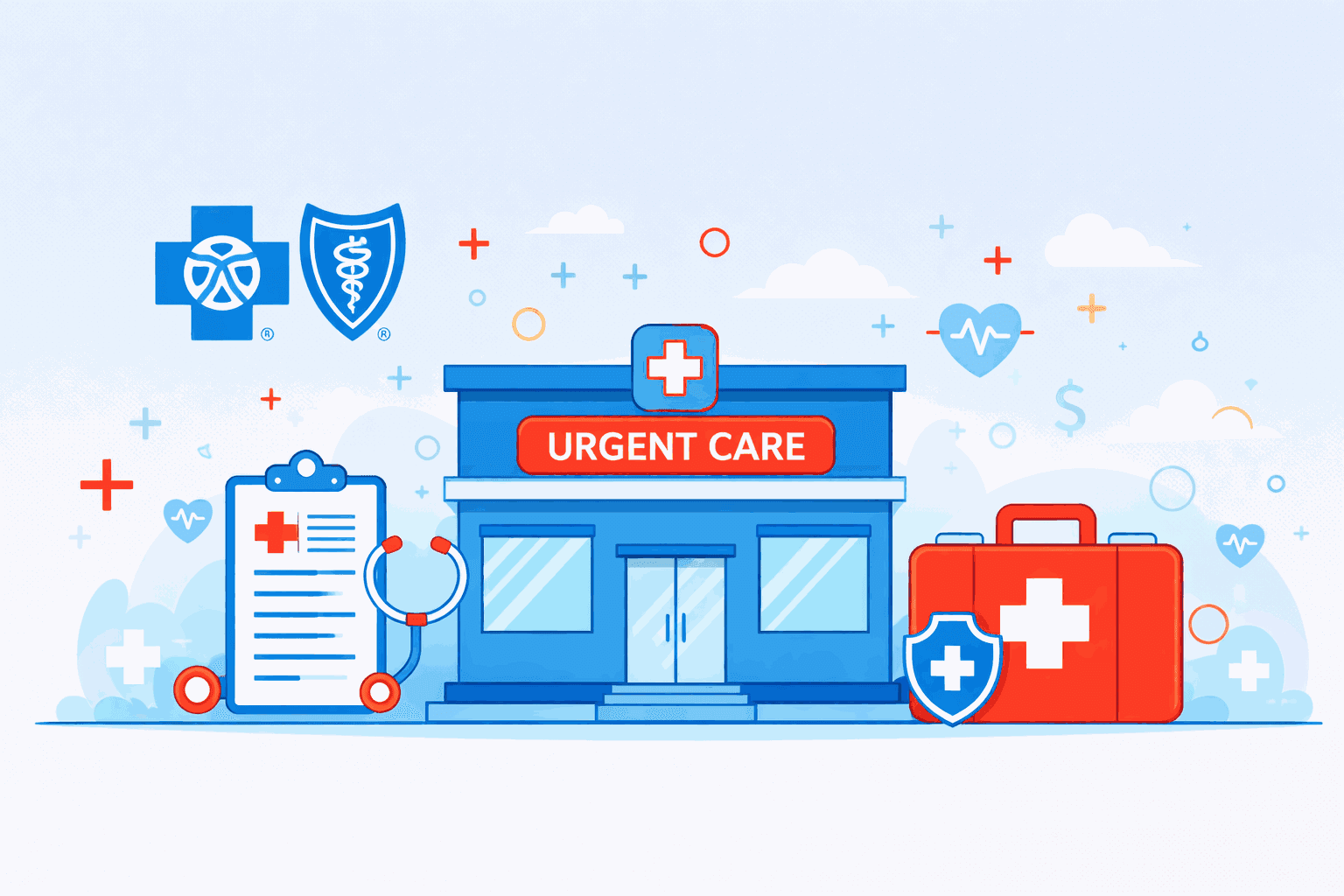
Where to go by severity: primary care for mild routine issues, urgent care for moderate problems that cannot wait, and the emergency room for severe or life threatening symptoms
Blue Cross Blue Shield covers urgent care for medically necessary conditions that need prompt attention but aren't life-threatening emergencies. Coverage applies to sudden illnesses, minor injuries, infections, and conditions requiring same-day treatment when your regular doctor isn't available. Specific terms vary by plan, so check your own member documents.
Your plan treats urgent care as a middle ground between primary care and emergency room visits. BCBS recognizes that patients need accessible after-hours care without the high costs associated with ER visits. Understanding which conditions belong at urgent care versus the ER helps you know when this benefit applies.
Most BCBS plans don't require referrals for urgent care visits. You can walk into an in-network facility and receive treatment immediately. HMO plans occasionally have different rules; we'll cover those exceptions shortly.
Coverage extends nationwide through the BlueCard program for most plans. If you're traveling or live part-time in different states, your BCBS card typically works at participating urgent care centers across the country. This feature distinguishes BCBS from many regional insurance carriers.
Understanding Your BCBS Plan Type and Coverage
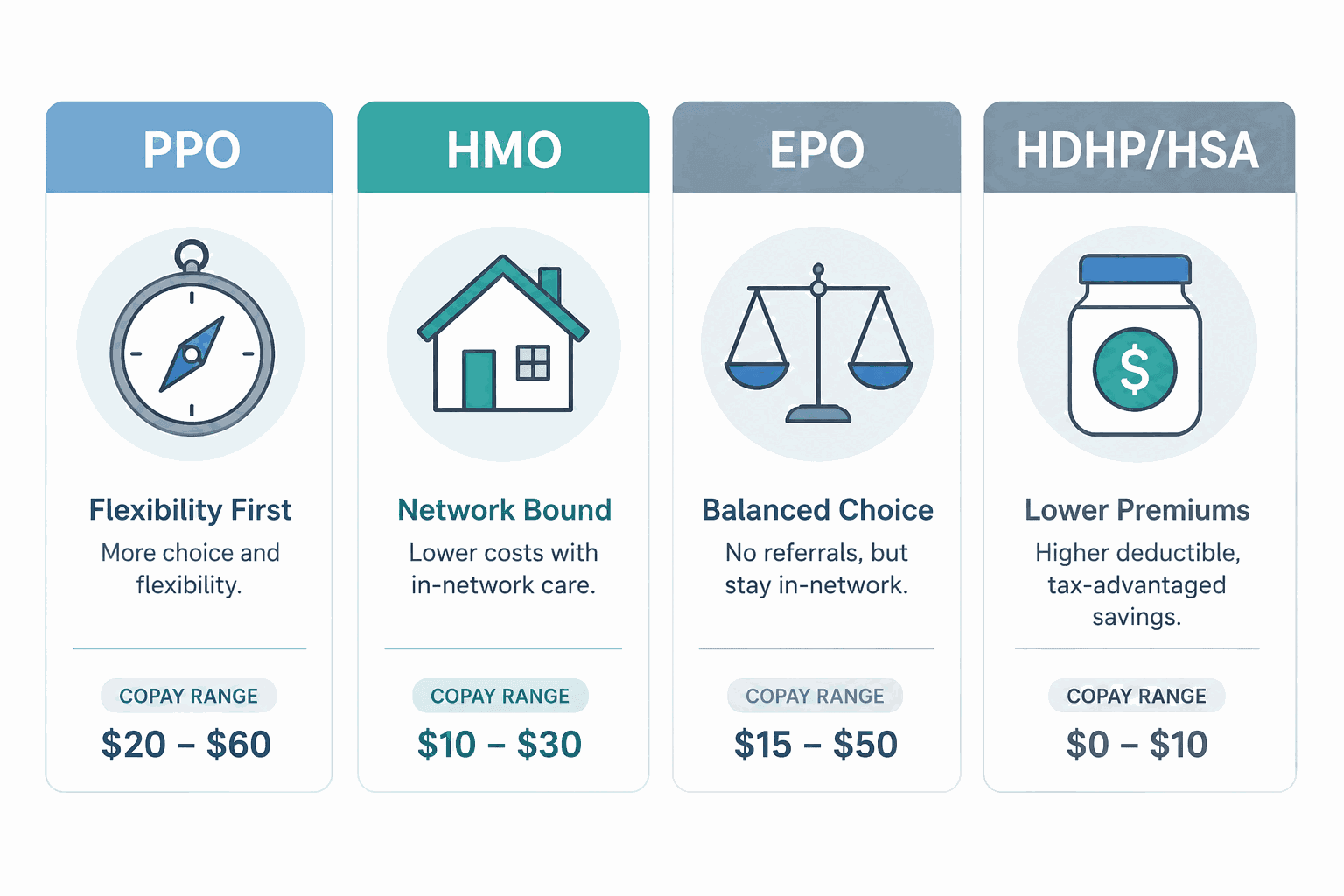
BCBS plan types and urgent care copay ranges: PPO $20 to $60, HMO $10 to $30, EPO $15 to $50 and high deductible HSA plans $0 to $10
Blue Cross Blue Shield PPO Plans
PPO (Preferred Provider Organization) plans offer the most flexibility for Blue Cross urgent care coverage. You'll pay $35 to $75 for in-network visits with no referral required. Out-of-network urgent care centers are covered at 50-70% of the allowed amount after you meet your deductible.
These plans work well if you travel frequently or want provider choice, but the trade-off is higher monthly premiums than HMO plans. Out-of-network visits require you to file claims for reimbursement; the facility doesn't bill BCBS directly.
Balance billing can occur at out-of-network facilities. The urgent care might charge $250, BCBS pays $125 (50% of their allowed amount), and you owe the remaining $125 plus your copay. Always check the network status before visiting.
Blue Cross Blue Shield HMO Plans
HMO (Health Maintenance Organization) plans provide lower copays, typically $25 to $50 for urgent care visits. The catch: you must use in-network facilities exclusively, except for true emergencies. Out-of-network urgent care generally isn't covered at all unless you're out of state and it's medically necessary.
Some HMO plans require you to notify your primary care physician within 24-48 hours after an urgent care visit. Others operate more flexibly. Check your specific plan requirements to avoid coverage issues.
Geographic restrictions sometimes apply. Certain HMO plans limit coverage to your home state or region. BlueCard access varies; verify coverage before traveling if you have an HMO plan.
Blue Cross Blue Shield EPO Plans
EPO (Exclusive Provider Organization) plans fall between PPO and HMO structures. Copays range from $35 to $65 for in-network urgent care with no referral required. Out-of-network coverage is available only for emergencies, similar to HMO restrictions but without primary-care gatekeeping.
These plans suit people who want direct access to specialists and urgent care but don't need out-of-network flexibility. Monthly premiums are typically lower than those for PPO plans but higher than those for HMOs.
Network directories become crucial with EPO plans. Wandering into an out-of-network urgent care with an EPO plan is like using a gift card at the wrong store; it simply won't work, no matter how much you insist.
Blue Cross Blue Shield High-Deductible Plans (HDHP)
High-deductible health plans paired with HSAs change the urgent care cost equation. You pay the full negotiated rate, typically $150 to $300, until meeting your deductible ($1,500-$5,000 for individuals). After meeting the deductible, you pay 20-30% coinsurance.
These plans benefit healthy people who rarely need care. Money you don't spend on premiums goes into an HSA, building tax-free savings. Understanding urgent care with high-deductible plans helps you budget appropriately.
Early in the year, urgent care visits feel expensive. By December, after meeting your deductible, costs drop dramatically. Track your healthcare spending carefully with HDHP plans.
BCBS Plan Type Coverage Comparison:
| Plan Type | In-Network Copay | Out-of-Network Coverage | Referral Required? | Best For |
|---|---|---|---|---|
| PPO | $35-$75 | Yes, 50-70% covered | No | Flexibility, frequent travelers |
| HMO | $25-$50 | Usually not covered | Sometimes | Lower costs, don't mind network limits |
| EPO | $35-$65 | Not covered | No | Balance of cost and choice |
| HDHP/HSA | Full cost until deductible | Varies by plan | No | Healthy individuals, HSA savers |
| Medicare Advantage (BCBS) | $0-$50 | Limited | No | Seniors wanting urgent care access |
What You'll Pay: Copays, Deductibles, and Coinsurance
Typical BCBS Urgent Care Copays by Plan Type
Copays are the fixed payments you make at the time of service. Most BCBS plans charge urgent care copays that apply before your deductible is met, a significant advantage over many other services that require deductible satisfaction first.
PPO members typically pay $35 to $75 per visit. HMO members enjoy lower $25-$50 copays. EPO plans fall in the middle, ranging from $35 to $65. These amounts cover only the basic office visit and provider consultation; additional services cost extra.
Medicare Advantage BCBS plans vary widely. Some charge $0 copays for urgent care; others charge $20 to $50. Check your specific Medicare Advantage plan details, as they differ significantly from standard BCBS commercial plans.
How Deductibles Affect Your Urgent Care Costs
Understanding deductibles prevents billing surprises. Standard PPO and HMO plans typically have individual deductibles ranging from $500 to $3,000. Many apply copays to urgent care before deductible requirements, meaning you pay your $50 copay even if you haven't met your $1,500 deductible yet.
High-deductible plans work differently. You pay 100% of the costs until you meet your deductible ($1,500-$5,000). After that threshold, coinsurance kicks in; you pay 20-30%, BCBS pays 70-80%. An urgent care visit in January costs you $285. The same visit in November, after meeting your deductible, costs just $57 (20% of $285).
Family deductibles complicate calculations. Some plans require meeting the family deductible ($3,000-$10,000) before anyone receives benefits. Others provide individual coverage once one family member meets their individual deductible. Read your Summary of Benefits carefully.
Additional Costs Beyond Your Copay
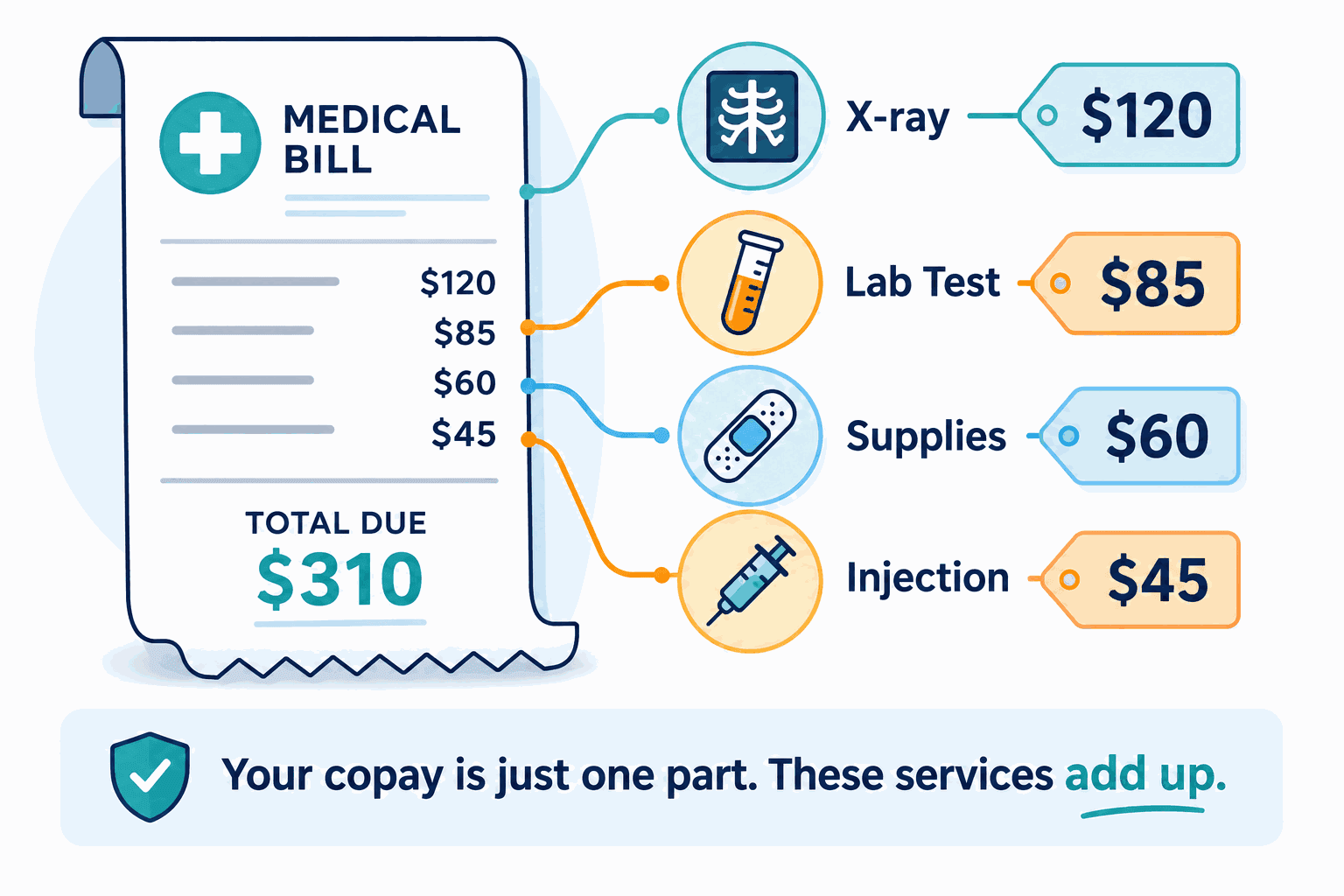
Sample urgent care bill totalling $310 showing charges beyond the copay: X-ray $120, lab test $85, supplies $60 and injection $45
Your copay covers the basic office visit. X-rays, lab tests, and procedures generate additional charges that catch many members off guard. These services are billed separately through the facility or outside labs.
💡 Coverage Tip Always ask the urgent care center for an itemized estimate before receiving services. Surprise charges beyond the copay are common, because patients assume the copay covers everything when it often doesn't. A quick question, "Will this X-ray have a separate charge?", can save you from an unexpected bill.
Typical additional costs members pay:
- X-rays: $40-$120 after insurance processes the claim
- Lab tests: $25-$100 depending on complexity
- Stitches or minor procedures: $50-$200
- Splints or braces: $30-$100
- IV fluids: $75-$150
- Nebulizer treatments: $30-$75
Prescriptions require separate pharmacy copays. Urgent care writes prescriptions you fill elsewhere. Expect $10 to $50, depending on the medication tier; generic drugs cost less than brand-name drugs.
In-Network vs Out-of-Network Urgent Care Coverage
Network status dramatically affects what you pay. In-network urgent care centers have contracts with BCBS. They accept negotiated rates and bill the insurance company directly. Out-of-network facilities don't have contracts, creating higher costs and billing complexity.
Consider this example: You need stitches for a minor cut. In-network urgent care charges BCBS $425 total; you pay a $50 copay, and BCBS pays $375. Out-of-network urgent care charges $550. With a PPO plan covering 60% of out-of-network costs, BCBS pays $330, leaving you responsible for $220 plus your copay.
Out-of-network billing works like shopping without checking prices first; you discover the total after committing to the purchase, and returning the merchandise isn't an option. Always verify network status before your visit.
Balance billing creates additional exposure. Out-of-network providers can bill you for the difference between their charge and what BCBS pays. Some states prohibit this practice, but many allow it. The No Surprises Act offers some protection, but understanding surprise medical billing rules helps you avoid problems.
BlueCard enables nationwide coverage for most BCBS members. When traveling, your card works at participating urgent care centers in other states. The network agreements follow you; a North Carolina BCBS member receives in-network rates at participating California urgent care centers through BlueCard. You can browse urgent care centers by state to plan ahead before you travel.
HMO members face more restrictions. Some HMO plans limit coverage to your home state except for true emergencies. Call member services before traveling if you have an HMO plan, and verify your out-of-state urgent care coverage.
What BCBS Typically Covers at Urgent Care
Standard Services Usually Covered
Blue Cross Blue Shield covers medically necessary urgent care services for sudden illnesses and injuries requiring prompt treatment. Office visits, physical examinations, and basic diagnostic evaluations fall under standard coverage with your regular copay.
Treatment for common conditions receives full coverage:
- Infections (ear, sinus, urinary tract, bronchitis)
- Minor injuries (sprains, strains, minor fractures)
- Cuts requiring stitches
- Minor burns and scalds
- Asthma attacks and breathing difficulties
- Allergic reactions (moderate severity)
- Flu, strep throat, and common illnesses
- Skin conditions and rashes
- Minor eye problems and foreign objects
- Back pain (acute episodes)
These services represent appropriate use of urgent care. BCBS expects members to use urgent care for these conditions rather than emergency rooms, which cost significantly more for the same treatment.
Diagnostic Tests and Procedures
X-rays, lab tests, and minor procedures are covered but often incur separate charges beyond your copay. BCBS processes these as distinct services; your copay covers the office visit, while additional charges apply to diagnostics.
Commonly covered diagnostics:
- X-rays for suspected fractures or injuries
- Urinalysis for UTI diagnosis
- Strep and flu rapid tests
- Blood glucose and basic metabolic panels
- Pregnancy tests
- EKGs for chest pain evaluation
- Oxygen saturation monitoring
- Wound cultures
Minor procedures also receive coverage with additional fees:
- Suturing lacerations
- Splinting and casting
- Foreign object removal
- Abscess drainage
- Nebulizer treatments
- IV fluid administration
- Simple wound care and dressing changes
Ask about additional costs before receiving these services. Urgent care staff can usually estimate your member's responsibility for common procedures.
Services That May Have Separate Charges
Certain services generate claims that are processed differently from those for your standard urgent care visit. Vaccines and immunizations sometimes fall under preventive care benefits, meaning they cost $0, but others require copays. Flu shots typically cost nothing, while tetanus boosters may incur a small charge.
Durable medical equipment (DME) like crutches, boot casts, or arm slings may have separate charges or might not be covered at all by your urgent care benefit. Your plan treats DME as a distinct benefit category with different cost-sharing rules.
Physical therapy or follow-up treatments ordered by urgent care providers are billed under different benefit categories. Your urgent care copay doesn't cover subsequent physical therapy sessions; those have separate copays or count toward your deductible.
What BCBS Typically Covers at Urgent Care:
| Service Type | Usually Covered? | Typical Member Cost | May Require Extra Payment? |
|---|---|---|---|
| Office visit/consultation | Yes ✓ | Copay only | No |
| Treatment for illness/injury | Yes ✓ | Copay covers | No |
| Minor procedures (stitches) | Yes ✓ | Copay + procedure fee | Sometimes |
| X-rays | Yes ✓ | Copay + imaging fee | Often |
| Lab tests | Yes ✓ | Copay + lab fee | Often |
| Prescriptions | Yes ✓ | Separate pharmacy copay | Yes |
| Splints/braces | Yes ✓ | May have a separate charge | Sometimes |
| IV fluids | Yes ✓ | Usually covered with a copay | Sometimes |
| Vaccines/immunizations | Yes ✓ | May be preventive (no copay) | Depends |
| Physical exams (non-urgent) | No ✗ | Not covered | N/A |
When BCBS Won't Cover Your Urgent Care Visit
Coverage denials occur when services don't meet medical-necessity standards or fall outside covered benefits. BCBS reviews claims to ensure urgent care visits address truly urgent conditions, not routine care better suited for your primary doctor.
Services explicitly not covered include:
- Routine physical examinations
- Sports physicals for school or athletics
- Cosmetic procedures
- Work-related injuries (covered by workers' compensation)
- Experimental or investigational treatments
- Services deemed not medically necessary
- Pre-scheduled treatments or procedures
Non-urgent visits can trigger coverage issues. Using urgent care because it's more convenient than scheduling with your regular doctor doesn't constitute an urgent medical need. BCBS might deny claims for clearly routine care delivered in urgent care settings.
For example, a parent who takes a child to urgent care for a school sports physical, expecting insurance to cover it like a regular visit, can receive a bill of around $165. A physical exam isn't an urgent medical need, so it isn't covered the way a normal urgent care visit would be.
Appeals processes exist for denied claims. If BCBS denies coverage, you can submit additional documentation explaining medical necessity. Success rates improve when providers document why the condition required urgent care rather than scheduled appointments.
How to Find In-Network Urgent Care Centers
Finding in-network facilities prevents surprise bills and maximizes your Blue Cross urgent care coverage benefits. BCBS provides multiple tools for locating participating providers before you need care.
Start with the BCBS member portal or mobile app. Enter "urgent care" in the provider search, specify your location, and filter results to show only in-network facilities. The directory displays:
- Facility names and addresses
- Distance from your location
- Phone numbers for verification
- Network participation status
- Sometimes, patient ratings and reviews
Call ahead to confirm network participation. Provider directories occasionally contain outdated information; facilities can leave networks without immediate directory updates. A quick phone call asking, "Do you participate in Blue Cross Blue Shield [your plan type] plans?" prevents billing surprises.
Search for urgent care centers near you using online tools that show facility locations and real-time wait times, or browse by state to see what's available in your area. Cross-reference these results with your BCBS network directory to identify in-network options with minimal wait times.
Verify at check-in before receiving treatment. Ask the front desk staff to confirm your insurance participation and explain your expected copay. Most urgent care centers verify insurance electronically, and they'll know within minutes whether you're in-network.
Calling the member services number on your BCBS card before a visit lets you confirm which nearby clinic is in-network and what your copay will be. In one common scenario, that quick call turns a potential $200 surprise bill into a known $50 in-network copay.
National urgent care chains often participate broadly. CityMD, MedExpress, CareNow, and similar chains typically maintain contracts with major BCBS affiliates. Still, verify before visiting, network participation varies by region and specific BCBS company.
Pre-Authorization and Referral Requirements
Most BCBS plans don't require pre-authorization or referrals for urgent care visits. The nature of urgent care, treating unexpected conditions requiring prompt attention, conflicts with pre-authorization processes designed for scheduled services.
Walk-in access remains a core feature of urgent care. You can visit any in-network urgent care center whenever needed without calling your insurance company first. This benefit applies to PPO, EPO, and most HMO plans.
Exceptions exist for certain HMO structures. Some HMO plans require notification to the PCP within 24-48 hours after an urgent care visit. This doesn't prevent you from receiving care; you visit first, notify later. Check your plan documents for post-visit notification requirements.
Pre-authorization occasionally applies to specific procedures or expensive treatments. If urgent care recommends CT scans, specialist referrals, or advanced diagnostics, those services might require authorization. The urgent care handles this process during the visit; it's not your responsibility.
Distinguish between referrals and pre-authorization. Referrals come from your primary care doctor, who directs you to specialists. Pre-authorization is the insurance company's approval for services. Urgent care rarely requires either, but understanding how to use health insurance prevents confusion.
Filing Claims and Getting Reimbursed
In-network urgent care centers file claims directly with BCBS. You pay your copay and leave. The facility handles all billing and claim submission. This represents standard procedure for most visits.
Out-of-network visits require member-submitted claims. You pay the urgent care center directly (often full cost upfront), then file for reimbursement from BCBS. This process takes several steps:
Step 1: Request an itemized receipt showing date of service, provider information, diagnosis codes, procedure codes, and total charges. Standard receipts don't provide enough detail, specifically ask for itemized billing documentation.
Step 2: Download the BCBS claim form from your member portal or request one by phone. Different BCBS companies use slightly different forms, so get yours from your specific carrier.
Step 3: Complete the form, including your member ID, contact information, service details, and provider information. Attach your itemized receipt to the form.
Step 4: Submit via the method specified by your plan; many accept online submissions through member portals, others require mail or fax. Keep copies of everything.
Step 5: Wait 30-45 days for processing. BCBS reviews the claim, applies your plan benefits, and issues payment directly to you via check or direct deposit.
Reimbursement amounts depend on your plan's out-of-network benefits. PPO plans typically reimburse 50-70% of the allowed amount, not necessarily the amount charged. If urgent care charged $300 but BCBS's allowed amount is $200, you receive 60% of $200 ($120), not 60% of $300.
Track claim status through your member portal. Most BCBS companies provide online claim tracking that shows the submission date, processing status, and payment information. Call member services if claims remain unprocessed after 45 days.
⚠️ Important Claim Tip Keep all urgent care receipts and documentation for at least two years. If claims are denied or underpaid, you'll need this documentation for appeals. Initial claims are often denied for missing information, and having complete records helps you successfully appeal and receive proper reimbursement.
Frequently Asked Questions About BCBS Urgent Care Coverage
Does Blue Cross Blue Shield cover urgent care visits?
Yes, Blue Cross Blue Shield covers medically necessary urgent care visits across all major plan types, PPO, HMO, EPO, and high-deductible plans. Your specific copay and coverage level depend on your individual plan, whether the facility is in-network, and if you've met your annual deductible. Most BCBS members pay between $25 and $75 for an in-network urgent care visit, with no referral required.
How much is an urgent care copay with BCBS?
BCBS urgent care copays typically range from $25 to $75 for in-network visits, depending on your plan type. BCBS is a federation of independent local companies, so copays are set by your specific plan rather than nationally. HMO plans charge the lowest copays ($25-$50), while PPO and EPO plans average $35-$75. High-deductible plans require you to pay the full amount ($150-$300) until you meet your deductible. Check your insurance card or member portal for your specific copay amount.
Do I need a referral for urgent care with Blue Cross Blue Shield?
No, most BCBS plans don't require referrals for urgent care visits; you can walk into any in-network facility without prior authorization. Some HMO plans ask you to notify your primary care physician within 24-48 hours after the visit, but this doesn't prevent you from receiving care. Confirm your plan's specific requirements by reviewing your benefits summary or calling member services.
What if I go to an out-of-network urgent care?
Out-of-network coverage depends on your plan type. PPO plans typically cover 50-70% of allowed charges after you meet your deductible, while HMO and EPO plans usually don't cover out-of-network care except emergencies. You'll pay significantly more out of pocket, possibly including balance billing, where providers charge you for amounts above what BCBS pays. Always verify network status before visiting to avoid surprise bills.
Does BCBS urgent care coverage apply in other states?
Yes, most BCBS plans provide nationwide urgent care coverage through the BlueCard program, allowing you to receive in-network care at participating facilities across all 50 states. HMO plans sometimes have geographic restrictions, and some limit coverage to your home state except for true emergencies. Call member services before traveling if you have an HMO plan to verify out-of-state urgent care coverage. You can also look up urgent care centers by state before you go.
Will BCBS cover urgent care for my child?
Yes, BCBS covers urgent care visits for all dependents listed on your policy, including children, using the same copays and coverage rules that apply to adult members. Pediatric urgent care facilities and general urgent care centers both accept BCBS coverage for children's treatment. Learn when to take your child to urgent care versus the emergency room.
What's the difference between urgent care and emergency room coverage?
BCBS typically charges lower copays for urgent care ($25-$75) compared to emergency room visits ($150-$500), encouraging appropriate facility use for non-life-threatening conditions. ER visits have different deductible rules and often higher coinsurance percentages. However, ER coverage applies regardless of network status since emergencies override network restrictions. Choose based on medical severity, not just cost.
How do I know if an urgent care is in my BCBS network?
Check your network status using the BCBS member portal, mobile app, or provider directory by searching "urgent care" in your area. You can also call the member services number on your insurance card or contact the urgent care center directly to ask if they accept your specific BCBS plan. Always verify at check-in before receiving treatment, as directory information occasionally contains outdated entries.
Can I use urgent care instead of seeing my primary care doctor?
Yes, you can use urgent care for conditions requiring prompt attention when your regular doctor isn't available, but BCBS expects appropriate usage, urgent medical needs, not routine care convenience. Using urgent care for physicals, follow-ups, or clearly non-urgent matters may trigger coverage denials. Reserve urgent care for unexpected illnesses and injuries that can't wait until your scheduled appointment with your regular physician.
What happens if urgent care sends me to the ER?
If urgent care providers determine you need emergency-level care and refer you to the ER, you'll pay separate copays for both facilities, the urgent care visit, and the ER visit. BCBS won't waive charges for appropriate referrals, though some plans waive ER copays if you're subsequently admitted to the hospital. Both visits apply separately toward your deductible and out-of-pocket maximums.
Common Scenarios and What You'll Pay:
| Scenario | Plan Type | What You Pay | Coverage Details |
|---|---|---|---|
| Sprained ankle with X-ray | PPO | $50 copay + $40 X-ray = $90 | In-network UC |
| Strep throat with test | HMO | $35 copay + $0 test = $35 | Test included in copay |
| Child's high fever | EPO | $45 copay + $25 lab = $70 | In-network, after-hours visit |
| UTI treatment | HDHP (pre-deductible) | $185 full visit cost | Applied to the deductible |
| Minor cut needing stitches | PPO (out-of-network) | $75 copay + 30% of $150 = $120 | Submit a claim for reimbursement |
| Flu symptoms + medication | HMO | $30 copay + $10 Rx copay = $40 | Both in-network |
Get the Most from Your BCBS Coverage
Understanding your Blue Cross Blue Shield urgent care benefits helps you receive care confidently while avoiding billing surprises. Know your plan type, verify network status before visits, and keep your insurance card accessible for quick reference.
Key actions to maximize your coverage:
- Call member services before your first urgent care visit to understand your specific copay, deductible status, and any plan-specific requirements
- Save in-network urgent care locations in your phone for quick access during unexpected illness or injury
- Download the BCBS mobile app to check network status, view digital insurance cards, and track claims on the go
- Keep itemized receipts from all urgent care visits, especially out-of-network care requiring claim submission
- Review your Explanation of Benefits (EOB) after each visit to verify proper payment and identify billing errors
Your urgent care insurance coverage works best when you understand it before needing care. Taking 15 minutes now to review your plan details saves hundreds of dollars and significant stress in medical situations.
📋 Take These Steps Today Don't wait until you're sick to understand your coverage. Log in to your BCBS member portal right now, locate your urgent care copay amount, download the provider directory, and save the member services' phone number in your contacts. These simple preparations ensure you'll make informed decisions when health issues arise unexpectedly.
Note: Coverage details described here reflect common BCBS plan structures as of March 2026. Your specific coverage, copays, and network requirements depend on your individual plan and which BCBS company serves your area. Always verify benefits by checking your plan documents, member portal, or calling the member services number on your insurance card before seeking care.
Need urgent care now? Find in-network urgent care centers and emergency rooms near you on ERWaitTimes.org. Check real-time wait times, verify facility locations, and make informed decisions about your care, all in one place. You can also compare urgent care and the ER or browse facilities by state.
Have questions about your BCBS coverage? Call the member services number on the back of your insurance card before your visit to confirm your copay, verify network status, and understand what you'll pay.