
How Much Is Urgent Care Without Insurance? 2026 Cost Guide
How Much Is Urgent Care Without Insurance? 2026 Cost Guide
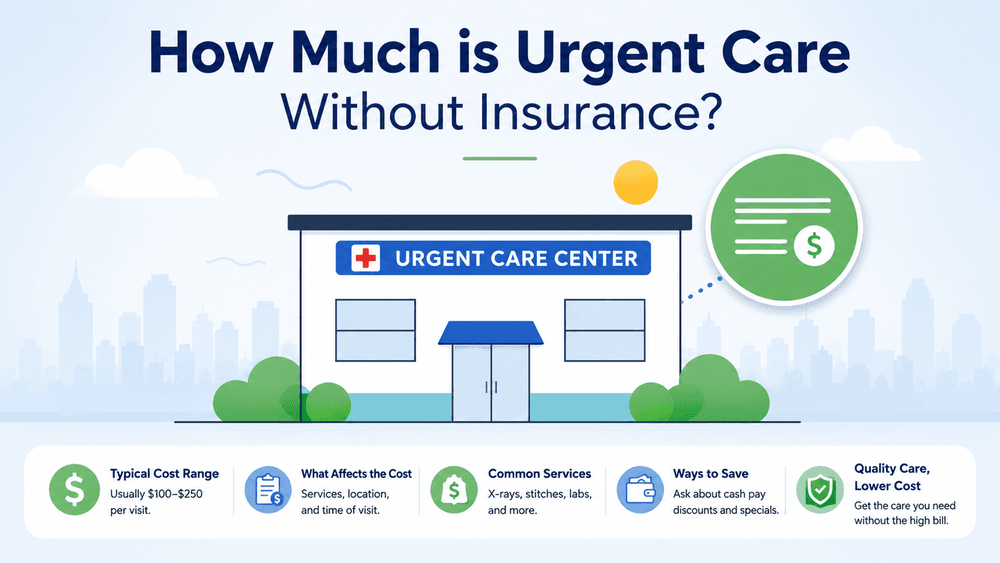
How much is urgent care without insurance? Most self-pay visits run $150 to $500 or more, depending on the services you need. A basic visit costs $150 to $200, while adding an X-ray, lab tests, or a procedure pushes the total. This 2026 guide breaks down real urgent care prices, what drives the wide variation from clinic to clinic, and how to lower your out-of-pocket cost before you ever walk through the door.
Key Takeaways
- A basic urgent care visit without insurance costs $150 to $200; adding an X-ray raises it to $300 to $500.
- Lab work (strep, flu) adds $75 to $200, and stitches, splints, or IV fluids can push totals past $400.
- The median self-pay visit is $171, but 10% of patients pay more than $400 (Urgent Care Association, 2025).
- Most centers offer 15-30% cash discounts, payment plans, and charity care, so always ask before treatment starts.
- Choosing urgent care over the ER for non-emergency conditions saves an average of $1,200 per visit.
What a Real Urgent Care Bill Looks Like
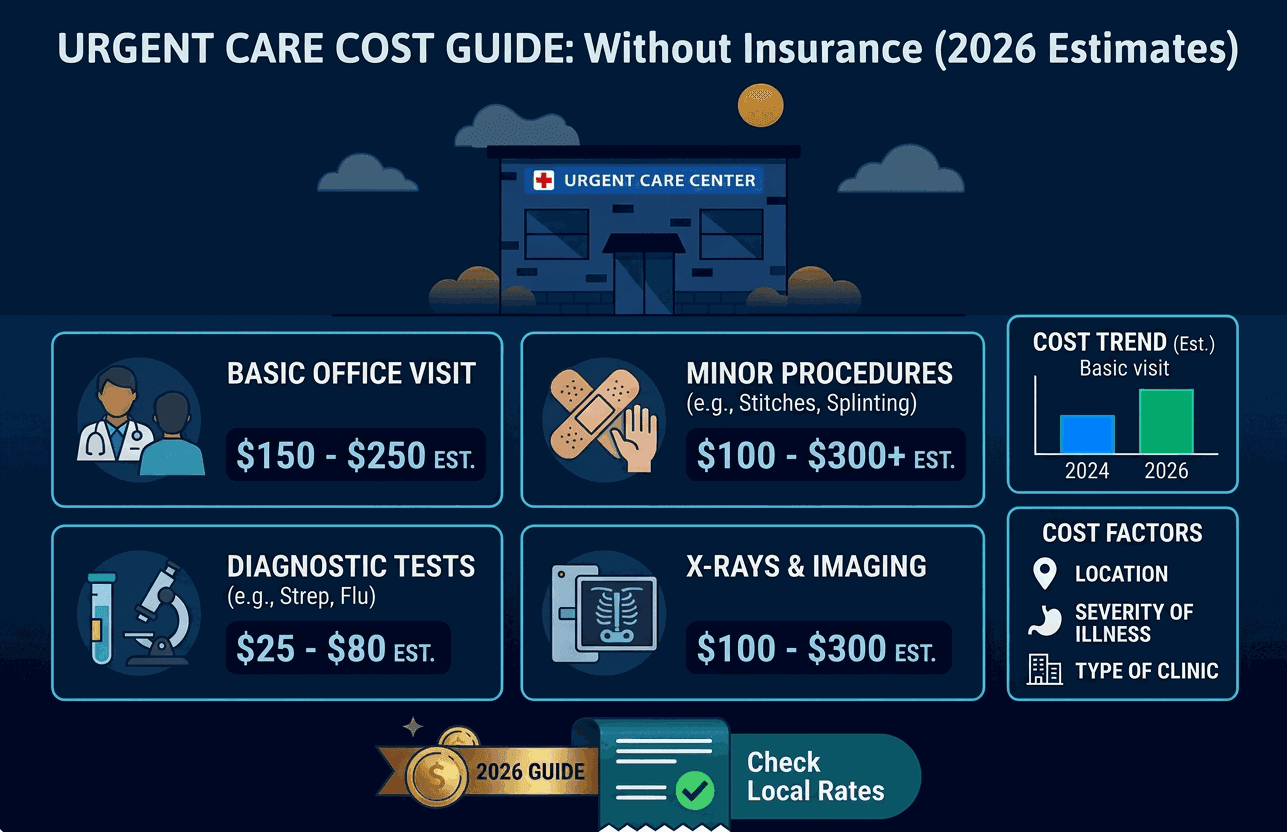
Urgent care cost guide without insurance showing a basic office visit at $150 to $250, minor procedures such as stitches and splinting at $100 to $300, diagnostic tests at $25 to $80 and X-rays and imaging at $100 to $300
Consider a common scenario: a parent loses health coverage after a job ends, then a six-year-old falls and needs stitches. The clinic's website lists no prices, and the family has limited cash on hand. Would $400 be enough?
In a case like this, a child needing four stitches might see a bill of $247: $125 facility fee, $95 provider fee, $27 for supplies. Paying cash with a 20% discount brings it to $198. Not cheap, but manageable.
The same injury at a different clinic two miles away could run $380. Same city. Same day. Different price tag.
National data show that urgent care visits for uninsured patients range from $150 to $600, depending on the services rendered (Fair Health Consumer, 2025). That is a fourfold difference. Real patients see wild variations even within those ranges.
Basic visits cost between $150 and $200 for self-pay patients. Add an X-ray, and you are looking at $300 to $500. Need lab work? Tack on another $75 to $200. Procedures like stitches, splinting, or IV fluids easily push totals past $400.
Geography matters more than most people realize. Urban coastal clinics charge 30-40% more than rural Midwest facilities (Healthcare Bluebook, 2025). A strep test in Manhattan costs $185. The same test in rural Iowa? $95.
Why Urgent Care Costs Vary So Widely
Three factors drive price differences: ownership structure, local competition, and billing practices.
Corporate chains often charge more than independent clinics. They bundle services differently. A corporate facility might charge separate fees for the room, the provider, supplies, and medical waste disposal. Independent practices frequently roll everything into one visit fee.
Competition shapes pricing,g too. Areas with five urgent cares within three miles see lower prices than medical deserts with one clinic serving 50,000 people. Facilities near highways or shopping centers sometimes charge premium rates due to convenience and higher rent.
The median self-pay urgent care visit costs $171 nationally, but 25% of patients pay more than $265 and 10% exceed $400 (Urgent Care Association, 2025).
Billing transparency varies dramatically. Some clinics post prices online. Others require you to call. Many will not quote costs until after treatment. Federal price transparency rules require hospitals to publish rates, but urgent care centers face less stringent requirements unless they are hospital-affiliated.
Chain clinics typically use standardized pricing across locations. CityMD charges roughly the same in Brooklyn and Queens. Independent urgent cares set their own rates based on local costs and patient demographics.
Insurance contracts also distort pricing. Clinics that accept insurance often inflate their list prices, knowing insurers will negotiate down, leaving uninsured patients facing artificially high sticker prices, sort of like buying a car at MSRP when everyone else pays invoice.
Regional Cost Variations by Metro Area
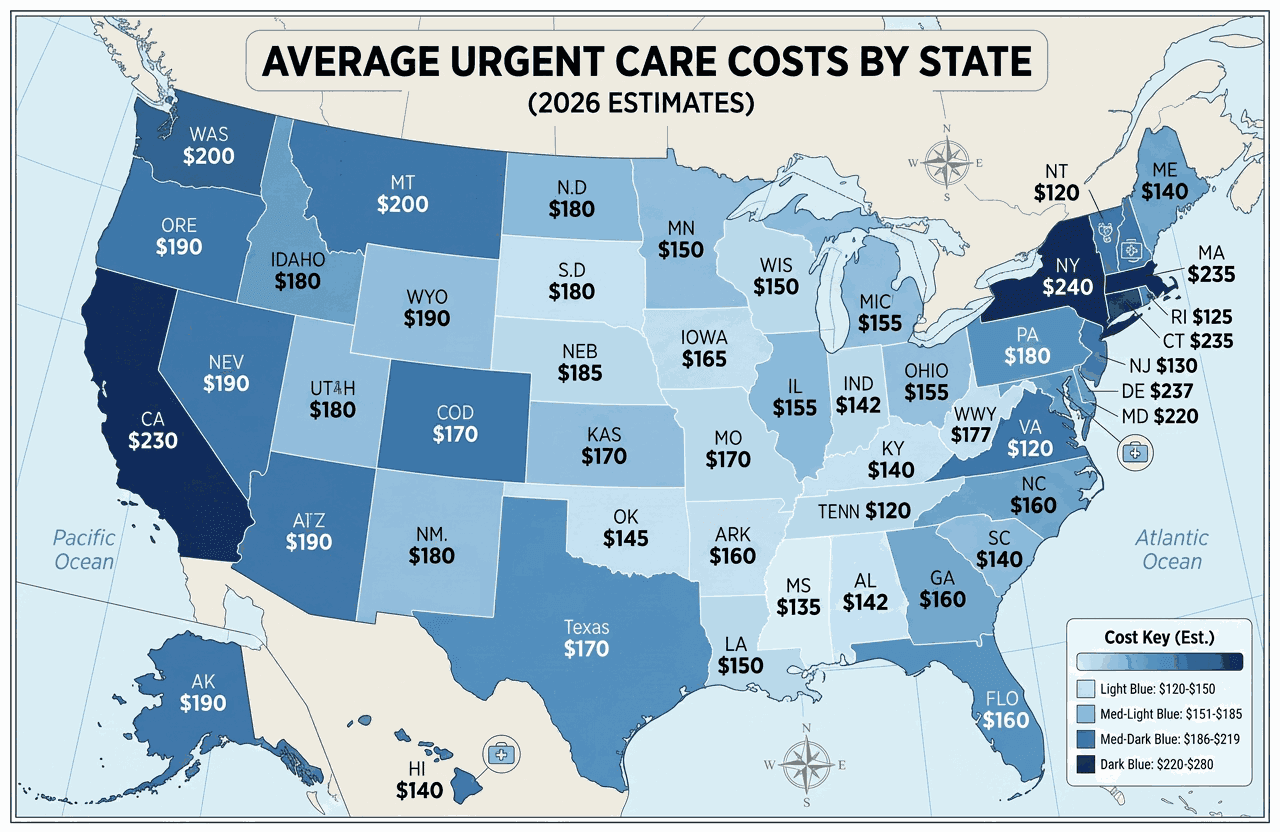
Map of average urgent care costs by US state, ranging from about $120 in the cheapest states to roughly $240 in New York
| Metro Area | Basic Visit | Visit + X-ray | Visit + Lab |
|---|---|---|---|
| New York City | $180-$250 | $400-$600 | $300-$450 |
| Los Angeles | $170-$230 | $380-$550 | $280-$420 |
| Chicago | $150-$210 | $320-$480 | $250-$380 |
| Houston | $140-$190 | $300-$450 | $230-$350 |
| Phoenix | $145-$195 | $310-$460 | $240-$360 |
| Rural areas | $120-$170 | $250-$400 | $200-$320 |
Prices swing widely by region, so browse wait times and facilities by state to see what options are near you.
Breaking Down the Bill: What You Are Actually Paying For
Your urgent care bill is not one charge. It is several line items bundled together. For a wider look at standard pricing, see our guide to urgent care costs.
Facility fees cover overhead: rent, utilities, equipment, and staff. These run from $75 to $150 at most clinics. You are paying for the room even if you are only there for 15 minutes. Hospital-owned urgent cares charge higher facility fees than standalone centers.
Provider fees compensate the doctor or nurse practitioner who examines you. Expect $75 to $125 for a straightforward visit. Complex cases requiring more time cost more. Some facilities bill provider fees separately, while others include them in the base visit charge.
Diagnostic services add up fast. Basic X-rays cost $100 to $200 for a single view and $200 to $500 for multiple angles. Rapid strep tests run $25 to $50. Flu tests hover around $30 to $60. Blood work ranges from $75 to $200 depending on panels ordered.
Procedures carry separate charges. Stitches cost $150 to $300 plus supply fees. Splints run from $75 to $200. IV fluids for dehydration can add $150 to $300. These fees add to the base visit cost.
Medical supplies show up as separate line items at some clinics. Gauze, bandages, and antiseptics might appear as $15 to $40 for materials you assumed were included. Prescription medications administered on-site also incur an extra charge.
Some facilities charge administrative or registration fees ranging from $10 to $35. Critics call these junk fees. Clinics say they offset electronic records systems and compliance costs.
Real-World Cost Scenarios: Three Common Visits
Numbers matter more when they are attached to real situations. Here are three typical self-pay scenarios and how the bills break down.
Scenario 1: Minor Laceration
Imagine a deep but clean cut to the hand from opening a can, treated at urgent care at 6 p.m. on a Thursday. Asking about the cost before treatment, the receptionist estimates around $200, maybe a bit more.
The final bill comes to $312: $110 facility fee, $95 provider fee, $75 for suturing, and $32 in supplies. With a $104 monthly payment for three months, with no interest, the cost spreads out in a manageable way.
Even when an estimate runs $100 or more low, many clinics are upfront about payment plan options when a patient says they cannot pay it all at once. Total time in clinic might be 47 minutes, and choosing urgent care over the ER for a cut like this typically saves at least $700.
Scenario 2: Strep Throat Test
Consider familiar throat pain on a Sunday morning when primary care is closed. Urgent care costs far less than the ER for this.
A clinic might quote $175 over the phone for a basic visit with a strep test, and the actual bill matches that estimate: $125 visit fee and $50 rapid strep test. With a 15% cash discount, it comes to $149.
After a test, prescription, and a visit lasting about 20 minutes, an antibiotic prescription filled at a discount pharmacy using a GoodRx coupon can cost as little as $8 for amoxicillin—total out-of-pocket, including medication: $157. Checking real-time wait time tools before the visit helps confirm the facility has minimal delays.
Scenario 3: Sprained Ankle X-Ray
Picture a rolled ankle from playing basketball, swollen and purple by evening, treated at an urgent care center at 8 p.m.
Staff X-ray it (no fracture), wrap it, provide crutches, and send the patient home. The bill comes to $438: $135 facility fee, $105 provider fee, $165 for two X-ray views, and $33 for the wrap and crutches.
When the X-ray costs more than everything else combined, it is worth asking whether it is needed. Insurance usually requires it, but for self-pay patients, it can be optional, though many choose it to rule out a break. Applying to the clinic's charity care program and qualifying for a 60% reduction can bring the final payment to $175. Checking which urgent care facilities were open before leaving home keeps the whole process short. For bone and joint injuries like this, an orthopedic urgent care center can offer more specialized evaluation.
How Urgent Care Compares to ER and Primary Care Pricing
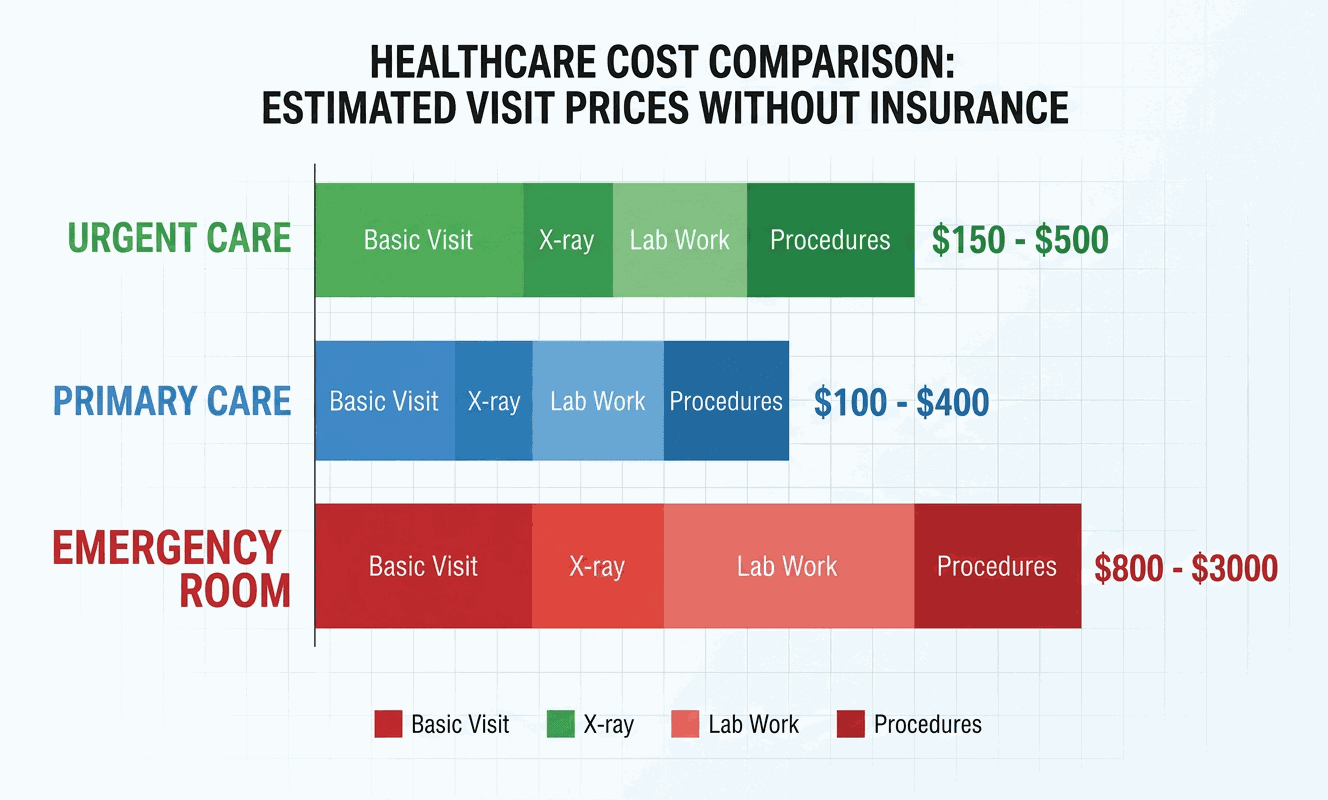
Estimated visit prices without insurance comparing urgent care at $150 to $500, primary care at $100 to $400 and the emergency room at $800 to $3,000 across basic visit, X-ray, lab work and procedures
Emergency rooms charge 3 to 10 times as much as urgent care for the same condition. A strep test that costs $175 at urgent care runs $900 to $1,800 at the ER (Health Care Cost Institute, 2025).
ERs tack on facility fees that start around $500 before any treatment begins. You are paying for 24/7 specialist availability whether you need it or not. Critical care equipment, trauma teams, and round-the-clock imaging inflate every charge.
Primary care is the least expensive option when available. A sick visit with your regular doctor costs $100 to $180 without insurance. Add $30 to $75 for basic tests. Total: $130-$255 for common issues.
Cost Comparison by Visit Type
| Visit Type | Urgent Care (Self-Pay) | Primary Care | Emergency Room |
|---|---|---|---|
| Basic consultation | $150-$200 | $100-$180 | $800-$1,500 |
| Strep throat test | $150-$250 | $120-$200 | $900-$1,800 |
| Minor laceration/stitches | $200-$400 | $150-$300 | $1,000-$2,500 |
| X-ray (single view) | $100-$300 | $80-$200 | $400-$1,200 |
| Sprained ankle (with X-ray) | $300-$500 | $200-$400 | $1,200-$3,000 |
The catch with primary care? Appointments. Most offices do not do same-day scheduling. If you are sick on Saturday, your primary care doctor's office is closed. That is when urgent care fills the gap.
Think of it like car repairs: the dealership (ER) charges premium rates, the independent mechanic (urgent care) offers mid-range pricing, and your buddy who is good with cars (primary care) does it cheapest, but only when he is available and it is not an emergency.
Self-pay patients using urgent care instead of the ER save an average of $1,200 per visit for non-emergency conditions (Urgent Care Association, 2024).
Wait times factor into the real cost, too. ERs average 40 to 240 minutes,s depending on acuity and location. Urgent care typically runs 15 to 60 minutes. Checking real-time wait times before heading out prevents wasted trips and helps you avoid situations where long delays push you toward a much more expensive ER visit.
Payment Options When You Do Not Have Insurance
Illustration of an urgent care center building next to a billing statement icon
Cash discounts are standard at urgent care centers. Most offer 15% to 30% off if you pay in full at the time of service. Always ask before treatment starts. Some clinics advertise these discounts online, but many require you to request them.
Payment plans spread costs over 3 to 12 months, usually interest-free if you arrange them upfront. Clinics want to get paid and would rather set up a plan than chase unpaid bills. Expect to make a down payment of 10% to 25% when enrolling.
Credit cards work,k but carry interest if you do not pay immediately. Some patients use medical credit cards like CareCredit, which offer promotional 0% APR periods, usually 6 to 24 months, depending on the amount charged. Read the fine print carefully. Deferred interest can hit hard if you miss the payoff deadline.
Charity care programs exist at many facilities, especially those affiliated with nonprofit health systems. You will complete an application that shows your income and assets. Approval can reduce your bill by 50% to 100%. Processing takes 2 to 6 weeks in most cases.
Income-based sliding scales adjust fees according to what you earn. If you make less than 200% of the federal poverty level, you might qualify. Each clinic sets its own thresholds. Ask the billing office specifically about sliding scale options.
Community health centers receive federal funding to serve uninsured populations. They charge based on the ability to pay. A visit might cost you $25 to $75 versus $200 elsewhere. Find them through HRSA's health center locator or by searching for Federally Qualified Health Centers in your area.
Negotiation works more often than people expect. Tell the billing office your situation. Ask if they can reduce the bill. Worst case, they say no. Often, they will knock off 10% to 20% just for asking, especially if you are willing to pay immediately.
If you later regain coverage, our breakdown of Blue Cross Blue Shield urgent care costs shows what insured visits typically run.
Payment Discount Comparison
| Payment Method | Typical Discount | When Applied |
|---|---|---|
| Cash/debit (same day) | 15-30% | At time of service |
| Payment plan enrollment | 10-15% | Within 30 days |
| Charity care qualification | 50-100% | Based on income verification |
| Membership programs | 20-40% | Annual membership fee required |
Health savings accounts (HSAs) and flexible spending accounts (FSAs) cover urgent care visits. You are using pre-tax dollars, which effectively saves you 20% to 35%, depending on your tax bracket. Keep all receipts for reimbursement.
Smart Strategies to Lower Your Out-of-Pocket Costs
Shop around before you are sick. Call three or four urgent cares in your area. Ask what they charge for common visits. Keep a note in your phone with prices and contact information. This prep work pays off when you suddenly need care.
Ask about cash prices explicitly. Receptionists sometimes quote insurance rates by default. Say, "I'm paying cash today, what's your self-pay rate?" That single question can save you 15% to 30% immediately.
Request an itemized bill always. Review every line. Medical billing errors happen in 30% to 80% of cases, depending on which study you read (Medical Billing Advocates of America, 2025). Challenge anything that looks wrong or duplicated.
Strategically timing your visit matters if the condition allows it. Monday mornings and Friday evenings are busiest. Tuesday through Thursday midday often means shorter waits and more time for staff to discuss costs upfront.
Bringing your own over-the-counter medications saves money. If the doctor recommends ibuprofen, acetaminophen, or antihistamines, buy them at a drugstore for $5 to $12 rather than paying $25 to $40 for the clinic to dispense them.
Using prescription discount programs dramatically cuts medication costs. GoodRx, SingleCare, and RxSaver can reduce prices by 60% to 80%. Show the coupon at any participating pharmacy, no insurance needed. Download the apps before you need them.
Questioning unnecessary tests protects your wallet. If the provider recommends imaging or labs, it's reasonable to ask whether the result will change your treatment. But don't skip imaging your provider says you need, especially for a possible fracture or other serious injury. When in doubt, follow the clinical recommendation.
Documentation matters for future reference. Keep receipts, bills, and payment confirmations. If you apply for charity care later or dispute charges, you will need proof of what you have already paid.
Consider direct primary care memberships for routine needs. You pay $50 to $150 monthly for unlimited office visits, basic tests, and medication discounts. Not insurance, but it covers many needs that would otherwise send you to urgent care—a good option for families with kids who get frequent minor illnesses.
Transparency Tools: Finding Prices Before You Go
Federal price transparency rules have made some information available, but navigating it takes work. Hospital-based urgent cares must post their chargemasters online, massive files listing thousands of procedure codes and prices. Standalone centers face less stringent requirements.
Healthcare Bluebook (healthcarebluebook.com) offers free cost estimates based on your location. Type in your ZIP code and the service you need. It shows you fair prices and can identify cheaper alternatives nearby.
Fair Health Consumer (fairhealthconsumer.org) provides cost estimates drawn from insurance claims data. Their urgent care estimates reflect what both insured and uninsured patients actually pay across different regions.
Individual clinic websites vary widely. Corporate chains like GoHealth Urgent Care and American Family Care list some prices online. Independent clinics often do not. The inconsistency makes comparison shopping difficult.
Calling ahead and asking specific questions yields the most accurate information. Do not just say "How much is a visit?" Say "How much for a visit, strep test, and antibiotics if needed, paying cash today?" Get the name and timestamp of who you spoke with. Please follow up with an email confirming the quoted price.
Platforms like ERWaitTimes.org help you identify which nearby facilities can see you quickly. Combining wait-time information with cost research gives you the full picture before you walk through any door. Long waits waste your time and may prompt you to seek a more expensive ER visit if your condition worsens.
New price transparency startups are emerging. Turquoise Health, MDsave, and similar services let you compare prices and sometimes book appointments at guaranteed rates. Adoption remains limited but growing.
State-level tools exist in Colorado, New Hampshire, and a handful of other states. These official databases compile pricing from multiple providers. Check if your state offers one through your state insurance commissioner's website.
What Is Changing in 2026 and Beyond
Price transparency is slowly improving. More clinics are posting costs online voluntarily to attract self-pay patients. Competition forces transparency. Facilities that hide prices lose customers to those that advertise them.
Several states introduced legislation requiring urgent care facilities to disclose prices. Maryland, California, and Washington now mandate that facilities provide good-faith estimates to uninsured patients before non-emergency treatment. Violations can result in fines.
Telehealth offers cheaper alternatives for some conditions. Virtual urgent care visits run $40 to $70. Not appropriate for injuries requiring imaging or procedures, but useful for infections, rashes, and minor illnesses. Many platforms now operate 24/7.
Retail clinics inside pharmacies (CVS MinuteClinic, Walgreens Healthcare Clinic) offer expanded services and typically cost less than traditional urgent care: $80 to $125 for basic visits. They handle simpler cases but offer convenience and posted pricing.
Subscription-based urgent care models are being tested in several markets. Pay $20 to $40 monthly and get unlimited visits with reduced per-visit fees. Early data suggest this works well for families with kids who get frequent minor illnesses.
Federal proposals to expand price transparency requirements to all outpatient facilities remain under discussion. If passed, urgent care centers would face the same disclosure rules as hospitals. Implementation timelines remain unclear.
Technology enables better price shopping. Apps that aggregate urgent care pricing are in development. None have achieved wide adoption yet, but investor interest suggests more tools are coming.
The uninsured population has fluctuated as Medicaid eligibility rules change. This creates pressure on urgent care facilities to offer clear, affordable self-pay options or risk losing patients who simply skip care they cannot afford.
Frequently Asked Questions About Urgent Care Without Insurance
How much does urgent care cost without insurance for a basic visit?
A basic urgent care visit without insurance costs $150-$200 on average nationwide. This includes the facility fee, provider consultation, and basic examination. Many centers offer 15-30% self-pay discounts if you pay in full at the time of service, bringing costs down to $105-$140.
Do urgent care centers offer discounts for uninsured patients?
Yes. Most urgent care centers offer cash discounts ranging from 15-30% for uninsured patients who pay in full at the time of service. Some facilities also provide payment plans, charity care programs, and income-based sliding fee scales. Always ask the billing office about available discounts before receiving treatment.
Is urgent care cheaper than the emergency room?
Urgent care is significantly cheaper than the emergency room for non-life-threatening conditions. The same strep test costs $150-$250 at urgent care versus $900-$1,800 at the ER. Emergency rooms add facility fees of $500 or more before any treatment begins, making urgent care the better financial choice for minor illnesses and injuries.
Can I negotiate urgent care bills if I do not have insurance?
Yes, you can negotiate urgent care bills. Call the billing office, explain your financial situation, and ask if they can reduce the charges. Many facilities will offer 10-20% discounts just for asking, particularly if you can pay immediately. You can also request payment plans or apply for income-based charity care programs.
What payment methods do urgent care centers accept?
Urgent care centers accept cash, debit cards, credit cards, HSA/FSA cards, and medical credit cards like CareCredit. Many facilities also offer in-house payment plans with 0% interest if arranged before or at the time of service. Some accept checks, though this varies by location.
How much does an urgent care X-ray cost without insurance?
An urgent care X-ray without insurance costs $100-$300 for a single view and $200-$500 for multiple views. This fee is in addition to the base visit charge. The total cost for a visit, including X-rays, typically ranges from $300-$500, though you may receive a cash discount that reduces this by 15-30%.
Do I need to pay upfront at urgent care without insurance?
Most urgent care centers require uninsured patients to pay at the time of service or arrange a payment plan before leaving. Some facilities will bill you later, but this is less common. Bringing a credit card or having cash available ensures you can receive treatment without delays or additional paperwork.
Are there free or low-cost urgent care options?
Federally Qualified Health Centers (FQHCs) and community health centers offer free or low-cost urgent care based on your income. They charge on a sliding fee scale, with visits costing $25-$75 for qualifying patients. Find centers near you through the HRSA health center locator or by searching for community health centers.
How much do urgent care lab tests cost without insurance?
Urgent care lab tests without insurance cost $25-$200 depending on the test type. Rapid strep tests run $25-$50, flu tests cost $30-$60, urinalysis ranges $25-$75, and basic blood work costs $75-$200. These charges are in addition to the visit fee. Many urgent care centers that perform lab work offer bundled pricing.
Can urgent care centers set up payment plans?
Yes. Most urgent care centers offer payment plans, typically spreading costs over 3-12 months with 0% interest if arranged upfront. You will usually need to make a 10-25% down payment and set up automatic monthly payments. Ask about payment plan options before receiving treatment to ensure you understand the terms.
Your Next Step: Making the Right Choice
Understanding how much urgent care without insurance costs means you can plan instead of panicking about what needs care. The difference between a $175 bill and a $425 bill often comes down to knowing what questions to ask and where to look for answers.
Start by researching urgent care options in your area now, before you need them. Call for cash prices. Save that information. Know which facilities offer payment plans or charity care. This preparation pays off when you are dealing with an injury or illness.
When you do need urgent care, ask about costs before treatment begins. Request itemized bills afterward. Apply any available discounts or assistance programs. Many patients leave money on the table simply because they do not ask.
Remember that urgent care costs depend partly on choices you make: which clinic you choose, whether you pay cash, what services you agree to, and whether you negotiate. You have more control than you might think.
Find affordable urgent care near you: check real-time wait times and compare facilities at ERWaitTimes.org. See which center can help you sooner, before you leave home.
This article is for informational purposes only and is not a substitute for professional medical advice. In an emergency, call 911.